Among Lilacs-Gone-to-Sticks…

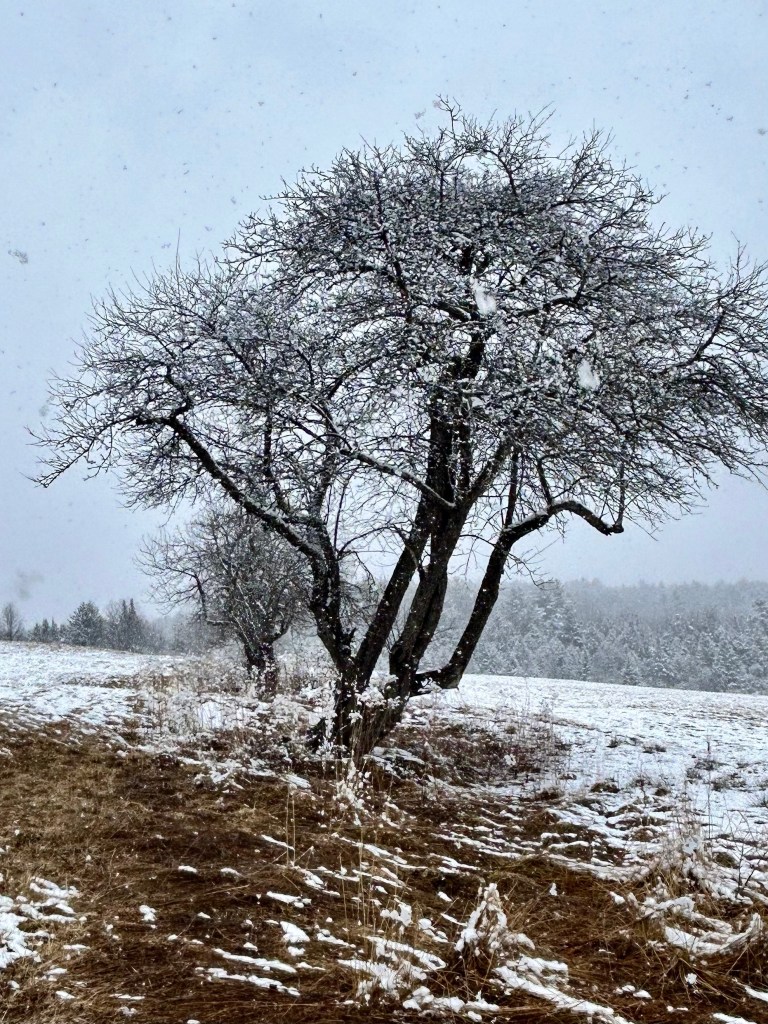
Late afternoon in Vermont December is twilight; I’m hustling along my road, a glass container of hot soup wrapped in a pink cloth in my hands, and I stop for a moment and talk to the neighbor boys who are sledding. The light is dim enough that I squint to count the three children, shadowy figures in snowsuits. The cold is fierce on my face. This day has been sprint from one thing to another, more yet to come, but I pause, that glass steaming in my mittens, the sunset sprawling over the great sky, the stars already emerging in the east’s darkness. A small moment, a tiny exchange of hellos. Such luck to be in this ordinary afternoon.

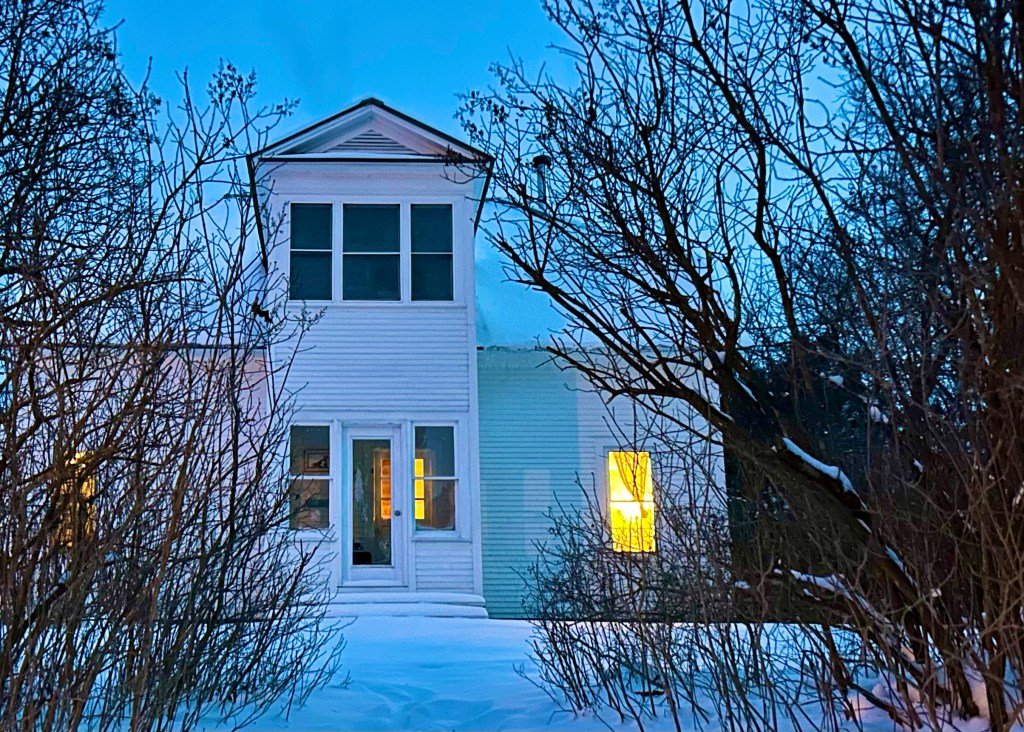
I walk through the parting in the lilacs-gone-to-sticks for the winter, study the bird feeder hung in the mock orange, the seeds sprinkled in the new snow. Behind me, the boys call to each other. In their lit kitchen window, I see the boys’ parents. Dinnertime nears. The cold is so mighty a body without shelter could and would perish. In the snow that gleams with the last of the day’s light, my boot prints lead to me, my lit window and cat, the upstairs bedroom dark where I stood a year ago and wondered if I would die. Wrong question. Not if but when. For this moment, however (a great big however), I remain in this simple-not-simple equation of laughing children, hot soup, the night swooping in. I study my bootprints with satisfaction and then head towards my own kitchen door.

“The Way It Is”

There’s a thread you follow. It goes among
things that change. But it doesn’t change.
People wonder about what you are pursuing.
You have to explain about the thread.
But it is hard for others to see.
While you hold it you can’t get lost.
Tragedies happen; people get hurt
or die; and you suffer and get old.
Nothing you do can stop time’s unfolding.
You don’t ever let go of the thread. ~ William Stafford

Keeping Company. Neighbors.

A friend mentions her mother has an art opening that evening in the sprawling building that was once the village inn. We’ve just returned from a walk and stand in a field where, 25 years ago, she sold homemade pies and I sold maple syrup. We each held a nursing baby, in those years.

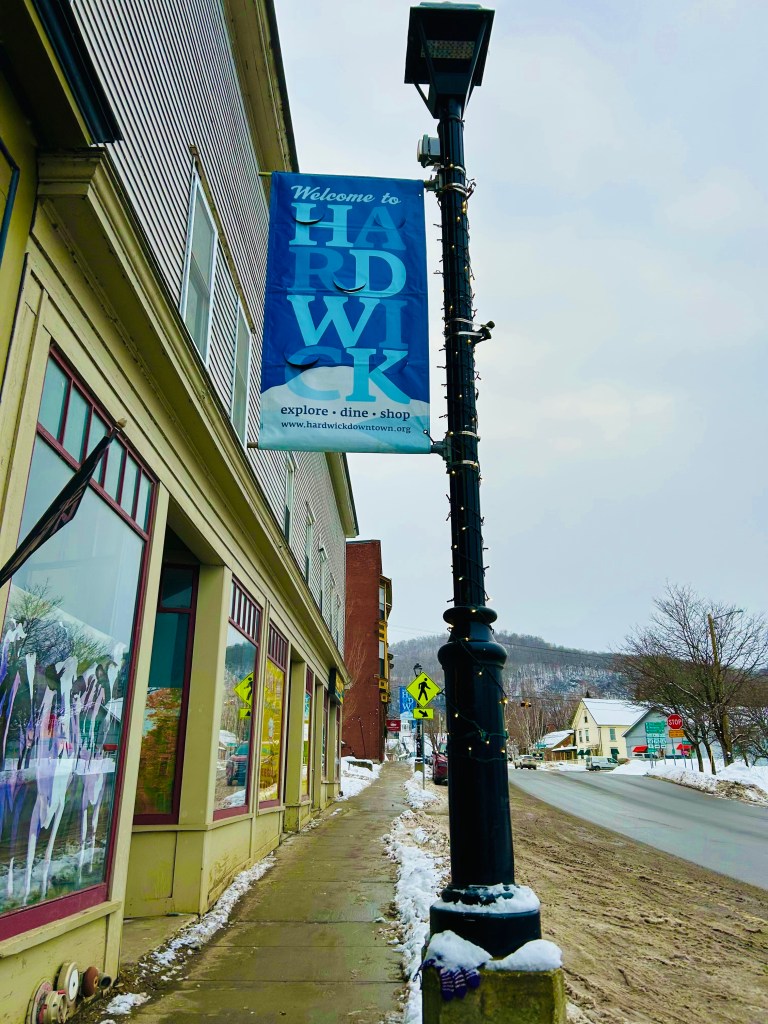
Her mother lives beside me, so about eight o’clock, the time I’m usually brushing teeth or walking around the house putting water glasses and cat bowls in the kitchen sink, I pull on a sweater (hello, Vermont July) and walk downtown. Monday, hardly anyone is out this evening, as the sunset does its peach-and-rose watercolor magic along the mountains.

I’m amazed, again, at my neighbor’s talent, her unique vision a mixture of O’Keeffe and Cézanne. I stand holding her hand and talking, this woman who lived plenty of lives before I met her. When I weed my front yard garden, she’ll sometimes lean out of her door and holler, “Hello, neighbor!” her hair in plastic curlers.

I walk the long way home through neighborhoods where the children have been called in for the night. Stray teenagers are out; no one else. There’s no glimmer of moon, but the stars are winking into their nightly places. I take an extra loop, and the darkness folds around me.

I’m in this odd place where people I hardly know touch my shoulders, rub my growing-back hair, as if to confirm that, yes, I’m alive. Or I’m looked at silently, uncertainly. The cancer’s made me rougher and gentler. Disinterested in cattiness, willing to visit a neighbor when my body aches to lie down.

At home, I linger on the house steps, the tree frogs serenading. These summer days are long, long, with some hours of work. More than anything, I’m determined to finish a draft of this third novel, determined to sell this book, too. Stubborn my mother would tell me. You’re so stubborn. By now it’s dark, the scattered village lights cupped in the town’s narrow valley, the Milky Way a silent celestial river. My mother despised my stubbornness, this trait that mirrored her. Or maybe I’m completely wrong about that.

I water the hanging plants, and yet I’m not willing to go in for the night, lie down and read, sleep. Last November, I was sitting on these steps in the darkness, the news of having cancer fresh and raw. A different neighbor appeared and sat with me. We talked about opioids and THC. She told me about her husband’s death. In the chilly November, we sat in our coats, a quiet between us, she keeping me company.

“The purpose of poetry is to remind us
how difficult it is to remain just one person,
for our house is open, there are no keys in the doors, 
and invisible guests come in and out at will.”
― Czesław Miłosz

At the edge of damage…

A few days of radiant sunlight and steady breeze, a burnish on my cheeks: solid medicine. It’s spring.

In rapid succession now, the coltsfoot, the lungwort, Siberian squill, my mini daffodils bloom. Each day I remain out of the hospital feels like a victory, a day worth savoring. Afternoons, evenings, I lie in bed reading Dostoyevsky.

There’s this line from a Louise Glück poem I mull over as I walk around my budding forsythia, the Daphne I planted last summer that survived the winter. The line is: “Nothing can be forced to live.” In these lengthening days, I wonder if perhaps my attitude has been skewed for years, gritty-mouthed and wry, one foot behind me ready to flee, the other toes nestling into the garden. Mid-April, and green shoots and velvety petals thrust from the earth. The honeybees swarm. The groundhogs feast and dig. The children ride bikes.

We’re early enough in the season that I can yet pick out this patch of Chionodoxa, the lilac buds. My sandy Vermont hillside thrusts towards life. A poem my friend Jo sent my way, and I’ll send yours is below. Swan’s words about the crack in our world — how much these resonant with me. Now, in my days and nights after chemo, as I begin putting my life and soul back together, I remind myself (as my siblings remind me) to lean into my cracks, to embrace the holes and the whole of my life.

BOWL

BY HEATHER SWAN

for my mother

From the mud in her hands,
the bowl was born.
Opening like a flower
in an arch of petals,
then becoming a vessel
both empty and full.

Later, in the kiln
it was ravaged by fire,
its surface etched and vitrified,
searing the glaze into glass
as its body turned
to stone.

It is at the edge of damage
that beauty is honed.
And in Japan,
the potter tells me,
when a tea bowl
cracks in the fire,
that crack is filled
with gold.

Snow geese and cancer and macaroni and cheese.

My friend walks into my kitchen. The windows are shrouded in the remains of last night’s darkness. She bends down and looks at my face, reminding me of those enervating conversations in ERs with doctors. After a careful moment, she pronounces, You look good. My house is warm; her sentence warms me more.

In the St. Johnsbury hospital, she drops me at the laboratory door. A receptionist sends me down the hall, in search of elevators. A woman in the waiting room follows rickety me in my winter boots, and repeats the directions. I wander down halls empty of people, interspersed with lit Christmas trees in what seem to me random corners and notches. Someone calls my name. I turn and look, and of course this is my friend, who for a fleeting moment I don’t recognize in her bundled coat, surgical mask.

Not far from the Canadian border, St.Johnsbury has a faded charm from its former heyday of logging and Fairbanks scales. This December morning, the day sputters, promising no sunlight, maybe a few rosy strands in the opening daybreak. In my strange fog, I wonder if the light mirrors Siberia. My blood is drawn and spun. Waiting for the verdict, I stare out the window, the layers of coal and washed-thin blue and last night’s pale snow. Beside me, a man introduces himself says he owns a garage and towing business. I pull down my mask and offer my name. My voice is so muted he can hardly hear me, but I ask him to tell me about his plowing so far this winter. While we wait, he obliges me. My hands, he says, will never be clean enough for hospitals.

Siberia, I think, Siberia, as the garage owner pinpoints roads. The daylight notches up a bit. Save for my friend, waiting elsewhere, I know no one here, but this winter landscape of snow and pale mountain, the livelihood of working with hands and backs and people, is familiar to me as my thumb knuckles, the loneliness of lingering over the morning’s last cup of cooling black coffee, pondering some decision that’s wormed itself in the day.

So disease, cancer, that forbidding word, burrows in. The disease is me; the blood is mine; the nurse explains numbers, says hematocrit, hemoglobin. Less than a handful of weeks into this journey, I know my blood courses with immutable facts, ragingly powerful chemistry. The blessing to leave is laid upon me.

Home again from distant Siberia — is it midmorning? afternoon’s mire? — my friend sweeps ashes from my wood stove and nourishes gleaming coals with birchbark and splinters, odd pieces of end wood. This day unfurls, somber and patient, settling into winter’s long haul. I offer a piece of my daughter’s gingerbread. For hours now, we’ve talked about migrating snow geese and cancer and macaroni and cheese. She asks if I would take her on a nighttime walk — I envision the throb of spring peepers, the redolent rotting slop of thawing earth — indeed, a pleasure I might give back, to one of my shepherds holding me steady as I wobble down my back steps.

This precise moment… Now.

My daughter and I drink coffee at the kitchen table and talk about the election. Sun pours in through the glass doors. A cat lies on the table between us, purring, utterly blissful.

At 19, it’s her first presidential ballot. At 19, I was a different kind of young woman, holed up in a far-off-the-path cabin with a boyfriend, determined to forge my future in “the smithy of my soul….” My daughter’s generation was shaped in the smithy of the pandemic. Last week, I tore off the New Yorker cover and clipped the illustration of Harris to our kitchen calendar, a white star gleaming on her earlobe. My daughter and I wonder, if Harris, then what? If not, then what? There’s no answers, yet, to any of this, the future yet to be revealed. We fry eggs, butter toast, brew more coffee.

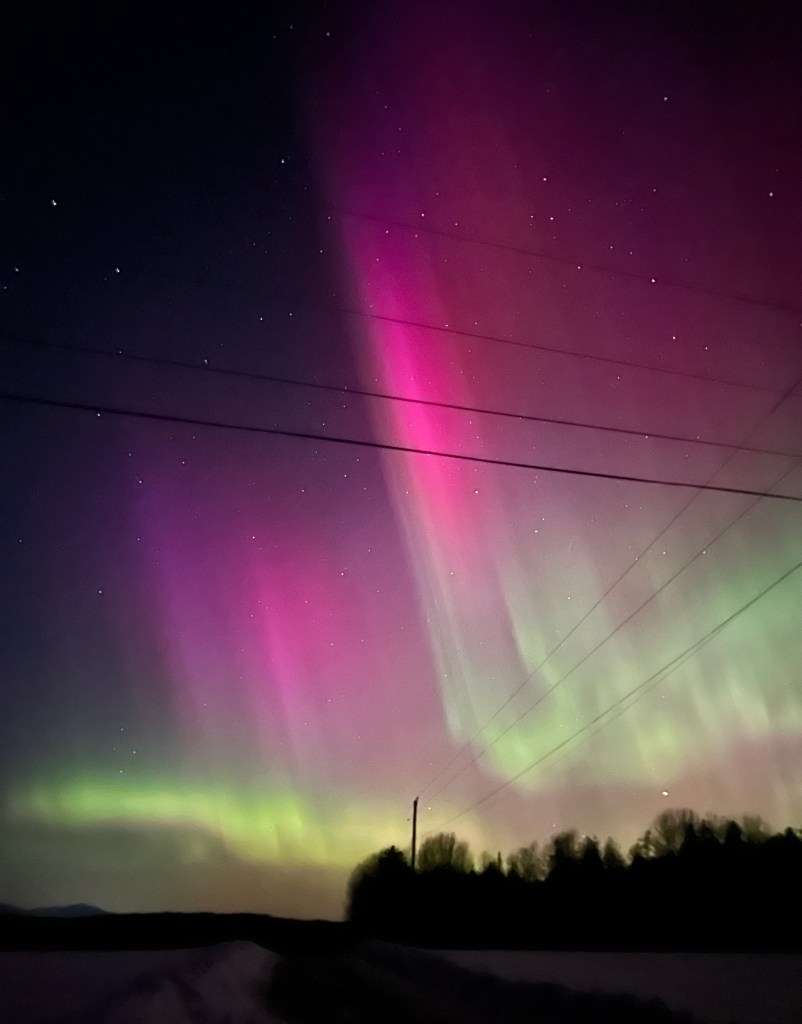
Later, in the night, I’m out in my fat wool sweater and Danskos, holding a cup of hot honey tea, looking for the northern lights. The stars are crystalline, swirled through with white. The wind soughs through the white pines in the ravine behind my house, and a creamy half-moon, like a luscious unworldly melon slice — so tantalizing I’d like to hold it with both hands — hangs over my house.

I’m at the edge of my garden, that familiar place where, if I smoked cigarettes or drank scotch, I’d linger, contemplating the sunflower stalks and the village lights below. The night pretties up the village, wraps it up, so I can see how small this place really is. In the night, my heart opens toward the village; in the daylight, not so much.

The light from my house illuminates stray leaves sailing through the darkness, the great shift of autumn. Like so many of my friends, I’m at that place in life, kids growing and grown, where creative possibilities unfurl. I’m doing the things I’ve done nearly all my life: drinking tea, staring up at the wonder of the night firmament, contemplating which way I’ll jump. In the meantime, I’ve been housekeeping: edge away from that negative snarl, lean into what and who I know is true, the wind and the stars, the moving moon, this swallow of tea, this precise moment. Now.

“Problems that remain persistently insoluble should always be suspected as questions asked in the wrong way.”

— Alan Watts