How Time Shifts, or Doesn’t

In Hardwick, Vermont, today, a woman approached me and said, I know you. As she spoke, I realized she had worked, over ten years ago, at State Street Market in Montpelier. Although that market had long since closed, and I had only rarely gone there, she remembered me with a small child. She said, Your little girl was so darling.

I listened while this woman unwound her life for me, spinning from a broken, unhappy marriage to touring as a circus cook, then living in a Buddhist retreat. Her face gradually rubbed into familiarity as I remembered those days from so long ago, my daughter’s warm hand in mine, walking among the high shelves of that market, in a place I remembered as sunny. I had repeatedly purchased a few particular things: yeast for root beer I brewed in gallon jugs and sold at a farmers market, umeboshi vinegar, a carob-covered rice cake for my daughter. The hippiest, strangest collection. How she would laugh at this now.

While this woman leisurely told me her story, I missed my little girl, my ruby-lipped merry child, the world that seemed often merely the two of us. Listening as the woman told me of her cancer and surgery, her own healing, I thought of how my eyes often catch on my daughter these days, this tall and lovely young woman still suffused, chock-full, with that vibrant, radiant energy, yet blossoming into a flower with myriad, distinctive layers of petals. Within, though, that small child is folded within her being, as that younger woman with the packets of yeast in her hand is meshed through my own womanhood.

Unlocking the bookstore door this morning, above Hardwick’s Main Street in the clear blue sky, nine turkey vultures circled, near enough I saw their tail feathers flickering in the breeze’s constant motion.

On Columbus’ first encounter with the new world…

…he said that it was such a joy to see the plants and trees and to hear the birds singing that he could not leave them and return. He says that this island is the most beautiful that eyes have ever seen.

Photo by Molly Blume S.

Photo by Molly Blume S.

Courage

Driving along the interstate the yesterday, I looked up at blue heron winging its oddly graceful way, silently above the rush-hour pavement. This strange bird, who always reminds me of its ancient, prehistoric ancestors, set me thinking of what I’m writing, where turkey vultures circle and ascend, silently, reappearing over and over in this novel, a wordless image of mortality.

On this drive home, the sprawl of Burlington thins gradually, and with relief  I cross over the Morrisville border where the farm fields spread out, and Mt. Elmore appears to my right, my familiar blue companion. I was still thinking of those vultures and that solitary heron when the rain began again, hurling down in handfuls as I alternated through patches of downpour and sunny spots. As I drove out of Morrisville, up the hill towards Elmore, the rainbows appeared, two great arcs, iridescent beyond belief, their tails not tucked neatly behind the mountain, but seemingly almost right before me: they seemed so near I could practically pull over, sprint into the woods, and discover their mythical ends. I parked on a dirt road and jumped out. The rain had already ceased, and only the green still shimmered its glittery glow. The other colors had already faded and paled, wicked away into the clouds.

I stood there watching the rainbows disappear into nothingness. The rain had muddied the road and swept a coolness over the day’s heat. The crickets sang weakly, as if they neared sleep.  The wet soil and tangled weeds along the roadside emitted a briny scent that reminded me of a place in Maine where we had once been happy. I wondered if the fall was edging in there, too, this place where I would never return.

The last miles home, I thought of those things–heron, vulture, rainbows, the Maine ocean and sky. The next morning, I told my younger nephew I had seen a double rainbow, and he asked, A double rainbow? Are you sure?

Yes, I said. I’m sure.

Let it not be said that in passing through this world
you turned your face and left its wounds unattended.
Instead, let it be said that when your friends
cut open your chest to partake of its courage,
a loon was calling.

–– Janisse Ray

IMG_3628

Photo by Molly Blume S.

Summer

My younger daughter told me today, It will be bad for me in a few years.

Why’s that? I assumed she was pre-mourning her older sister’s forthcoming passage into adulthood and that ached-for leap into adult life.

My child said, Because my aunt buys my really nice pajamas at a place where she buys her boys’ pajamas, and we love these pajamas, and the sizes don’t go above 12.

My child will never remember this conversation. Two years hence I could bring up this remark around the woodstove, and I bet cash now she likely won’t remember this. But today, here, this meant something to her. A summertime world of utter happiness, a way of living this season where she and her two beloved cousins sleep in a small room, reading and giggling, all in their same beloved pajamas. These are days filled with bikes, swimming, endless meals –  also of ears primed to hear, trying to piece out the puzzle of adult lives, the constant threads of conversation and emotion. Mainly, though, these children seek space for their growth and energy. Tonight, this child wanted to go walking in the gloaming. We went out, all of us, walking along the gravel road, and didn’t cross back into the house until long past dark.

Here’s Dylan Thomas on childhood in a stanza of “Fern Hill”:

All the sun long it was running, it was lovely, the hay
Fields high as the house, the tunes from the chimneys, it was
air
And playing, lovely and watery
And fire green as grass.
And nightly under the simple stars
As I rode to sleep the owls were bearing the farm away,
All the moon long I heard, blessed among stables, the
nightjars
Flying with the ricks, and the horses
Flashing into the dark.

Photo by Molly S.

Photo by Molly S.

Vermont Travels

Early this Sunday morning while the girls were sleeping and dew lay slick in the garden, I was reading Rinker Buck’s The Oregon Trail, his new book about traveling across long stretches of the Oregon Trail in contemporary America. By the time the kids were up, I was itching to read parts of the book to my girls, as Buck’s brother Nick reminded me in many ways of my own brother Nik.

I said, Girls, it’s settled. We’re headed out west next summer in a prairie schooner.

One of the girls remarked somewhat disinterestedly, I thought we were driving the Toyota to Alaska, and why are we out of bagels again?…

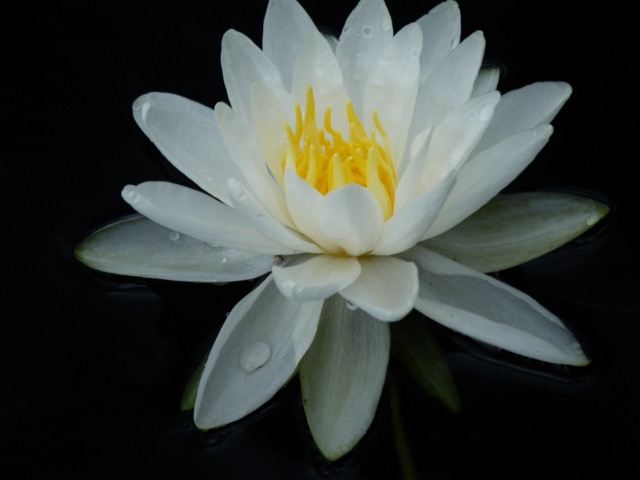
In rural Vermont, so much of our travels are undertaken in a car. Today, with effort, we loaded the canoe on the car, drove to Number 10 Pond and unloaded the canoe. We had the loveliest paddle. People were swimming far out in the pond, and they called cheerily to us, hello, hello! and a little Jack Russell terrier yipped at us from a peninsula. My older daughter, in the canoe’s rear, guided us into a patch of water lilies, and while she meticulously photographed the aquatic flowers, I lay on the canoe’s bottom and watched the cumulus clouds drifting. Then it was back in the old truck again, with the transmission’s curious tendency to lurch out of third gear as we rattled along. All this time, though, we held the pond within us, its cool surface pinged with skittering water bugs, and the clouds reflected in its green depths.

Buck writes:

In a covered wagon, while riding slowly out in the open air, every blade of grass, every fence post and farm, or the mallard ducks rising from the streams, assumes a visual and olfactory intensity that you can never feel while trapped inside a speeding car. While on a wagon seat, the land embraces you, emotionally. The rumbling wheels, the creaking top, the pull of the driving lines in your hands multiply the pleasure of travel. A part of me would always long for that strength of feeling again, and no other form of travel could match it.

–– Rinker Buck

IMG_1988

Waterlily by Molly S.

Art and Gambling

My older daughter attended an art institute this summer that emphasized art for art’s sake. That’s a particular phrase that’s always rankled me, likely much to my discredit, as my daughter pointed out that art for art’s sake reigns fairly prominently in our unfinished abode. She was wholly annoyed by that proposition, too. When I asked why, she said, When I grow up, I want a salary. Clearer thinking, perhaps, than I’ve ever achieved. She doesn’t want what honestly amounts to the gambling I do with our lives.

Nonetheless, she loved this art institute. She loved the whole-hearted infusion of art, of walking across a college campus and meeting fiction writers who read thirty-second stories, of poetry slams, of improve and theater. That Government Night was run by a political filmmaker.

What if our culture truly was infused with art? If poets were valued more than CEOs? Is that so improbable? So foolish? Or too revolutionary?

But I, without a penny to my name, I still say that when it comes down to it, money is one kind of currency and painting is another.

VINCENT VAN GOGH

Photo by Molly S.

Photo by Molly S.

What Is of Value

This afternoon, in a driving rainstorm that almost instantaneously altered to sunny skies, I took the girls with me to a staff meeting in Burlington. They read for a while, then headed down to the lake’s waterfront, and by the time I arrived, they had both decided Burlington was THE place to live.

On the way home, we stopped in at Big Box Store Land. With all our recent house guests, our towels have been revealed in all their deplorable condition. While I wandered around a mammoth store looking for towels in what had been advertised as a bath store, but had a sizable luggage department, too, the girls scoped out the premises.

They were truly amazed: hair clips could be bought in a plentiful pack and three dozen hairbrushes were on display. One daughter murmured, I’ve never seen so much shampoo in one place.

Such marvels! We left with towels and hair clips. Back at our house, in the cool and rain-fresh evening, we walked around the garden, the little girl noting the singing crickets, while the wood thrush trilled her inimitable melody. As summer winds down, the birdsongs gradually diminish.

The world of plastic baubles thoroughly admired, the girls and I sat on the couch and read.

(Donald Hall) is a writer who (at least on the best day) does not succumb to inner or outer pressure but, rather, knows that what he calls “absorbedness” is the answer–the only answer. Through all of life’s twists and turns–those fleas–he turns to the work the way his grandparents turned to the soil, to the harvest, which waits for no one.

– Dani Shapiro

IMG_7088

New Hampshire White Mountains by Molly S.