Tool, Weapon, Daily Bread

How lucky I was to have a houseful of girls tonight, laughing and eating, with just so much chat-chat-chatting. They have questions and their own contrived theories – could this be true? This? Would life be different with a houseful of sons? Somehow, I think so.

Driving to the movies, in this dark November night, I listened to their talk braiding around each other, and I realized these girls know each other through language. Too often, I’ve thought of my own use of language as either tool or weapon. A few years back, I wrote an essay about industrial wind in VTDigger, intentionally using language as weapon. Now, in the bits of journalism I do for paid work, it’s a serviceable tool. But these girls remind me, again, of simple loveliness of speaking, and that the deepest profundity is often what’s right at hand.

…If you can read and understand this poem
send something back: a burning strand of hair
a still-warm, still-liquid drop of blood
a shell
thickened from being battered year on year
send something back

— Adrienne Rich

FullSizeRender

Woodbury, Vermont

November 2015

Vermont Public Radio and my teenager and so many questions, questions: what does this mean? Why did this happen? So many questions and I have no answers, merely: think of this bit of information, and that geography matters, history matters, that anger and desire and fury and bitterness matter.

I slid potatoes and squash in the oven and stepped outside for firewood. With the sun going down, the air had abruptly cooled. My younger daughter and the neighbor child were in the darkening woods, laughing. Overhead, the clouds parted over the crescent moon, and then concealed this heavenly beauty. Unseen, geese honked their mournful journey, away.

Between our two lives
there is also the life of
the cherry blossom.

— Basho

IMG_0303


Sunday

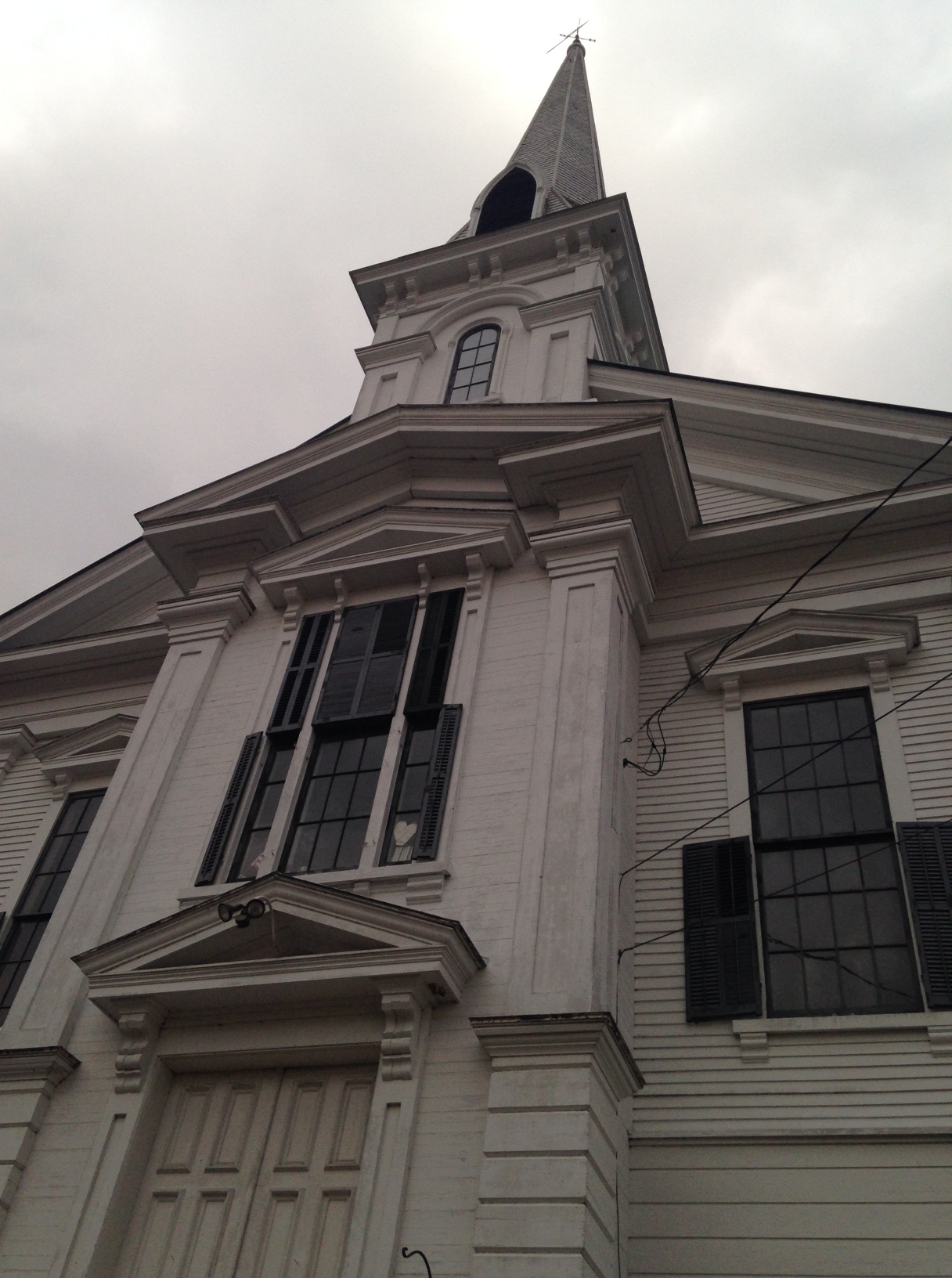
My children and I were never church-going people, although the enormous quantity of churches in Vermont mark our bearings. We’ve spent hours on ecumenical lawns, from the nursing and changing diapers days, to a safe place for toddlers to stretch their legs on the long syrup delivery routes I used to drive. Years ago, I was lost in Addison County, with a starving four-year-old in the backseat. I handed her the Gazetteer and told her to read the map. Hidden behind the upside Gazetteer, she informed me: Mommy, we’re lost. Go backwards.

We weren’t lost today, in our own little town, at the old church with its doors folded up like hands over a face. These old relics are beautiful and enduring, quietly going about their business, present for need, reflecting those admirable yankee qualities.

Some keep the Sabbath going to Church –
I keep it, staying at Home –
With a Bobolink for a Chorister –
And an Orchard, for a Dome –

— Emily Dickinson

IMG_0299

South Woodbury, Vermont

Children Laughing

A number of years ago, we were having dinner with friends in our kitchen, laughing and talking, when suddenly one of us ordered the others to be quiet. Our friend held up his hand. I had recently laid my baby in her crib upstairs, in that rosy end-of-the-day glow. She lay there babbling her echolalia, singing away happily in her own baby world. Our friend, whose children were older then, insisted we listen. Our own clamorous adult chatting ceased, and from the open room just above, we listened to the baby’s talk.

This morning, I sat on the couch and ceased my own work for a moment. My ten-year-old daughter and her friend were whispering in the bunk bed they had slept in together, giggling and planning their day off from school. Like a brook, their laughter tumbled to me, clear and sweet.

…Laugh at the night,
at the day, at the moon,
laugh at the twisted
streets of the island,
laugh at this clumsy
boy who loves you,
but when I open
my eyes and close them,
when my steps go,
when my steps return,
deny me bread, air,
light, spring,
but never your laughter
for I would die.

— Pablo Neruda

IMG_9507

Photo by Molly S.

November Blooms

I drove along the road to East Hardwick today, a narrow road I’ve driven countless times. I’ve transported numerous kids in many vehicles, often to the lake’s beach, wearing our swimsuits, the trunk filled with floaties, our bags packed with sunscreen and snacks and knitting. This road means to me little children in diapers, stacks of library books, and the long winter the crew worked on an old farmhouse along this road. The snow blows mercilessly across this road. This road means the public library at the end, and the general store where I buy groceries, mud boots, sugaring supplies and lemonade.

Today, driving a companion to a doctor’s appointment, we talked about his dream to get piglets and sheep. You have to think about something, he said.

There’s a line from a TC Boyle novel, World’s End, where a character defines himself as hard, soulless and free. How I aspired to that in my brash youth. But now, fully immersed in Dante’s woods, I see hardness crazes and breaks, whereas a malleable heart, smeared across the terrain of a road and intersecting journeys and lives, offers a tensile strength, the possibility for growth, the chance to bloom in this brief, dear life.

… The spring
will come soon. We will have more birthdays
with cakes and wine. This valley
will be full of flowers and birds.

–– Hayden Carruth

IMG_2678

Molly S. Photography

Fear of the Dark

I wrote my novel Hidden View in bits and pieces, in notebooks, on a computer, in endless rewrites on the back of printed pages. I began this book during my daughter’s nap time, those golden hours when I could sit down and breathe creativity in the solitude writing demands. I wrote for no one but the novel itself: to write as well and truly as I could.

This book has joined the world. It’s out there, for the taking and reading. When I think about what made this book, I took what I had at hand: a ball of yarn, imaginary rabbits, Vermont’s exquisite and desolate winter, a house both a solace and a menace. But equally driving the book are three forces. One of these is mothering. Like the ceaseless gritty wind in a canyon, my children have formed and hewn me, in a multitude of ways I never could have imagined. My children are my anchor, the physical weight that has pinned me to this soil and forced me to know the world in an expanse I never could have imagined.

When my older daughter was a baby, my husband left the state for work, and the baby and I remained. On a 100 acres, our house is surrounded by woods. At that time, I was afraid of the dark. When the baby slept at night, I had to walk down to the unlit sugarhouse in the dark, by only the thin light of a flashlight and the stars overhead. Those months were late fall then, around this time of year, and the nights were cold. The rural dark in Vermont is so profound I have held my hand inches before my face and yet been blind to my own flesh. I forced myself to go out in the dark, because I knew every journey would lessen my fear. And I knew I could not mother this baby, in this house, in this agricultural life, if I feared the dark.

Of the dark, at least, I am no longer afraid.

The true self seeks release, not constraint. It doesn’t want to be corseted in a sonnet or made to learn a system of musical notations. It wants liberation, which is why very often it fastens on the novel, for the novel seems spacious, undefined, free.

–– Rachel Cusk

IMG_0262

Milkweed Seed/Morrisville, Vermont/Photo by Molly S.