Vectoring….

Autumn has stretched out in Vermont into days of balminess, the warm air shot-through with the gold that lingers on the trees. It’s so warm, I keep at my makeshift back porch deck, a table I moved out this summer that’s become a place of succor, resting my bare feet on a wooden crate of those onions I pulled from the garden.

I’m taking a class with the unmatchable Lauren Markham about structure in writing, one of the hardest challenges. Online, there’s attendees from California (what? you get sun and ocean?) and Phoenix and Boston. Signing in, I leave my laptop camera on. I throw a chunk of wood in my stove from sheer laziness so I won’t need to rekindle the fire as the colder night creeps in, but I open the back window so my cats can sit on the sill and enjoy this sweet October breeze. When I join, the group is admiring the view of my clapboard house and frost-killed morning glories vines. I tell them my chore which doubtlessly immediately marks me as…. quaint rural.

Late afternoon, I pull out the dead basil plants and then lie down under an apple tree. Her leaves, blacked with frost spots, spiral down, one by one, to the unmown grass. It wasn’t until I had babies and was forced to slow down (all those nursing hours beneath apple trees, milk-sweet baby in my arms) that I realized every leaf takes its own precise trajectory, from spring bud to the autumn dive earthward. Around me, rotting apples, persistent slow-flying wasps.

I might have slept; when I open my eyes, the sky is already draining of blue. Thinking of Markham’s words, I suddenly see the taunt arc of this fourth, yet unfinished book, the map that holds this story, the treasure at the reader’s end far from a Hallmark card. Vector is the word she used. Indeed, all story, all life, is motion. The chill rising up from the earth, I vector myself indoors….

A great many, who have spent their lives in cities, and have never chanced to come into the country at this season, have never seen this, the flower, or rather the ripe fruit, of the year. I remember riding with one such citizen, who, though a fortnight too late for the most brilliant tints, was taken by surprise, and would not believe that there had been any brighter. He had never heard of this phenomenon before. 

— Thoreau

Rowing in autumn…

In a cold rain, my friend and I set off walking. It’s a joke between us. When we were neighbors, I would call and ask her to meet me for a walk.

It’s sleeting, she’d say.

Only a little.

Invariably, she’d join me, gung-ho.

The rain lets up, though, as we walk up a muddy path, cross streams, pause to admire where a view might be through dense mist. The woods are gold and black, redolent with the humus-y scent of fallen leaves, this summer’s bounty already turning back into the damp soil. I remember her oldest son, now a teacher himself, standing on a chair in my kitchen, rolling out dough for sugar cookies, happy. Rain or snow probably fell then, too.

This is familiar forest to me, as I lived here for so many years. But I grew up surrounded by New Hampshire forest, and the exquisite beauty of New England fall, its sharp bite reminding us of winter, is as familiar to me as the backs of my hands. While the greater political world is utterly unfamiliar — which way will this go? — this path, our conversation, is balm for my soul. Both our lives have gone rocky ways, and yet here we are in rain, pressing on, pocketing especially pretty leaves.

On my way home from our soggy walk, I stop at the coffee shop and spread out my papers and laptop on a table. I’m standing there, thinking (or maybe dreaming), when a long-ago acquaintance appears. We sit and talk for a bit. There was a quarrel in the past between us. As she speaks, I feel the blood quickening in my rain-damp flesh, from my cheeks to my sodden toes. Here it is again, how experience shapes and changes us. Our culture pushes us, pushes us as women, to smooth the edges, say all’s well, be polite, diminish ourselves and pretend we’re still in the land of childhood, when the grownup woman world is a vast sea of star and moonlight, treacherous waves, radiant beauty, and the great unknown. At the end of our conversation, there’s no conclusion, no tidy wrap-up, just the two of us rowing together for a bit, handing the oar back and forth.

October: where are we going?

This weekend cleaves the summer, the marker where the light changes.

As the leaves drop, the light sharpens and thins. I’ve been here before, so many times, knowing full well how the sun will continue to dwindle. October is a season of brilliant contrasts: emerald hayfields, swaddles of mist, orange remnants of zinnias.

The season mirrors the human realm, too, such a lusciously lovely summer this has been. Now I yank out spent tomato vines, stow away my garden rake and hoe. I gather a handful of kindling, an armful of wood. So much winter, so far to go.

In the co-op’s baking aisle, I run into an old friend, and we chat while her daughter shops. I’m certain we mark different sides of the ballot, but our friendship is hard-tested, solid. Our conversation swirls. Through the window, yellow leaves scatter and leap in a breeze. I lean towards her, listening to a thread of her story.

Change of season is never the same. My youngest daughter tumbles towards womanhood, our lives shift, stretch. Within, always the constants, the long threads of conversation, the joy of the natural world, my ever-present marvel at the world’s flux: where are we going? why? Is it true that other people live these steady, predictable lives? Who knows?

Overhead, those geese, honking their way out of here. And us, here, for now at least.


Each fall in New Hampshire, on the farmwhere my mother grew up, a girl in the country, my grandfather and grandmother finished the autumn work, taking the last vegetables in from the cold fields, canning, storing roots and apples in the cellar under the kitchen. Then my grandfather raked leaves against the house as the final chore of autumn.

— Donald Hall, String Too Short to be Saved

Cutting grass at night…

I’m finishing mowing the front lawn when my neighbor opens her door and hollers, “Hey, there!” across her driveway. Save for a series of apartments in my twenties, I’ve never lived so close to another house and moved here, in fact, from a house that was surrounded by wilderness.

She’s a darn good neighbor. Twilight fattens to darkness as we talk about small things — a mutual friend who visited her, red roses blooming yet by her door. My pink cottage beauties have long since dried up.

I’ve lived long enough now in this town to have experienced the meanness of catty gossip and the kindness of strangers; nothing different from any other town or city, I suppose, simply the variety of human behavior, the tenor of thinking that makes me satisfied to be standing here in this dew-dampening grass, listening. A fallen pear that’s split by the mower blade bleeds its sweetness into the evening.

It’s a harvest full moon night, diminished by the eclipse and then returned. I sleep with the windows wide open, the moonlight on my curled cat who’s sleeping in his own cat way, more dream than rest, busy at his own cat magic. Here, too, I can hear the traffic on route 15, coming and going, going and coming. At 3:30 a.m., the traffic stills. The tree frogs sizzle on.

As a girl, we traveled summers in a green jeep and slept in tiny nylon tents. Waking in the night on those cross-country trips, I’d hear the interstate. So curious I was to know where everyone was headed. I repeated all that again in my hungry twenties. For a summer, we lived near the river in St. Johnsbury, Vermont. Every night, the train whistle bleated mournfully, passing through. Here I am now, in my fifties, lying awake, listening. The scent of the grass I cut that evening drifted into our house. In the moonlight, my cat lifts his head, questioning. “We’re here,” I counsel, “all’s well.” He tucks himself back into his curl. The moon and the frogs keep on. A milk truck rumbles by, pushing us towards day.

Two autumns…

I leave the garden to do its final hallelujah of the season, the tithonia and sunflowers and cosmos fraying now, the basil still slipping into my cooking pot. September 11, the morning I stood in my sun-filled kitchen watching my toddler tricycle around the table, listening to public radio and wondering what was happening. My youngest was not yet born. Now, 23 years later, my daughters and I text during the debate. My cats are curled at my feet, in their usual, wise cat-disdain way, thinking their feline thoughts, savoring like any smart creature the warmth from the wood stove.

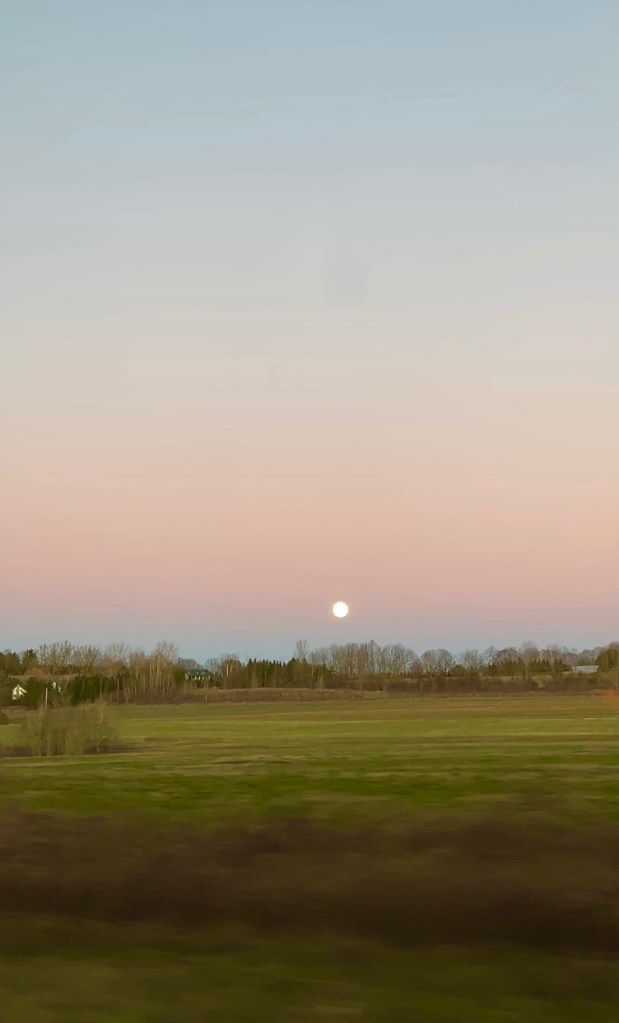
On my evening walk, I meandered the long way home. A half moon hung in the sky, sweet as maple pudding, so near I imagined I could reach out and lay my fingertips on its smooth sheen. Early autumn. So much more to come.

for me going

for you staying—

two autumns

– Buson

All kinds of summer rains…

Too stormy to swim on Sunday, I take up a new friend’s offer to walk the trails she’s cut on her property. Her property is off a back road, with a gorgeous view into the valley where the Lamoille River is barely beginning to fatten its strength.

The trails wind down through the woods, studded with white quartz on either side, so gleaming the rocks appear to have been freshly washed. On the verge of rain, the forest is still. In a kind of labyrinth, I walk over springy moss, beneath leaning cedars, around a former beaver pond now dense with green. At the far end, I lean against a great pine, bark rough through my t-shirt.

Rain begins, pattering through the canopy, then soaking me by the time I’ve returned to my Subaru parked at the edge of the road. I’m so soaked the windshield scrims over with fog. But the time the glass clears and I’m on my way, the rain has stopped, the sun burst through the pearly clouds. In no rush, I pull over and walk along the road, admiring the luminescent rainbow, one end in a leafy hedgerow of maples.

Sunday afternoon, rural Vermont, there’s no one around. I keep walking, thinking about a conversation I had recently with a geologist about what’s happening in Vermont. He’d stepped away from a conference to answer my questions for an essay I’m writing, and gently pointed out that the concatenation of flooding and heavy rainfalls and the great shifting around of debris has been human-caused, not by the folks who live on slopes or streams, but collectively.

His voice is persistent, filled with facts, but also not despair; we need to be cognizant, wide awake, look lively. His voice reminded me of what a good summer’s rainstorm used to be, not so long ago. You might sit on the covered steps of your back porch, listening to the rain gather strength to satisfy your kale and broccoli, the thirsty hydrangeas.

The rainbow winks out, and I head home, carrying with me the memory of those silvery cedars, a few chips of pine bark nestled in my hair.