Cutting grass at night…

I’m finishing mowing the front lawn when my neighbor opens her door and hollers, “Hey, there!” across her driveway. Save for a series of apartments in my twenties, I’ve never lived so close to another house and moved here, in fact, from a house that was surrounded by wilderness.

She’s a darn good neighbor. Twilight fattens to darkness as we talk about small things — a mutual friend who visited her, red roses blooming yet by her door. My pink cottage beauties have long since dried up.

I’ve lived long enough now in this town to have experienced the meanness of catty gossip and the kindness of strangers; nothing different from any other town or city, I suppose, simply the variety of human behavior, the tenor of thinking that makes me satisfied to be standing here in this dew-dampening grass, listening. A fallen pear that’s split by the mower blade bleeds its sweetness into the evening.

It’s a harvest full moon night, diminished by the eclipse and then returned. I sleep with the windows wide open, the moonlight on my curled cat who’s sleeping in his own cat way, more dream than rest, busy at his own cat magic. Here, too, I can hear the traffic on route 15, coming and going, going and coming. At 3:30 a.m., the traffic stills. The tree frogs sizzle on.

As a girl, we traveled summers in a green jeep and slept in tiny nylon tents. Waking in the night on those cross-country trips, I’d hear the interstate. So curious I was to know where everyone was headed. I repeated all that again in my hungry twenties. For a summer, we lived near the river in St. Johnsbury, Vermont. Every night, the train whistle bleated mournfully, passing through. Here I am now, in my fifties, lying awake, listening. The scent of the grass I cut that evening drifted into our house. In the moonlight, my cat lifts his head, questioning. “We’re here,” I counsel, “all’s well.” He tucks himself back into his curl. The moon and the frogs keep on. A milk truck rumbles by, pushing us towards day.

Two autumns…

I leave the garden to do its final hallelujah of the season, the tithonia and sunflowers and cosmos fraying now, the basil still slipping into my cooking pot. September 11, the morning I stood in my sun-filled kitchen watching my toddler tricycle around the table, listening to public radio and wondering what was happening. My youngest was not yet born. Now, 23 years later, my daughters and I text during the debate. My cats are curled at my feet, in their usual, wise cat-disdain way, thinking their feline thoughts, savoring like any smart creature the warmth from the wood stove.

On my evening walk, I meandered the long way home. A half moon hung in the sky, sweet as maple pudding, so near I imagined I could reach out and lay my fingertips on its smooth sheen. Early autumn. So much more to come.

for me going

for you staying—

two autumns

– Buson

All kinds of summer rains…

Too stormy to swim on Sunday, I take up a new friend’s offer to walk the trails she’s cut on her property. Her property is off a back road, with a gorgeous view into the valley where the Lamoille River is barely beginning to fatten its strength.

The trails wind down through the woods, studded with white quartz on either side, so gleaming the rocks appear to have been freshly washed. On the verge of rain, the forest is still. In a kind of labyrinth, I walk over springy moss, beneath leaning cedars, around a former beaver pond now dense with green. At the far end, I lean against a great pine, bark rough through my t-shirt.

Rain begins, pattering through the canopy, then soaking me by the time I’ve returned to my Subaru parked at the edge of the road. I’m so soaked the windshield scrims over with fog. But the time the glass clears and I’m on my way, the rain has stopped, the sun burst through the pearly clouds. In no rush, I pull over and walk along the road, admiring the luminescent rainbow, one end in a leafy hedgerow of maples.

Sunday afternoon, rural Vermont, there’s no one around. I keep walking, thinking about a conversation I had recently with a geologist about what’s happening in Vermont. He’d stepped away from a conference to answer my questions for an essay I’m writing, and gently pointed out that the concatenation of flooding and heavy rainfalls and the great shifting around of debris has been human-caused, not by the folks who live on slopes or streams, but collectively.

His voice is persistent, filled with facts, but also not despair; we need to be cognizant, wide awake, look lively. His voice reminded me of what a good summer’s rainstorm used to be, not so long ago. You might sit on the covered steps of your back porch, listening to the rain gather strength to satisfy your kale and broccoli, the thirsty hydrangeas.

The rainbow winks out, and I head home, carrying with me the memory of those silvery cedars, a few chips of pine bark nestled in my hair.

“The apparition of these faces in the crowd…”

In the Albuquerque airport, I’ve tucked myself into a corner, editing a manuscript and drinking coffee, when suddenly I see the small airport is jammed. I pack up my things. In search of my gate, I ask a man if he’s headed to Chicago. “Houston. We’ve been deplaned from the tarmac, twice, and I’m pretty sure everyone here is about to have a nuclear meltdown.” Edging away, I hear a woman cajole her child to “let daddy figure this out.” The ruddy-faced daddy glares at a monitor.

At the terminal’s far end, I join an elderly couple (retired psychiatrists), a pediatric oncologist, and a mechanic who’s hoping to visit his mother before her open heart surgery. They tell me the news of Biden’s withdrawal.

Our plane has not arrived, and we step to one side of the swirling crowd. The oncologist shares that he’s been a fan of Biden. Such suffering in that family, he says; it changed him. The psychiatrists nod, listening. He tells us that his experimental research department received a flood of funding, but that’s all ceased now, with staff layoffs in anticipation of the election. He plans to retire in a few years and return to Botswana to volunteer. I don’t want to be dismal, he says, but the need for help won’t end.

We spy two pilots, admire their youth — but not too young — and gladly note they disappear through a door towards the tarmac. The loudspeaker voice informs us the pilots will have a short meeting with the cabin crew and then we’ll board. We’re not quite sure what that huddle is about — go team? keep the plane in the air? — and the oncologist muses that airports are one of the few places he’s experienced where strangers keep the social fabric together. No one, he tells us, says anything to strangers on D.C. public transportation.

That does not bode well, I think.

Just before we board, we shake hands and wish each other well. All these matryoshka doll layers in us: I walk down the ramp with the sign maker, who confesses his worries about his mother. Like a kind of magic, then, we’re in the air. Hours later, I land in Burlington, Vermont. Under a crimson full moon, I cross the street. The night sprinklers are watering a swathe of grass. All those dark miles of driving ahead of me. At home, the hydrangeas shine in the moonlight, boughs weighted with blossoms touching the ground.

IN A STATION OF THE METRO

The apparition of these faces in the crowd:
Petals on a wet, black bough.

— Ezra Pound

Hand-me-down mud boots.

These few days I’ve spent in New Mexico, my mother is a constant presence and absence. She’s powerfully here, in her sunny kitchen or in the stacks of empty flower pots in the garage. Yet, she’s vanished, too. All night, the desert breathes into this house, sage-sweet wind and coyotes barking and the robin songs here, too, like in my Vermont world. These days, the skies have been layered with lightening and sooty storms, golden sun, the blowing gritty sand that scours my skin to softness.

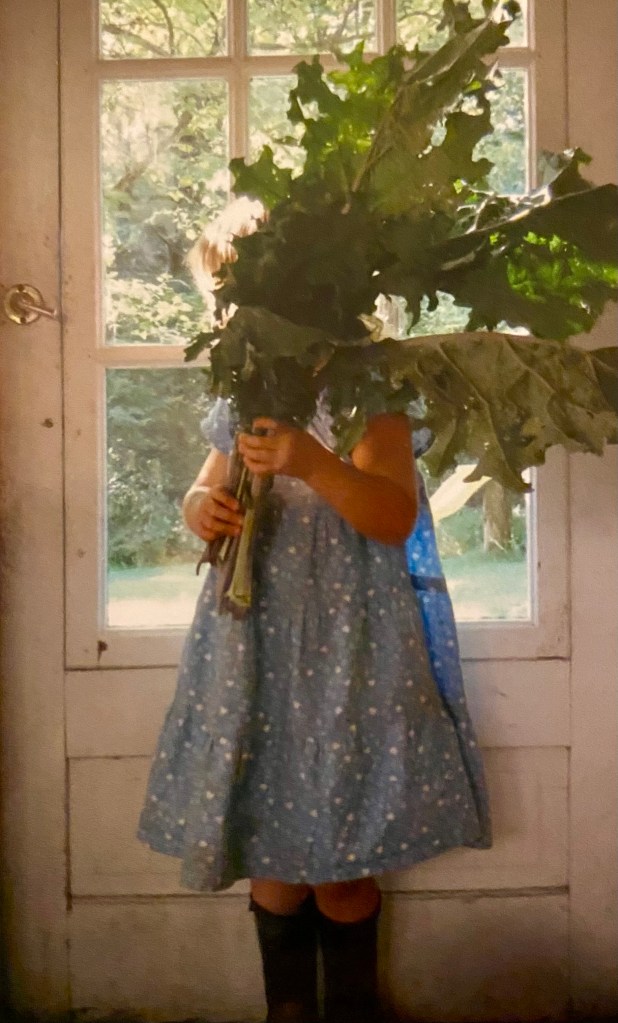
The world far beyond my small family’s sorrows teeters towards deceit and collapse. There’s no inoculation against any spiritual ailment, really. Measles, sure, but never the terrifying largeness of grief or rage, or losing safety or love. Which leads me back to the photo above, my little daughter as she was at our kitchen door, in her hand-me-down mud boots and a handmade cotton dress, carrying stalks of garden-cut kale. A reminder never to sentimentalize or diminish the rugged and real lives we live.

A Pretty Song

From the complications of loving you
I think there is no end or return.
No answer, no coming out of it.

Which is the only way to love, isn’t it?
This isn’t a playground, this is
earth, our heaven, for a while.

Therefore I have given precedence
to all my sudden, sullen, dark moods
that hold you in the center of my world.

And I say to my body: grow thinner still.
And I say to my fingers, type me a pretty song.
And I say to my heart: rave on.

— Mary Oliver

The natural course of things.

Dawn, I’m barefoot in the dewy garden, gathering peas, the world ignited. By the time my daughter and I meet in the kitchen, a little after five as she drinks coffee and heads to work, gray has skimmed over the sky, rain rain rain pushing in. (Side note: Red Sky at Morning, Richard Bradford’s novel, is a terrific classic novel, the former husband of my very long ago nursery school teacher, somewhere in Santa Fe….)

A year ago, heavy rains flooded much of my state. As I left Greensboro yesterday afternoon, I passed a village resident digging a trench with a shovel, some preventative channeling. About this time last year, I realized I knew a number of people who were driving around with shovels in their cars or pickups.

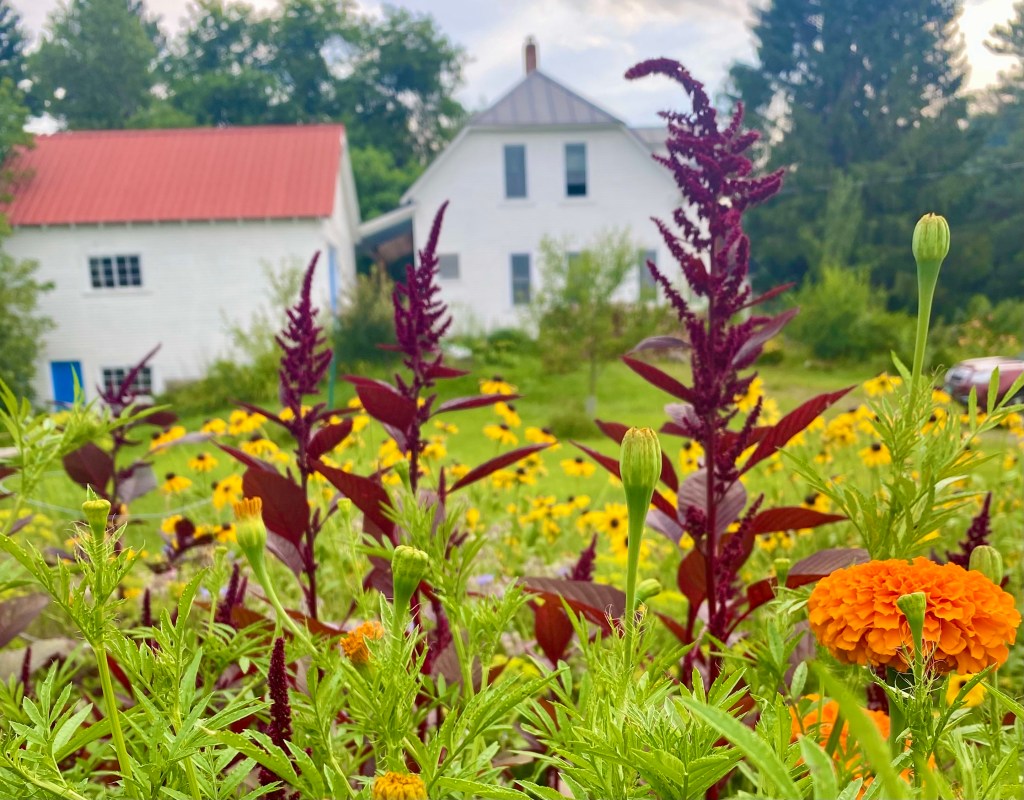
We are now in midsummer. Around two sides of our house, my garden grows — cottage roses and cup plant and phlox — and the wild rallies on the other two sides — jewel weed and box elder and goldenrod twine around porch railings, brush against the clapboard. Snip snip must be done, and yet somehow hasn’t yet. The groundhogs multiply, run beneath our chairs on the deck. I wonder about those foxes, about the natural course of things, wonder again, Well, what do I know? What will happen will happen….