Writing Dialogue

There’s this odd word gnomon in James Joyce’s story “The Sisters” which is used in the mathematical manner: it’s a way of knowing a physical void by what is visible. That returns to that notion of understanding ourselves as creatures of change: not full and certainly not complete.

A writer once pointed out to me the gnomon is a way of writing dialogue, too. Truest dialogue always reflects the sub-story of what we’re not saying. We live in worlds of stories we create: the spoken story we share, and then all those winding sub-stories beneath.

Isn’t that partly what makes us so infuriating to each other at times, and, conversely, also so intoxicatingly fascinating? Behold, then, the strawberries, the nasturtiums, sun rising through a scrim of fog, the Milky Way arching through the black of a moonless night – this exquisite world we inhabit – and us, with our endless stories…. essence of our humanity.

 If a writer of prose knows enough about what he is writing about he may omit things that he knows and the reader, if the writer is writing truly enough, will have a feeling of those things as strongly as though the writer had stated them. The dignity of movement of an ice-berg is due to only one-eighth of it being above water. A writer who omits things because he does not know them only makes hollow places in his writing.

–Ernest Hemingway, Death in the Afternoon

FullSizeRender

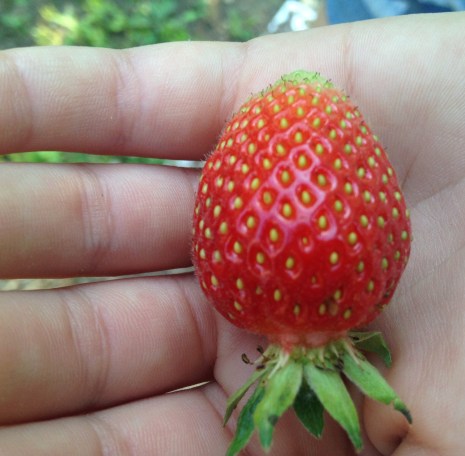
first berries from our garden

The Earth Herself

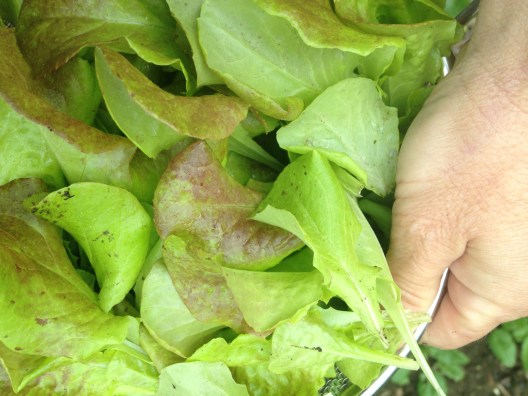
In the garden, on this chilly, almost autumn-esque day, I pulled lettuce from a fattening line, admiring the myriad green. So much of writing is spinning the stuff of language into this three-dimensional world we inhabit. Our world is so amazingly complex, jammed ceaselessly with variations of color and light, that language at times seems a poor descriptor.

I always remind myself, begin at the beginning, with the very first word. Setting aside my basket of lovely leaves, my fingers crumbled dirt into my palm. Dirt? Or the earth itself, but a few grains of this celestial, spinning orb? Or Thomas Wolfe’s “loamy soil”? Or is this broken sod? Tenacious clay?

I held the handful near my face: black earth, lavish enough to devour.

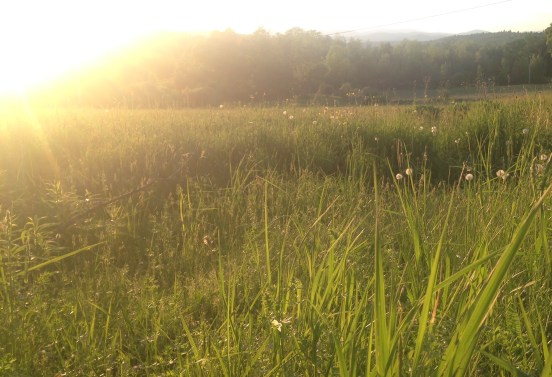
The voice of forest water in the night, a woman’s laughter in the dark, the clean, hard rattle of raked gravel, the cricketing stitch of midday in hot meadows, the delicate web of children’s voices in bright air–these things will never change.

– Thomas Wolfe, You Can’t Go Home Again

IMG_1435.JPG

Woodbury, Vermont

Yin Yang, or Giving Rise To Complements

Here’s a simple thing which took me a ridiculously long time to learn: that famous yin yang symbol isn’t particularly about a dot of white in a tear of black or vice versa. Instead, the black and white are all smeared together.

As an American woman, for years I perceived the world as opposites: you’re in the house or out, it’s light or dark, we’re dead or alive. Through gardening, I began to perceive growth demands decay, and then I carried that notion to writing: creation depends on destruction. The universe is intricately braided with myriad shades of being, color, sound….. There is no one single thing separate and opposed to the whole other rest of the world.

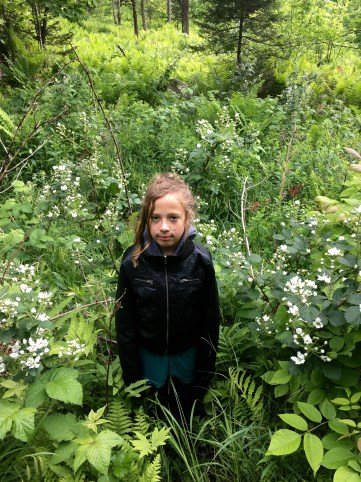
So when my daughter comes with me on a drizzly and rainy afternoon in the woods behind our house, I’m grateful this the childhood world she knows, the place she is rightfully at home in.

….These two emerge together but differ in name
The unity is said to be the mystery
Mystery of mysteries, the door to all wonders….

– Tao Te Ching

FullSizeRender.jpg

Photo by Molly S./Woodbury, Vermont


Onamonapia

This afternoon, my 11-year-old daughter walked around the house saying 0namonapia,  over and over, desperately trying to drive her sister nuts, by repeating this beautiful word, richly rolling off her tongue.

Years ago I used to nurse this child at the farmers market where my then-husband and I sold maple syrup. One afternoon, I nursed my baby on the grass behind our tent, leaning up against a pole. A couple sat down somewhat near me, in the shade beneath a poplar tree. Eating, they casually spoke in a slavic language I didn’t recognize. I generally knew they were talking about the day, but I couldn’t really piece together much more than that.

My baby fell sleep, and I pulled a blanket over her soft little limbs, then leaned my head back against the pole and closed my eyes. While the couple kept eating and talking, I listened to their words, this beautiful language I couldn’t precisely understand, but I knew the language tied them together.

Surely, 0namonapia relays much more than cluck or moo. This is a word whose meaning can stretch to entire languages: an audible beauty that makes us human.


The Bells

Hear the sledges with the bells—
Silver bells!
What a world of merriment their melody foretells!
How they tinkle, tinkle, tinkle,
In the icy air of night!

– Edgar Allen Poe

FullSizeRender

sweater weather in June Vermont


Go For It, Kiddos!

Not only the season of popsicles and swimming, summer for 11-year-olds is truly Trampoline Season. About a month before my daughter’s birthday, I inquired at a local on-line forum if anyone had a trampoline no longer in use. Almost immediately, a grandfather at my daughter’s school located a trampoline in a nearby town. And then, as back-up, a few more, too.

The gift was an utter surprise to my daughter, and brought her such joy it made me happy, too.

Up above the garden, behind the burgeoning forest of asparagus and weeds, elecampane already massing into its giant summer growth, comes the squeak squeak of trampoline springs, the children launching themselves off our buggy bit of Vermont into their kid version of the wild blue yonder.

There is a place where the sidewalk ends
and before the street begins,
and there the grass grows soft and white,
and there the sun burns crimson bright…

… the children, they mark, and the children, they know,
the place where the sidewalk ends.

– Shel Silverstein, “Where the Sidewalk Ends”

FullSizeRender.jpg

West Woodbury, Vermont

The Garden’s Geometry

As a new mother, I was surprised by the weight of children; even babies, carried all day long, are heavy, and nursing in the nighttime, my arms often drooped with exhaustion. While my daughters are long since beyond the babes-in-arms stage, all afternoon yesterday I carried buckets of mulch and compost, bent with my hoe and scythe, and tugged my garden back from wilderness into domesticity: for a brief bit of time.

Step away, and the raspberry canes will run their way back. Creeping buttercup – or creeping crowfoot – proliferates knottily.

May is the season of optimism. I’ve planted melons for my watermelon-loving daughter, and promised to water well. The vertical territory of my beds lies low yet; visit in a few months and – like growing children – the vines will be lushly magnificent, the peppers spread out and holding hands, the bachelor buttons in bloom. May, like mothering, is the season of patience, too.

I’ve always preferred the woods in America to the woods where I grew up in Hampshire, which I can never help knowing are the hemmed-in exception to towns and villages and farms. New England is the other way around: a series of clearings in a forest. Keep walking north, and the clearings will shrink, until there are none.

Adam Haslett, Imagine Me Gone

FullSizeRender.jpg