Look at This

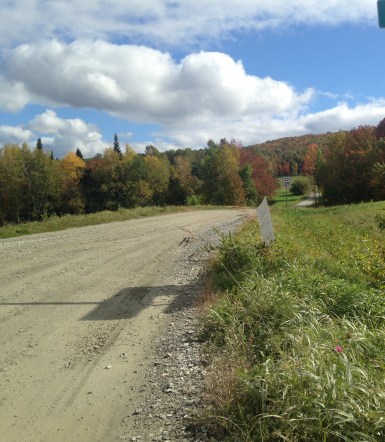
Driving my 11-year-old to school this morning, I remarked on the stunning foliage, and she answered in her even-keeled way, I kind of hate to say this, but the leaves are a little boring. What if we were along the Pacific Ocean, driving on a cliff, and looking out at the sea? Now, that would be really interesting.

Oh, my daughter, my daughter. Isn’t that the way of the world? I asked if she wondered if the kids on the Pacific coast might want to see Vermont’s gold and crimson leaves?

My daughter thought about that for a good while. Finally, long past the time I thought she might have lost interest, she offered, Maybe.

….O hushed October morning mild,
Begin the hours of this day slow….
– Robert Frost, “October”fullsizerender

The Void and Story

One of the more harrowing experiences I had recently was offering up testimony in a county courthouse. In a large, wood-panelled room with no windows, separated from the landscape I know and love – my children and the dark-green mountains where I live, the world of singing crickets and flower petals easily frost-bit, the sky sprawled infinitely overhead, I was asked to give my story.

What’s in each of our own, unique stories, anyway? Breath, thought, memory: words from my larynx spun from the slender bends of my ribcage. To return to David Hinton’s Experience again, while speaking I realized how keenly our stories are presence surrounded by absence. Into this unknown world, I told my story of fear and love, my presence filling that space. In this 21st-century American world, we’re accustomed to defining ourselves in terms of our acquisitions: degrees we hold, a dwelling, occupation, the clothing we choose each day, political beliefs we cherish, whether we raise our own meat and vegetables or buy boxed foodstuffs at Price Chopper. Pushed up the against the razor’s edge of the void – through illness or a turn of misfortune we’ll all experience – we’re left with only a body created from carbon and calcium, and the immaterial thread of our story.

Our stories, always imperfectly told, are not a reflection or mirror of who we are. The stories are who we are. Hand-in-hand with telling our stories is that persistency of doubt. Is this true? Is my story worth telling? For a writer: why write, anyway? The answer, perhaps, may be as simple and raw-edged as this: because at our hearts, we are but the conjoining of body and story. In the face of the void that courthouse morning, my story hooked into strangers’ stories, as my story now weaves into yours, and yours winds into others.

In Chinese with its empty grammar, Absence appears as the space surrounding the ideograms, and ideograms emerge from that empty source exactly like Presence’s ten thousand things – a fact emphasized in the pictographic nature of ideograms, and no doubt the ultimate reason for that pictographic nature. Indeed, the ideograms are themselves infused with that emptiness, as they are images composed of lines and voids, Presence and Absence…

David Hinton, Experience: A Story
 

fullsizerender

Elm Street, Montpelier, Vermont

Technological “Advances” in Rural Vermont

Living in Vermont and relying on a cell phone means knowing the best reception landscape around you – precisely which few feet along your dirt road have enough bars to dial out.

Yesterday, with our home reception reliably lousy these days, I parked behind the Greensboro Garage’s yellow barn, opened my notebook, unstrapped my sandals, and went to work. The crickets were singing, and the sun was a peachy end-of-August temperature. I spread my notebook on the dash, with the doors open, in a little breeze that moved along that valley. As a writer, I’ve worked in all kinds of places, from cemeteries to a hospital closet, and this was prime territory, but I’m not sure this represents all that much of a technological advance.

I once used a landline at my own desk; now the phone fits in my hand, which is good thing because I sometimes need to hold it up, believing that will improve reception or send off an email I’m anxious to move along.

Admiring this substantial barn reminded me of Salinger’s Raise High the Roof Beam, Carpenters. Remember Seymour Glass calling his fiancée in World War II?

The connection was so bad, and I couldn’t talk at all during most of the call. How terrible it is when you say I love you and the person at the other end shouts back “What?”

– Salinger, Raise High the Roof Beam, Carpenters & Seymour: An Introduction

Yesterday evening, parked at the top of Kate Brook Road, near a meadow storybook-beautiful with wildflowers and ringed by mountains, neighbors stopped and asked if I had a flat tire. When I held out my phone, they said, Use our landline anytime. The door’s unlocked. If I stopped by, chances are, I’d leave some of my tomatoes, and sample some of theirs.

FullSizeRender

Hardwick, Vermont


Novelist as Voyeur

Among many, I’m reading Gay Talese’s intensely bizarre The Voyeur’s Motel, and I squelched an impetus to conceal the unmistakable cover at the lake with my kids this afternoon. There’s an underlying subtext of, well, porn, which is something I never read.

Perhaps the other subtextual issue is that I realize, like all novelists, I’m a tenor of voyeur, too, always looking at other people and parsing their lives, wondering at the mechanics not only of their material lives, but their souls, too. Talese’s book reminds me of the far classier Blink by Malcolm Gladwell, and the four horsemen in relationships. Over and over, I’ve thought of that Contempt horseman rearing its head. (How much I wish I’d heeded Gladwell’s words, many years ago.)

A third of the way through the motel book, I’m already longing for Talese to toss me some kind of bone of human decency, and perhaps one reason I keep reading is I want that decency to rear up at some point.

You can never really determine during their appearance (of couples) in public that their private life is full of hell and unhappiness. I have pondered why it is absolutely mandatory for people to guard with all secrecy and never let it be known that their personal lives are unhappy and miserable.

– Gay Talese, The Voyeur’s Motel

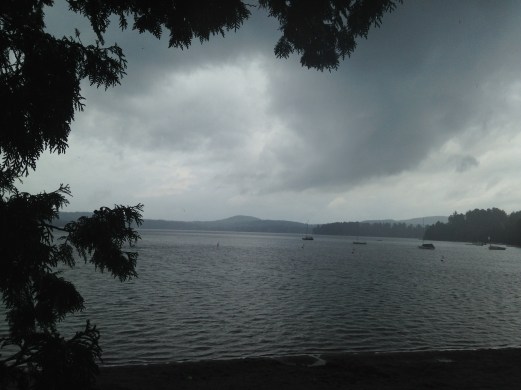
Such a grim view. Then there’s this: swimming, we could see a bank of clouds rushing across the lake today. In this humid day, with no sign of lightening, only the rain rushing in and rushing out, the girls kept swimming in the downpour, just the two of them in all that cool water. Voyeur that I may be – beneath a cedar tree in a shower storm – I hope to catch a more joyous slice of human life.

IMG_2076

Greensboro, Vermont

The Stars

I first fell in love not with Vermont’s pastoral landscape but its nightsky. I grew up in a New Hampshire village, so the New England terrain was intimately familiar to me, but the constellations were dimmed by the town’s lights and curtailed by roofs and wires. When I was eighteen, I moved to rural Vermont, and the first night there, I lay in bed, staring out the uncurtained window at all those stars. Uncountable. I was beyond smitten.

In America, a country of such material excess, the whole force of the culture often seems to push for more, more, more. Of course, I understand as much as anyone the mathematics of economics, of raising children and hard work and a driving need for stability; none of that necessarily excludes our human need for the stars. Shouldn’t we encourage our teenagers to envision their adult lives as productive within the real context of earth beneath the soles of your feet, stars arced over your head?

Early August in northern Vermont: the children are tanned and healthy, the asparagus has shot taller than any 11-year-old, our pockets sag with lake pebbles, and the cucumbers are crisp and profuse on the vine. That’s something.

On the white poppy,
a butterfly’s torn wing
is a keepsake

– Matsuo Basho


FullSizeRender