Worms for the Body, Philosophy for the Soul.

A little light rain falls as I pull a few weeds from the Sweet William in my garden. I planted these flowers when I moved here, putting my shovel into this terrain, vying for flowers and vegetables versus lawn. At the moment, the flowers flourish. I’m thinking a little about a writers roundtable I participated in the morning before, how I urged writers to remember that cause and effect drive the world we live in. All the pretty and noble thoughts we have about ourselves are only illusions. Character lies in our actions, for good or ill, whether we chose to see this or not.

On this Father’s Day, I remember those conversations my siblings and I had with my father at our kitchen table, so many decades ago. This sense of the world comes from the Aristotle he had us read. It’s a lesson that I’ve been hammering out, over and over and over in my life, through garden (what truer way to learn cause and effect), through writing and childrearing, through work, divorce, friendship.

On my deck, the robins’ nest has open-beaked fledglings, tufted and mewling. All day, the parents fly in and out, worms draping from their beaks, feeding their young, this great Herculean parenting endeavor. My cat Acer lies on a kitchen chair, staring through the glass door, mesmerized. The robins, in their robin way, have taken a chance nesting just above my door. Will this pan out? Will the young survive?

Wendell Berry wrote that “Parenthood is not exact science.” Nor, by any means, is bird or human life. My father gave his three children worms and philosophy. He taught us to love bread for the body, wine for the soul.

Where We Are.

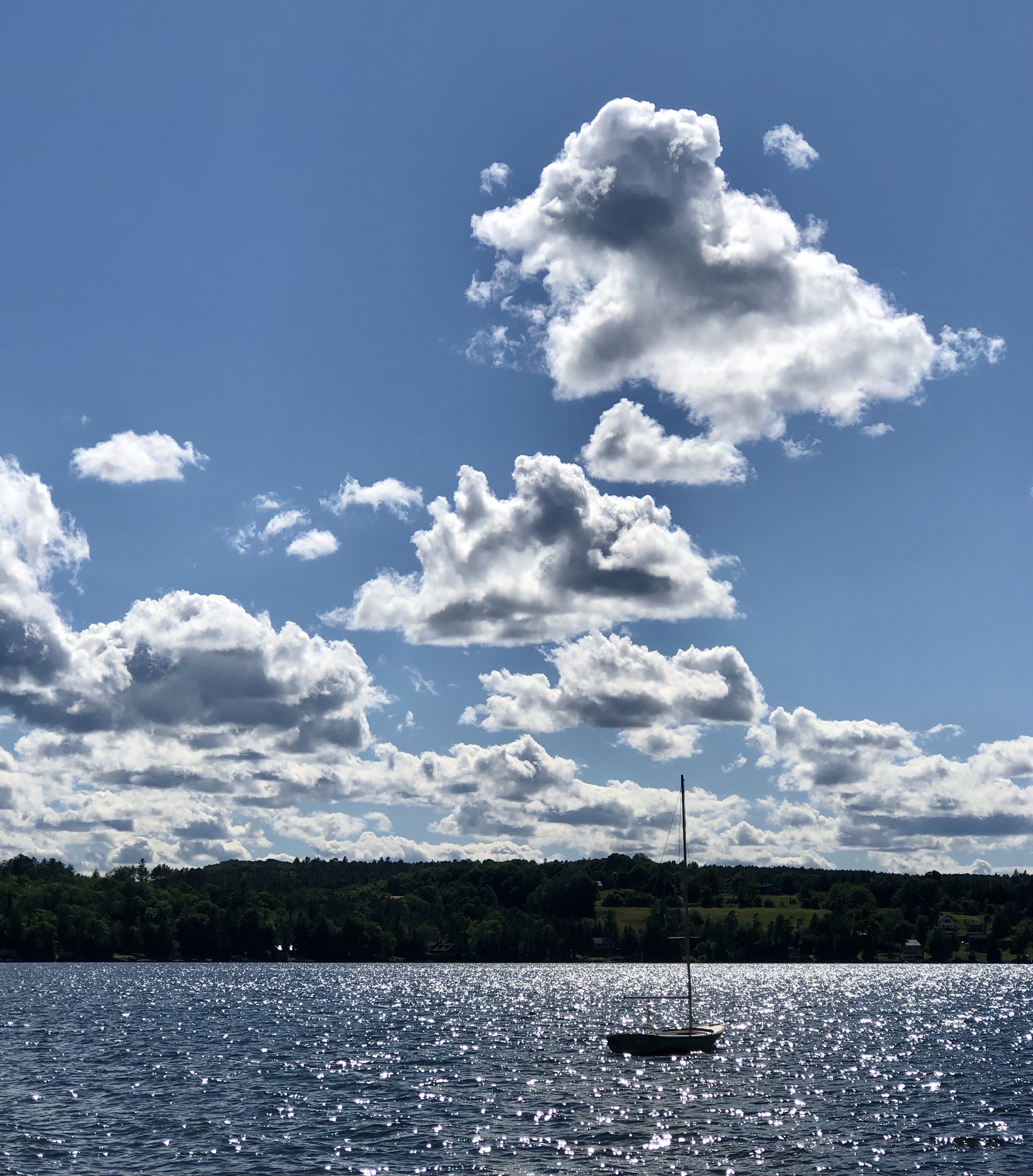
Mackville Pond, Vermont

My daughter and I drive around in the evenings. It’s a teen/parent compromise I suppose — a walk in the town forest where I gush over blooming trout lilies and spring beauties and trilliums as if ephemerals have never done this amazing show before. My daughter is cool and tough, utterly on that rugged cusp of childhood and womanhood. It makes my heart ache. It makes my heart swell.

We drive around in what might appear to anyone else as aimless nothingness, checking out geese and listening to the peepers. In our driveway again, I slip off my sandals and lean back in the carseat. Goddamn, I could sleep in her car, that the slip of moon would rise over us, and then we’d just begin again in the morning. Maybe we’d drive to Nebraska. Maybe to her high school. Maybe we’d just keep sitting here, talking, or not.

Meanwhile — spring goes on. Leaves unfurl.

My wrists and eyes and heart are baggy with wrinkles. That is how old I am. Meanwhile, I keep thinking of a line about doubt by Søren Kierkegaard. As a young woman, I thought this doubt thing was for the weak and the foolish. I believed in striking out, holding firm, sucking up the consequences of my actions. Now, it’s a koan that keeps rattling around in my late night, my early morning, my stray driving thoughts: “Doubt is conquered by faith….” I think, take heart from from that. Then, when I look up the line, I realize I’d forgotten the second half: “… just as it is faith which has brought doubt into the world.”

I think, Go listen to the peepers again.

Face From the Past

Every bird around us is singing this morning. The garden luxuriates in a clinging dew.

Unexpectedly, a woman I worked with for a number of years texts me with news she’s in town for a few days. We had last in early March, just before our world shut down.

We take a walk through the town forest and catch up on kids and work. Then, for a few minutes we stand in the parking lot, and our conversation branches a different way.

She asks about when my daughter and I were quarantining after my daughter contracted Covid. In those long days, waiting to see whether I (who wasn’t yet vaccinated) would contract Covid, too, I painted the window trim in our front porches, a blue light blue color called Innocence. While painting, I listened to hours of Derek Chauvin’s homicide trial.

So much of our lives, I muse, is simply circumstance — we’re white women, living in Vermont, with particular backgrounds and education. How much of our lives do we choose, and how smartly do we make decisions of what we do choose? It’s a question that’s been asked myriad ways in the past year, in innumerable ways.

Driving home, I keep wondering, what do we do with this now?

Walking Home

Aren’t we all thinking about this Covid anniversary? A year into the pandemic?

Time’s such a tricky thing. I’ve lived through moments that seemed like an eternity — such as the terrible experience when my baby had an allergic reaction and ceased breathing. Those were endless moments before she gasped again, her tiny chest taking in air. Conversely, my second pregnancy appeared to stretch out far beyond the standard nine months….

One year into the pandemic realm, I’m at the point where I’ve accepted: Live here now.

In a conversation with someone today via Zoom, I’m asked what I’m doing in September.

September, on one hand, is not so far off. On the other hand, I’m hoping there’s a lot of living between here and there. (Plus, I can hardly envision what I’m doing next month.)

This makes me think of my younger, more hippie days, reading Ram Dass.

We’re all just walking each other home.


Inner Glimpse

Researching an article I’m writing, I read about family patterns through generations. These wintry days, I see evidence in my own family. My parents never considered booking tickets to Florida, as I never considered with my daughters. Hence, we are not a family posting social media images this break from faraway beaches or warmer climates. Money and economics are a piece of this, obviously, but I suspect there’s a wider orientation to the world here, too — which makes me inevitably wonder what it is I’m passing along to my daughters, consciously or not.

In multiple ways, that Socratic phrase — Know thyself — has resurfaced in unexpected places all through my life. Recently, I spoke with a woman about her birth doula. When I hung up the phone and finished a few notes, I stared out my window at a light snow drifting down through the adjacent town cemetery, sparkling in a bit of sunshine that had pushed through overhead clouds. Know thyself was essentially the doula’s advice, an impossible, nearly koan-esque puzzle. How interesting, I thought….

One day he told me that he’d spent his adulthood trying to let go of his past, and he remarked how ironic it was that he had to get closer to it in order to let it go.

Bessel A. van der Kolk, The Body Keeps the Score

IMG_7257

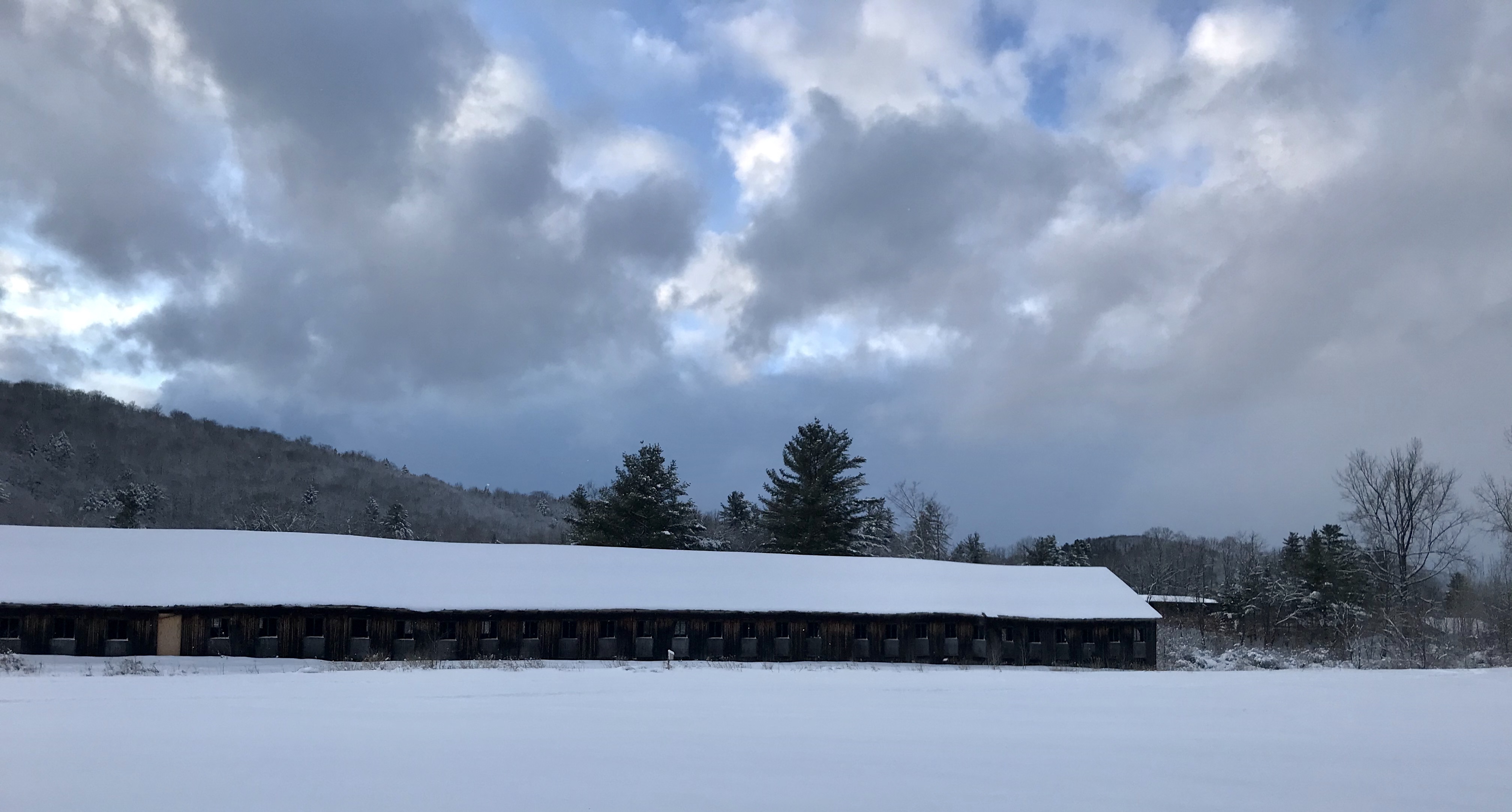
Granite cutting shed, Hardwick, Vermont


Poetry, Philosophy, Piles of Snow

Snow falls all night.

In the darkness, I lie awake thinking about a line from Karl Marx; “Men make their own history, but they do not make it as they please; they do not make it under self-selected circumstances.” The line figures predominantly in the book I’m writing — the initial draft nearly finished. More than that, the line is one of the main questions of my life.

In our dark house, the cat and I stand at the back glass door, watching the snow drift down in the cone of the porch light. Upstairs, one daughter reads, the other sleeps. For a little while, the cat and I read on the couch. Just before I turn off the light and head back upstairs, I glance at the pile of index cards penned neatly in my younger daughter’s hand. For school, she has to choose a poem, memorize it, and recite it aloud. I lift the top card and read, Two roads diverged in a yellow wood….

IMG_7067