At 86.

I grew up in a family nearly devoid of grown men. No grandfathers, no uncles save one uncle by marriage I met once in California and never saw again. Like any kid, how I grew up seemed just the way of the world.

Every summer, we saw my grandmother and wacky and wonderful aunts and female cousins. In those weeks, the ordinary rules were suspended. We kids lived in our realm, quite happily, while the adults did their endless talking and laughing. In all this, my father headed our rambling crew, whether we were swimming in Maine’s icy Atlantic or visiting a Shaker village. My father taught his three kids to love E. B. White and Shakespeare, to fly a kite and cross country ski. The original YouTuber before YouTube was a thing, my father is a lifelong library aficionado. He taught himself — and so taught us — to paint a house and repair a leaking washing machine, to write a clear sentence, play Hearts, understand mathematics is exquisite, and lean into the happiness of lying on your back under the summer constellations. The list is eternal: use a sharp pencil to solve algebra; chop garlic fine; Plato is sublime; be polite to cashiers; work hard; pay your bills; hike.

If you couldn’t figure out an answer, keep thinking. My god, that’s useful.

I inherited his nose and his utterly irreverent sense of humor. He never indulged his children in the illusion that the world is easy or kind. The summer I was ten, we drove from New Hampshire to Wyoming to Colorado to New Mexico, living out of our green Comanche Jeep and careening back into New England two days before school started. By that time, my sister and I had read his copy of Huck Finn at least twice over and thoroughly kicked around Huck’s aversion to civilization. 86 today, my father is still modeling Thoreau’s behavior of sucking the life’s marrow, grit and all, while savoring espresso.

Sundays too my father got up early
and put his clothes on in the blueblack cold,
then with cracked hands that ached
from labor in the weekday weather made
banked fires blaze. No one ever thanked him.

I’d wake and hear the cold splintering, breaking.
When the rooms were warm, he’d call,
and slowly I would rise and dress,
fearing the chronic angers of that house,

Speaking indifferently to him,
who had driven out the cold
and polished my good shoes as well.
What did I know, what did I know
of love’s austere and lonely offices?

— Robert Hayden, “Those Winter Sundays”

Snowy Days.

Socked in by snow, I wander through the neighborhood where kids are usually outside. Two boys ride along the unplowed street, the back wheel of one bike just a metal rim, no rubber tire. The wheel leaves a trench behind the boy. The boys are talking seriously, their words muffled by snowfall. Down the hill, a little boy, maybe five or so, stands in his too-big snowsuit, mouth open to catch falling snowflakes. The moment feels intimate, as if I were staring through a window. I pick up my pace a little and keep on.

“One winter morning Peter woke up and looked out the window. Snow had fallen during the night. It covered everything as far as he could see.” 

— Ezra Jack Keats

November Is, What November Is.

By chance, I meet a woman who was a teacher in a nursery school my daughter attended. She’s partnered now and has a child of her own. We exchange a few words, back and forth about little things, facts and details, while waiting for coffee. As with all of us, she’s older now although fixed in my memory as that very young woman who adored my daughter and said she would gladly keep her. In this few minutes, I have no sense of which way her life has unfolded. It’s none of my business really but here I am, wondering, nosy as all get-out as my daughters claim. Her child isn’t with her, and I wonder about the child, too. Back in those days, I believed in simple formulas for happiness (2 parents plus 1 home equals happiness). As with so much else in my life, I’ve rethought all that.

…. Balmy November. In the evening, I walk in the dark, cutting down through the wild patch behind our house and around the school ballfield. The three-quarters moon rises, more luminescent than any earthly thing. The neighbors are fighting. A door slams, and then the late autumn silence wraps around. November moves on, doing what it will.

…. Last, I discovered Anderson Cooper’s podcast “All There Is” through The New Yorker. For Stephen Colbert fans, I particularly recommend the interview about how grief shaped this man’s life.

“Grief is its own thing. It’s not like it’s in me and I’m going to deal with it. It’s a thing, and you have to be okay with its presence. If you try to ignore it, it will be like a wolf at your door.”

— Stephen Colbert

Washing Up.

Greensboro, Vermont

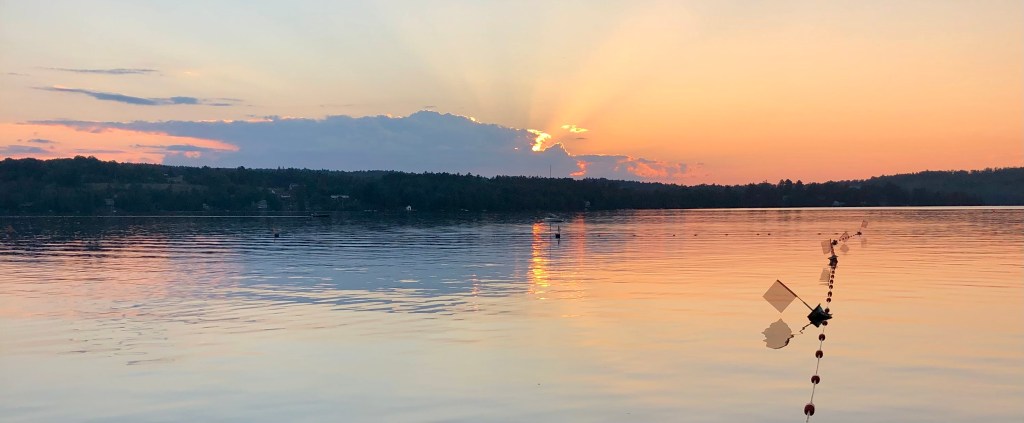
Late Friday afternoon, I swing by work for a few things and bring a friend. The day has cooled, and the evening is perfect in an August storybook way. Afterward, we stop by the beach where a few families are lingering with kids. The parents are clearly ready to head home. The children reluctantly leave the warm lake.

My friend and I sit on enormous pieces of donated granite that function as benches, admiring the spill of sunset over the serene lake, when an acquaintance drives up. He’s there for his daily swim. We kick around a few random exchanges, and somehow the conversation bends around to money. He tells us that his brother was a golf caddy in high school. Every night, he washed his tips in the sink and then ironed the bills.

We laugh and then swim. But later, driving home, I think about the teenage boy, decades ago, scrubbing up his tips, making them new. What was he thinking? And where did that take him?

Home again, the crickets sing mightily around my house. A moon hangs in the sky, and the constellations emerge. All that shadowy summer night, so much infinity.

A few lines from Brad Kessler’s novel North:

The Noonday Demon was invented at the monastery. You had to plumb the depths to reach the heights… Depression [at the monastery] is impossible to avoid; it’s where God enters — through the wound.

— Brad Kessler

Travels and Home Again.

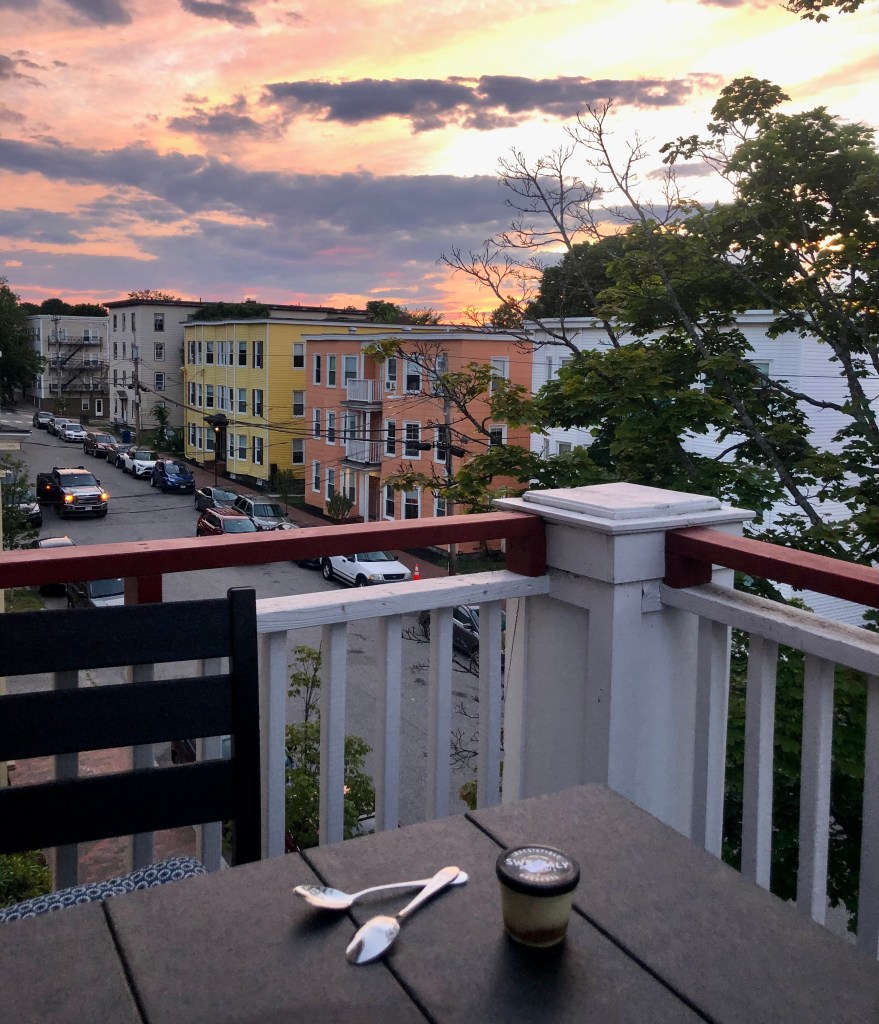
Portland, Maine

In the bit of time my brother and I drove through Portland recently, we talked about a few things — where to find a good cup of coffee and that my family grew up in the pandemic. Like that — and somehow, not like that. The next morning, with real regret, I sweep up the few things we’ve left around the apartment I’ve rented for a few days, gathering cherries from the refrigerator and sandy towels from the entryway.

At home later that evening, I wander through my garden. The hydrangeas and blueberry bushes I planted five years ago have now begun to thrive — or some of them. With my fingers, I slip off Japanese beetles.

July in Vermont is the season of utter growth, the one shot to rocket forward to the sun. Each day dawns with possibility — swim or don’t swim. Work long hours with an aim of working less on sunnier days. This is summer’s calculus. Slow down, slow down.

“To me, poetry is somebody standing up, so to speak, and saying, with as little concealment as possible, what it is for him or her to be on earth at this moment.” 

— Galway Kinnell

Nameless Places.

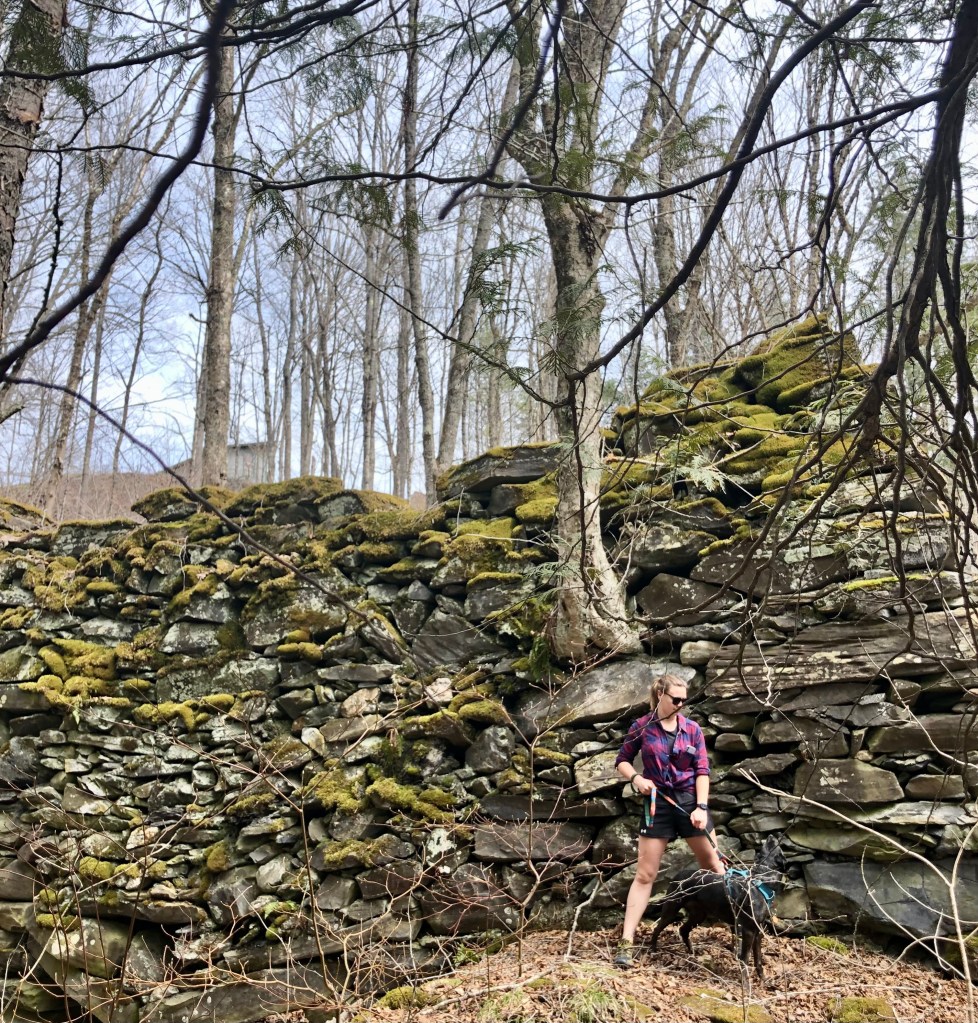
My daughter discovered the foundation of an old mill near where she lives, a fieldstone structure built beside a rushing stream. A grist mill I speculate.

Sunday afternoon, and the day has warmed. The bugs haven’t risen yet. The spring ephemerals haven’t unfolded from the forest floor.

With one daughter grown, my youngest nearly so, my own parents well along in old age, I think about the things I wish I’d done as a parent. I wish we’d traveled more, seen the northern lights, gone to concerts. I wish my daughters’ father had stuck around. That trite phrase — glass half-empty or half-full — comes to mind. But maybe a truer comparison is this foundation, this well-crafted structure that has now morphed into a wilderness home, where birch trees set seeds and grew in improbable places.

We keep walking, and she shows me a small swamp in a hollow far off the road. The peepers are singing. The mud beneath my boots is black and rich. Water runs through it.