Sisters

This morning when my older daughter left with friends, the younger sister watched her drive away as sadly as if the sun and all its life had departed, leaving only me, a distant and chilly star. The younger child’s first word was “Ma” – not a Ma for mama, but for her sister, Molly. Molly’s first word was mama and only mama, but her younger sister began with Molly and has pretty much defined her world from the sun of her sister. As the Inuit may have a 100 words for snow, the child had a multitude of variations of her sister’s name.

Hence, me – her mother – the distant star, or maybe at least the moon sailing by.

As the younger child added words to her repertoire, her words had a curious -y at the endlike coldy. Gradually, I began to realize Molly so deeply suffused this child’s world that even her emerging language evolved out of her primal interest in her sister. The truth is, I’m glad to hold my moon position, steady with my own unwavering gravitational pull.

Of course my girls bicker; of course they argue; of course at times they quarrel over things I find hideously unimportant like bagels; but at one thing I can count on is that they’re always watching the other’s back.

You know full well as I do the value of sisters’ affections; there is nothing like it in this world.

– Charlotte Bronte


FullSizeRender

Woodbury, Vermont

Birth

An image appears in art, over and over, of a human down a deep narrow well: trapped. What’s at the bottom? What’s at the top?

17 years ago, I had a prolonged labor with my first daughter, where, hours into it, I knew I was descending headfirst down a stone-lined chasm. In all that darkness, I saw only my outstretched hand, reaching down. At the bottom, I knew with a certainty, as clear as I have ever known anything, lay my death.

I never reached the end of that chasm that night. Instead, I met my daughter, born via emergency caesarian. When I saw her tiny, wrinkled body for the first time, held up for me in the surgeon’s bloodied gloves, her eyes were wide open, and I thought with a fierceness I have never relinquished, She’s mine.

These few lines are but a piece of her traverse into this earthly world, and my soulful journey to meeting her is as real as the glinting scalpel in the surgeon’s hand that released her from my body. So, as fiction writer, when I write of rock-lined tunnels or starless nights, I’m not fabricating stories from nothingness. The interior roads we take may be unseen to the eye but are just as vital, just as humming with mysterious life, as a newborn’s eyes.

…(my mother) was
bearing down, and then breathing from the mask, and then
bearing down, pressing me out into
the world that was not enough for her without me in it,
not the moon, the sun, Orion
cartwheeling across the dark, not
the earth, the sea--none of it
was enough, for her, without me.

–– Sharon Olds
FullSizeRender

Montpelier, Vermont

Creative Mountains

Driving to Stowe this morning, my ten-year-old daughter pointed at Mt. Mansfield and said with utter joy, I’m going up in those mountains today.

She did. With her companion and the child’s mother, they skied higher than she ever had, returning at the day’s end with cheeks sweaty red, her braids tumbled. On the way home, as she told me about her day, I realized she had made a mental map of her journey, laying winter skiing over her summer hiking.

While she skied, I sat in a sun-filled room with strangers and climbed my own mystical creative mountain, traversing the terrain of novel writing through rock and streams, dusty back roads and the variated sky bent over a village. My villagers (like the people I know) sleep and dream, wake and eat, their hearts filled with desire and lust, with unhappiness and the unrequited past, with daily pleasures, like eating salad and enchiladas with a child and listening to her story.

How I admire this child and her fearless joy, her unalloyed pleasure in sun and snow, in steep mountains, and the wind over her face. As creative adults, shouldn’t we aim for that confidence in hard places, that dusting away of doubt that so frequently plagues us?

More to the heart, perhaps, like a child, we should savor unfettered happiness in our hours.

And then, of course, the novel-writing itself affects the novelist, because novel-writing is a transformative act.

Jane Smiley, 13 Ways of Looking at the Novel

IMG_4372

Photo by Molly S./Woodbury, Vermont

The Better Part of a Day…Kid Land

Driving to pick up my daughter at basketball practice today, I kept thinking about David Lipsky’s book about David Foster Wallace, and Infinite Jest, which I can’t wait to read. Am I nuts? When am I going to fit in a 1,000-page plus novel? And yet, David Foster Wallace is now my current favorite three-word combination.

At school,  pleasant and convivial as my fellow parents may be, the finer part of a day is not talk about how legislation winds down all the way into our kindergarten classes. So much of this adult world is talk, talk, while the deeper issues that lie in our lives are often poverty – material and spiritual.

After basketball practice, the girls discovered hidden doors under the stage and crawled deep into the dark underbelly of their school. I crouched before the open little door and listened to their voices, young and female, problem-solving, figuring out the lay of their land, navigating obstacles. This, I thought, is what the adult world needs: a way to the look at the familiar world and find a hidden door, to look at our own world in ways we’d never imagined, from deep down in its guts, to see what holds us together.

There are these two young fish swimming along and they happen to meet an older fish swimming the other way, who nods at them and says “Morning, boys. How’s the water?” And the two young fish swim on for a bit, and then eventually one of them looks over at the other and goes “What the hell is water?

David Foster Wallace

FullSizeRender

Hardwick, Vermont

Gnomon

When I was in high school, my father, sister, and I read Joyce’s short story, “The Sisters.” I was thinking of that story again today, in this kind of chilly and drab weather that intimates how I imagine Ireland. The opening paragraph is one of my most favorite in all literature. In the story’s opening lines are three words – paralysis, gnomon, simony – that are keys to understanding the story.

With my daughters today, we were talking about family, and patterns of behavior, and I began to wonder myself, What are the keys to understanding each of us? For one of my daughters, at the age of three, I would have used tricycle and rabbit as her own particular talisman; for my other child, the word sister.

We use language so easily, so freely, that we’re often careless with its power, misunderstanding and underestimating its capability, both for destruction and redemption – or as a key to see into deeper recesses of our inner lives.

THERE was no hope for him this time: it was the third stroke. Night after night I had passed the house (it was vacation time) and studied the lighted square of window: and night after night I had found it lighted in the same way, faintly and evenly. If he was dead, I thought, I would see the reflection of candles on the darkened blind for I knew that two candles must be set at the head of a corpse. He had often said to me: “I am not long for this world,” and I had thought his words idle. Now I knew they were true. Every night as I gazed up at the window I said softly to myself the word paralysis. It had always sounded strangely in my ears, like the word gnomon in the Euclid and the word simony in the Catechism. But now it sounded to me like the name of some maleficent and sinful being. It filled me with fear, and yet I longed to be nearer to it and to look upon its deadly work.

– James Joyce

IMG_9725

Photo by Molly S./North Bennington, Vermont


Fire & Ice

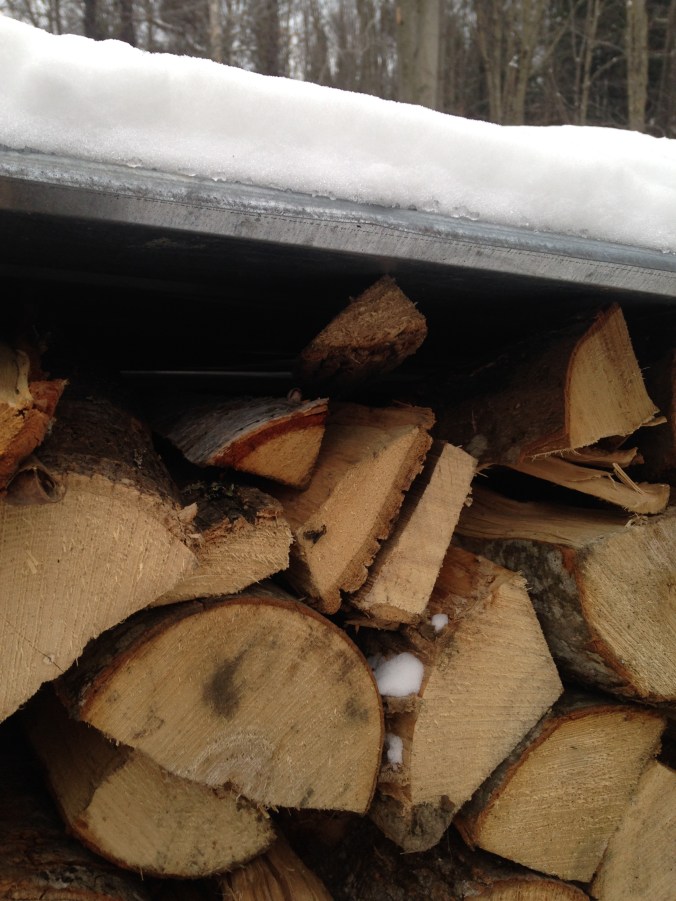
A few inches of loose snow cover the snow all around our house. Beneath this lies rock-hard ice. Maybe someday I’ll live again in a world of shoveled sidewalks, but for now, our footing changes all through the winter and even well into the spring, when mud begins its 10,000 variations. I carried out this morning’s ashes and made a trail to that essential woodpile. A gray dusting of ashes covered a bucket of gleaming coals that hissed, burning down through the ice and snow.

Fire and ice. Why I love Vermont could fill many pages, or simply these three words. The contents of my hearth lie cast out on the frozen ground, dying, while jays cull my compost pile. The girls replenish our woodbox, readying for another night.


Life is, in its very essence and character, a terrible mystery—this whole business of living by killing and eating. But it is a childish attitude to say no to life with all its pain, to say that this is something that should not have been.

– Joseph Campbell

IMG_0558

January, Vermont, 2016