Maize v. Corn

When I was ten, my family and I camped one summer all the way from New Hampshire to Wyoming to Mexico. One of the places we visited was Mesa Verde, in Colorado. In the visitors’ center, we saw an ancient urn found in a cave (as I remember), filled with corn seed. The archeologists planted some of the precious seed; the kernels germinated. The seedlings grew and thrived.

A few summers ago, I returned to Mesa Verde as a grown woman with my family, and that urn was still there, in that same visitors’ center. For a few days, we stayed with friends, who took us to one of the many once-upon-a-time villages, which had been excavated and filled back in, and now seemed traversed mainly by wildlife. We walked among the remains of walls and abode houses, theorizing where these families might have planted crops, how they harbored water, what kind of lives they might have lived.

Water and maize: clearly the narrative of life for these people: material and undoubtedly spiritual, too. As I begin planting seeds again this season, I can’t help but think of that ancient clay vessel, so reverently crafted and painted, its dear contents preserved. And, 21st woman that I am, I can’t help but remark what a far distance those precious seeds have travelled to the industrial giant of King Corn.

This is the yin and yang of the earth, an energetic feedback. What happens below relates directly to what is happening on the surface and in the atmosphere and vice versa. Tectonics does not end at the ground beneath your feet. It is a dynamic system from the earth’s interior all the way into the sky and back.

–– Craig Childs
FullSizeRender

Koyaanisqatsi: Unbalanced Life

Not long ago, one of my daughter’s friends remarked that everyone desires the warm feeling of home. And yet, why is it so darned hard to keep the home in balance? The stuff of literature is family, never wholly at ease, always shifting and turning, brimming with hunger and unmet desire…. the stuff of life: this material I write about; this very matter I live.

This winter, even a mouse came to die beneath my wood stove, spreading out its little furry body, relinquishing fear of us in its desire to expire on the hearth. The snow is all gone but the hard ugly leavings of dirtied lumps. Vermont in March should be heavy winter, sun bright over fresh snow, and we should be skiing in t-shirts, sunburning. The wind has been blowing every night, bringing neither spring nor storm. It’s off, all of it, this winter that never was.

Long after dinner tonight, the girls and I sat at the table, talking, myself knitting, pulling together through language. They tell me, this happened today, and we did that, while I’m thinking of those sunny faces of coltsfoot, the deep yellow blossoms that push up through the rockiest and poorest of soils. When will they return? I rely on language and story, yes, to bind us together, and my other old stand-by – resilience – thinking…

Surely some revelation is at hand…

– Yeats

FullSizeRender.jpg

March, Vermont

Maple, Maternal

The granite foundation of a barn I never saw standing once spread across a field not far from our house. The barn burned before I lived on West Woodbury Road, and a number of years ago, the property changed hands. The new owners grazed cows in that field, and someone removed all the old granite blocks. Now, a young Menonnite couple and their two small boys live there. Last spring, they tilled an enormous garden and planted a huge strawberry patch. Those plants should produce this summer.

Over years, my growing daughters and I watched this field change. One summer afternoon, as we sat on the lawn of the long-abandoned farmhouse,  I noticed the electrical line stopped at the barn. I’d heard rumored the bachelor who last lived in the farmhouse had no electricity, but I’d never noticed that rural electrification must have brought juice right up to the barn and then stopped. The house was across the road. From when it was built until it was pulled down, electric lights never lit its rooms.

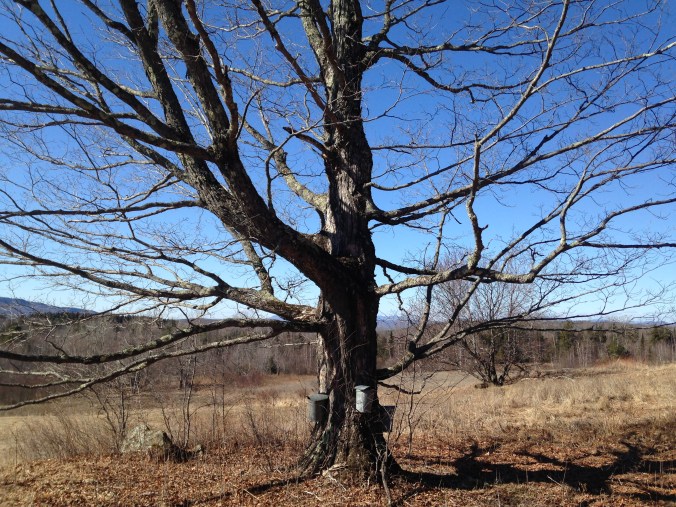
This spring, the young couple with their two merry-eyed boys tapped maples all along the road. Last summer, we saw them – father, mother in her skirts, boys in the bike seats – pedaling along the road in the well-lit evenings. May the sap flow generously for these kind people, from the trunks of these long-enduring, wide-reaching beauties. Today, I lay on the cold ground, staring up at that infinitely blue, March sky, world without end.

Whoever you are, go out into the evening,
leaving your room, of which you know every bit;
your house is the last before the infinite,
whoever you are.

– Rainer Maria Rilke

IMG_0875.JPG

West Woodbury, Vermont

How To Write a Story….

Any writer knows a story can be told a myriad of ways. Today, visiting a school that once hovered near the brink of disintegration, I realized that school’s story could once have been told in numbers that reflected too much poverty, too little resources and not enough skills: too little – and too little again, and again, and maddeningly again – all the way around.

Instead, this is now a story of growing gardens and colorful classes – and thriving children. Who decides when a story needs to be rewritten? For a school? Or for yourself?

I remember Mary Oliver’s line posing the question about what to do with your one wild and precious life. Create at least one or two fine things, I thought. Leave one or two marks for better, and not for worse.

Sometimes I go about pitying myself, and all the while I am being carried across the sky by beautiful clouds.

– Ojibway proverb

FullSizeRender.jpg

Hardwick, Vermont

Spring Fever

Since the time change, my ten-year-old daughter cannot sleep. At 10:30 last night, she peered from her bunk bed, cheshire cat-like in the dim room, insisting she couldn’t sleep because she was excited. But I don’t know what I’m excited about!

I reached up and held her slim, warm fingers. It’s spring fever, I told her.

But I don’t have a fever….

All day long, as much as possible, she’s outside, poking a stick in running streams, painting her fort beneath the pine trees, biking up and down with road with her friend. The two of them run into the kitchen, breathlessly excited about spying on her father and his friend in the sugarhouse. Their stories spill out about biking through icy puddles and finding turkey tracks along the road. Beneath our boots, more of the earth reappears in its muddy glory every day, shaking off winter. Spring!

….And does it not seem hard to you,
When all the sky is clear and blue,
And I should like so much to play,
To have to go to bed by day?
– Robert Louis Stevenson, “Bed in Summer”
IMG_1250

Molly S. Photo/Woodbury, Vermont

Trees, Rugged Earth

My brother has a stash of panoramic vista hikes in his terrain. This visit, we hiked up Jockey Cap in nearby Maine, an enormous round igneous rock practically in the town of Fryeburg.

At the top, we saw extensive Lovewell Pond, the substantial White Mountains to the west, and the flats of Maine where the land begins to stretch to the sea. The sole snowy peak, in this end of February, was Mt. Washington. From that height, in this too-warm winter, the earth appeared dull brown, even the blues of the mountains washed out under the brilliantly clear sky. Down below, we saw a conical pile of road maintenance sand, a Dollar General, a series of strip malls, traffic inching along the highways: not the earth in her shining majesty and glory, but hard-worn, patient, enduring.

At the crest, a pine tree no taller than myself grew stubbornly from the rock. My daughter and I knelt near its roots, our bare fingers over the hard curled wood searching for traces of soil. None. And yet this tree ruggedly remains, flourishing, seemingly against all odds.

SEEKING REST

Late night, dark night,
the house hums around me.
… High wind
swirls the stars around me.

Closed and still,
I hear and say the names
that do not stay in place
when night has found me.

Everything is shifting.

– Ellen McCulloch-Lovell

FullSizeRender

Fryeburg, Maine