Sabbath Day

A breezy Sunday, full of intent talk and laughter, seedlings – onions, tomatoes, nasturtiums – sprouting by the day, leftover rainbow cake from a birthday, the neighbor boy who pogo-sticked down the muddy road.

Sunlight splashing in puddles from melting snow, brilliant as chips of broken mica.

… But once I held
a kingfisher
in my hands,
I touched its blue power.
That may be the only time
I ever do….

– Janisse Ray, “Kingfisher,” in  A House of Branches


FullSizeRender

Love Better

What makes a life? A friend of mine told me she once took stock of her life, tallying.

How to measure a life? By a house, bank accounts, grandchildren at the Thanksgiving dinner table? Or perhaps none of this. When I look at my sprawl of past and present, the one thing I think is: love better. The best and most fulfilling things I have done have been freely given. Perhaps this is why to love as a parent (while unbelievably difficult at times) is so fulfilling; any morsels of childish love passed back are pure gravy, savory sweetness.

I’ve never known love as greeting card, prettied up with pastel hearts. Love is as indomitable a force as a woman’s contractions in labor, bearing down to bring a new being into this world, or slender coltsfoot blossoms cracking apart winter’s ice. Love better: surely that would mean widening your heart in unexpected ways.

Today, in this April brown and beige world, I saw a cardinal fly into a thicket, a rare bright bird this far north. I went looking for the hidden little feathered creature. I knew it harbored in those tangled branches, its tiny heart hammering away fiercely in this cold.

And now, I have my own household of teenage girls to attend to, with their own laughing and open hearts……

Locking Yourself Out,
Then Trying to Get Back In

You simply go out and shut the door
without thinking. And when you look back
at what you’ve done
it’s too late. If this sounds
like the story of a life, okay….

I stood there for a minute in the rain.
Considering myself to be the luckiest of men.
Even though a wave of grief passed through me.
Even though I felt violently ashamed
of the injury I’d done back then.
I bashed that beautiful window.
And stepped back in.

– Raymond Carver

IMG_0969.JPG

April in Vermont

The Footprint of Where You Live

I live in a Vermont town which has very little pavement. Route 14 heads north-south right through the village’s tiny center. In the village, a small amount of pavement fronts the post office, volunteer fire station, and the currently-closed general store. The elementary school has a square in the dooryard, none in the playground or dirt parking lot. Our town is wood, field, and a great deal of water in lakes, ponds, running streams.

The schoolkids took a field trip to Barre, and I met them in the morning, standing beside their one school bus, in a sunny but cold morning, eating apples on cracked asphalt. I laughed.

If you’re a kid, does it matter that your school garden’s footprint is larger than your pavement’s print? Does it matter as adult that you have both winter boots and mud boots? That your horizon is framed by trees and not rooftops?

I tend to think, whether we notice or not, where the soles of our feet walk matters.

Instructions for living a life.
Pay attention.
Be astonished.
Tell about it.

– Mary Oliver

FullSizeRender.jpg

Burlington, Vermont

This Small, Good Moment

When I was 17, I was infatuated with James Joyce. I remember watching a documentary with a woman who knew Joyce and described the undercurrent of his life as filled with tristesse. I was learning French at the time and found that notion so romantic. What would that mean, to have tristesse in one’s life? Oh, naiveté.

As a young mother, I endeavored (oh, how hard I tried) to never let unhappiness or want cross my daughter’s life. I failed, of course, miserably and utterly predictably. Now, I’m at that place in my life where I know human life is filled with tristesse and also fear, longing, happiness, and laughter: an ever-changing sky boundless with wind and cloud, studded with arcs of rainbows, their roots eternally concealed.

Over and over, I have wondered what I could give my daughters instead, what arms might they raise against the inevitable slings and arrows of their earthly lives? At the very least, this: my own pleasure in this tangible world, in a handful of strawberries, a kite cartwheeling across the spring sky, a daughter’s haircut. In this moment, in this time together.


One of the things I know about writing is this: spend it all, shoot it, play it, lose it, all, right away, every time. Do not hoard what seems good for a later place in the book or for another book; give it, give it all, give it now. The impulse to save something good for a better place later is the signal to spend it now. Something more will arise for later, something better. These things fill from behind, from beneath, like well water. Similarly, the impulse to keep to yourself what you have learned is not only shameful, it is destructive. Anything you do not give freely and abundantly becomes lost to you. You open your safe and find ashes.

– Annie Dillard
FullSizeRender

A Need for a Nap

The other day, I sat beside a woman who was breastfeeding her baby, and I remembered just how physical were those early years, so much milk and baby holding, so much need and so much affection. Mothering growing girls remains remarkably physical, too.

Who ate all the strawberries? Braid this girl’s hair, race down to the mailbox, rule on which friend is now taller than me. Sweep dried mud from boots, bake chicken legs with sage scavenged from the garden, whisper good night.

No wonder mothering can be so exhausting. Like writing, parenthood is something we take in, our very bodies forever expanding with this dimension.

Only after the writer lets literature shape her can she perhaps shape literature. In working-class France, when an apprentice got hurt, or when he got tired, the experienced workers said, “It is the trade entering his body.” The art must enter the body too. A painter cannot use paint like glue or screws to fasten down the world. The tubes of paint are like fingers; they work only if, inside the painter, the neural pathways are wide and clear to the brain. Cell by cell, molecule by molecule, atom by atom, part of the brain changes physical shape to fit the paint.

– Annie Dillard


FullSizeRender.jpg

Hardwick, Vermont

When Traveling Through a Storm….

Here’s one good reason to read:

Captain Bligh, in his ill-fated, famous Mutiny on the Bounty story, sailed from dreary, oatmeal-eating England to Tahiti, lush land of coconuts and little clothing. He naturally headed across the Atlantic to curve around Cape Horn, situated way down at the bottom of South America. But the ship, plagued by fierce winter storms, was unable to navigate that Cape. Instead, after weeks of battling fierce weather and sailing backwards rather than making headway, Captain Bligh ordered a change in course around the Cape of Good Horn (at the southern-most tip of Africa), adding over 10,000 more miles to the Bounty‘s journey.

In the midst of the sleet, snow, and wind that eventually turned him back:

Bligh could note that blue petrels and pintados, “two beautiful kinds of bird,” followed their wake. – Caroline AlexanderThe Bounty

When to turn? When to change direction in a life?

Remember this: in the harshest, most ungodly conditions, note unexpected beauty, following your travels.

FullSizeRender

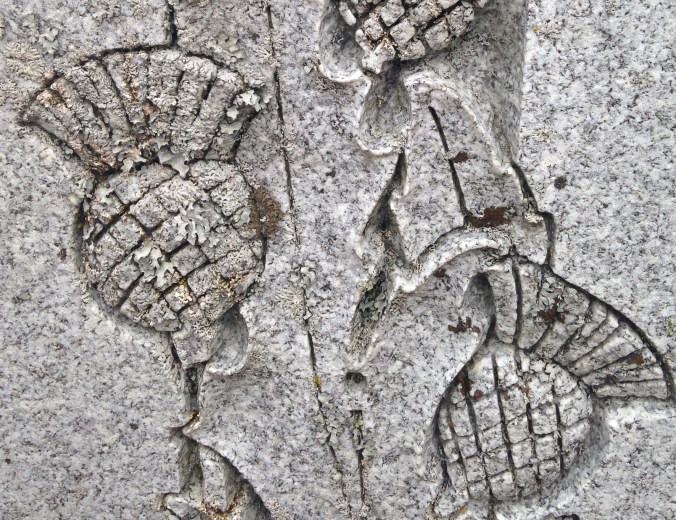
Hope Cemetery/Barre, Vermont