On Gaslighting.

Via email, my daughter’s school sends me a survey. The survey poses a question about what I desire for my student. The question is phrased in a way that reminds me of a question I was recently asked, by someone I hardly know. The question was unique; the questioner asked specifically about me and my life, and how I saw my life in the wider context of the town.

I’ve been thinking of that question since that conversation, returning to it in odd moments while opening my post office box or washing the oatmeal pot. It’s a question we might all want to be asking ourselves — not just what would improve our individual lives, but how do we understand ourselves in the landscape of where we live. Or maybe this is simply April musings, cusp of a storm that could go either way, rain or snow or perhaps simply wind, sweetened with the scent of thawing soil.

Here’s a few lines from a New Yorker article that seem contemporarily apt….

Gaslighting essentially turns its targets against themselves, she writes, by harnessing “the very same capacities through which we create lives that have meaning to us as individuals,” such as the capacities to love, to trust, to empathize with others, and to recognize the fallibility of our perceptions and beliefs. This last point has always struck me as one of gaslighting’s keenest betrayals: it takes what is essentially an ethically productive form of humility, the awareness that one might be wrong, and turns it into a liability.

Leslie Jamison

Travel in Out-of-Everyday Places.

In the quietest hours of the night, driving by the twinkling line of Santa Fe’s lights in the immense desert, a crimson half moon cupped in the firmament like a bowl full of mystery, I have the strange sense of transmogrifying into a Russian novel. Maybe in part because of the Bulgakov novel from my sister crammed in my backpack with my laptop and half-written notebook, or maybe it’s my family story unfurling simultaneously at lightspeed and also breath by labored breath.

At the Albuquerque airport, the shuttle bus holds just me and the driver who says he’s from the Chicago suburbs. He remarks that I’m shivering and wonders how that can be, as I’ve told him I’m flying back to Vermont. I’m tell him I’m just tired. Perhaps. But the illuminated city and the airport floodlights and mundane directional signs for United and Alaska Air bedazzle my 3 a.m. eyes: there’s so much of the world, so many people and stories braiding and twisting, from the sweet simplicity of a child cradling a beloved doll to an old woman gasping her way to the end of her life.

The driver asks me about the church scene in Vermont. I rattle off about white steeples in every town. Driving incredibly slowly, he launches into his story of knowing that he wanted to be a better man but kept falling into sin, and then a page in the book of his life turned. I can see this is doubtlessly headed to a pamphlet he wants to hand me. Yet, as he speaks, I wonder what that really means: Knock, and Jesus will open the door.

Later, in the terminal, drinking coffee, I sit in a space crowded with strangers, all on their meaningful journeys. My heart swells full with so many things: the robins singing in my parents’ aspen, last night’s dream of wandering through a sugarbush, forest floor sprinkled with spring beauties, the luminous crimson bowl of the moon in the infinite darkness. Nature never builds a door. Maybe those doors and windows we’re forever using as metaphors are illusions.

The driver had forgotten his bag, so the pamphlet was a no go. I take his words and tuck the sliver of his story into my writer’s mind with the hard-boiled egg I’d split down the middle and shared with a young woman yesterday morning. While we ate, she told me about her son’s heart surgery, and the surgeons who saved the boy’s life. With my fingers, I sweep the eggshells into a pile on the plate we’ve shared.

The Revenge Business.

Washing dishes this morning, I catch a little of NPR’s Morning Edition. Mandy Patinkin who starred in The Princess Bride says his famous line about avenging his father’s death. As I’m scrubbing out the coffee pot, Patinkin says the more important line is about how revenge never got anyone what they wanted. Ever.

For February, this Saturday is crazy warm. I hang the laundry outside to dry and open the windows. I finish up some work at the coffee shop and talk with a school board member from the board I quit, abruptly, last spring. A few raindrops are falling as we step outside on the sidewalk.

In the little rain, I walk home, thinking about that revenge line. Families, nations, epochs, have run on revenge. And the math always works out in its own calculation. Check out the NPR segment.

A little chaos…

I call the mechanic back about my car who says it’s all good news, a replaced muffler, and the car looks fine.

Finally. Something repaired in the chain of a dying range, a done-in washing machine, my own washed-out and piss-poor attitude.

In one of the few sunny days I’ve seen recently, I’m standing on my back porch, listening to water dripping. We talk a little about the shitstorm of this decade so far, the election roaring up in nearby New Hampshire. He mentions he doesn’t know my political leanings, and I laugh. I’ve been writing him checks for years now, and I’m certain it’s no surprise who I didn’t vote for. But he bends our conversation a little further, kicking the standard gloom-and-doom away and remarks that we might as salvage some happiness in this life.

On this rainy midwinter day, I convince my youngest to drive north to a library in search of a Claire Dederer book. Here’s a few lines from the last chapter of Monsters.

Love is anarchy. Love is chaos. We don’t love the deserving; we love flawed and imperfect human beings, in an emotional logic that belongs to an entirely different weather system than the chilly climate of reason….

The Long Night Moon.

In the year’s tail-end days, the neighbors’ children sled down their short hill, hats off, snowsuits unzipped in the warm afternoon. I wander over with a tin of sweets and chat for a bit about sledding conditions, getting the low-down on the mixture of slush and ice. The full moon rises silently, December’s Long Night Moon. Various blues layer the sky, the hues that remind me of the sea in my land-locked geography.

During the in-between pieces of holiday and work, I’m slowly savoring The Eight Mountains by Paolo Cognetti, an Italian novel about deep friendship and love of great mountains. A main character, Bruno, speaks about rebuilding a tumbled-in Alpine house: “Look, it doesn’t matter how long it takes. If you try to think too far ahead with this kind of work, it’ll drive you nuts.” Likewise: writing a book, parenting, living a life.

The neighbors’ children offer me a handful of wet snow, chock-full with dirt and last year’s sunflower seed hulls.

Solstice Dandelion.

I stopped into a candy shop in Montpelier to buy chocolate Santas for my daughters. We’ve been visiting this store since my daughters were so young I always held their hands downtown. The owner read my book, and we always talk about writing and family and Vermont small town life. Her store had reopened recently after July’s devastating flood. The rain and snowmelt in the forecast hovered around us as I filled a white paper bag with those bright foil-wrapped chocolates. As I listened, I added chocolate pastilles and more Santas, for her or my daughters or me, for the giving or taking, or maybe both.

This week’s rain likely spared this sweet shop, but towns around us were flooded again. In the town where I work, sections of roads carefully repaired after July’s flood broke again.

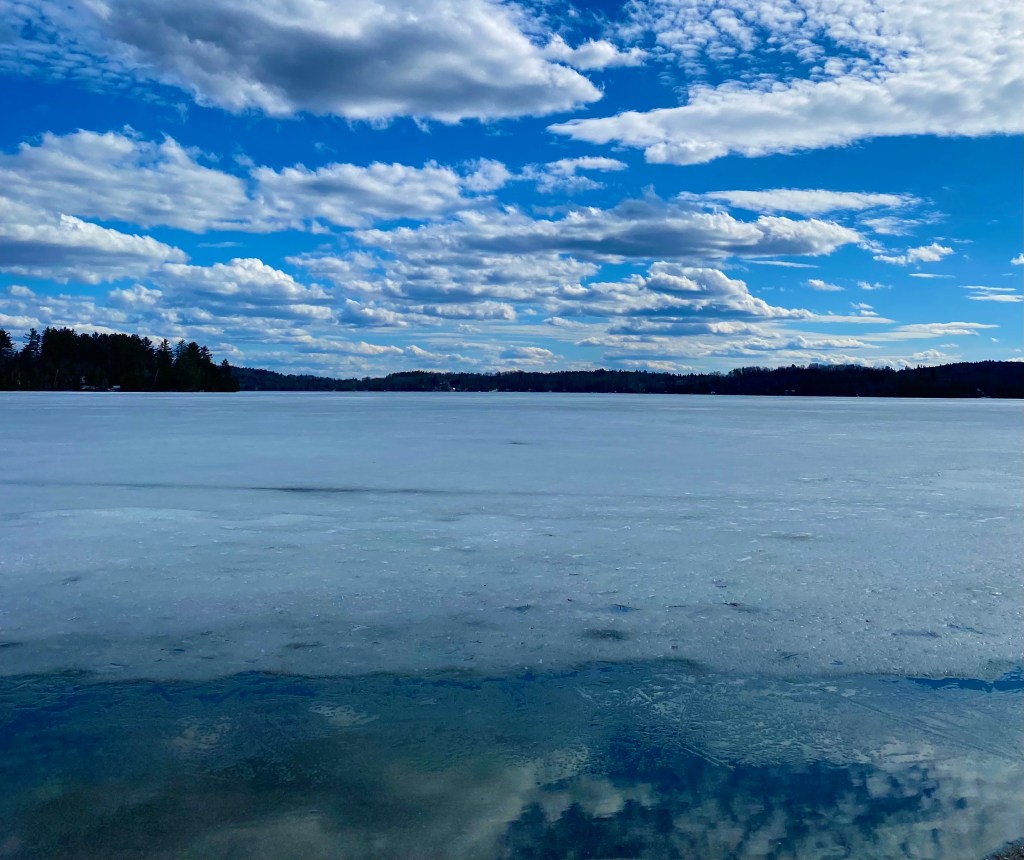
Yesterday, I spied a folded dandelion blossom in the town green. I squatted down and stared, not touching this brilliant gold in its emerald set. Overhead, those bunching clouds. A balmy breeze stirring over the lake that by day’s end will whet a bitter cold.

Solstice: hallelujah on this spinning planet.

Less and less surprises us as odd.

— Tracy K. Smith