Auditory Postcard from Vermont

Last night, hot from bike riding with my daughter and watering transplants in the garden, I madly put the screens in the upstairs windows. We slept with the glass opened all night, and this early morning is cool and lovely, a symphony of songbirds serenading my children in their dreams.

When I was a teenager, my cousin from New York City visited us in the summer and remarked every morning that the birds woke him with their singing. Turbo birds, he called them. These mornings, I sometimes remember the three enormous sugar maples that graced my childhood lawn, prime songbird habitat. As a child, I thought it amusing that someone would comment on songbirds. Really? You might as well comment on drinking water.

Like anywhere, Vermont has drawbacks: I’ve seen mercury at 42 below zero fahrenheight, the public libraries are too tiny, rural living can be darn lonely, and my ears are swollen with bug bites. But here’s just one ineffable joy: birdsong.

“A Minor Bird”

I have wished a bird would fly away,
And not sing by my house all day;

Have clapped my hands at him from the door
When it seemed as if I could bear no more.

The fault must partly have been in me.
The bird was not to blame for his key.

And of course there must be something wrong
In wanting to silence any song.

Robert Frost
FullSizeRender

West Woodbury, May evening


In my weekly commute to Burlington, some mornings I hit traffic, and some mornings I don’t. Today, waiting in a long line, I listened to Garrison Keillor read poetry.

“Despair” by Billy Collins

So much gloom and doubt in our poetry—
flowers wilting on the table,
the self regarding itself in a watery mirror….

Today, with the sun blazing in the trees,
my thoughts turn to the great
tenth-century celebrator of experience,

Wa-Hoo, whose delight in the smallest things
could hardly be restrained…..

Sitting alone in my little Toyota, I laughed out loud.

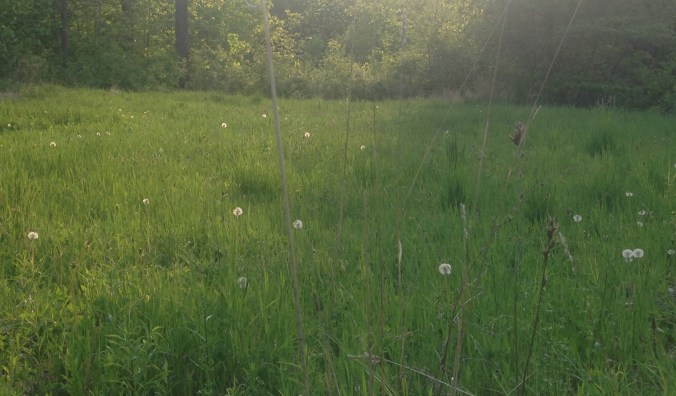
It’s the fragrant apple blossom season in Vermont. Dandelions are rampantly blooming. My teenager daughter texts me at work of her misery, the stark unfairness of the world. Of course, I text back, but go for a run. The ten-year-old skips on our evening walk. I’m just so happy, and I don’t know why.

How many decades has it taken me to relearn what I knew when I was ten? And to laugh about it? The black flies are out and biting fiercely, but the sparrows are singing mightily.

FullSizeRender.jpg

Unwinding the Rope of Writing

Not long ago, I was at the county courthouse in Barre, Vermont, waiting for the final hearing of my divorce. That courthouse contains the ebb of human life, chock-full of misery and grief, and every time I’ve entered that immense building I’ve witnessed adult women and men crying. I stood alone in a large room whose windows looked into a courtyard where trees were in bloom, and the sunlight shone bright and full of promise. What I was thinking about was a terrible illness in a family member, and how mortality’s knife lies in all of us. Dormant or not, at any moment that knife might turn and slash fatally.

Standing there, I vowed not to let my particular cup of sorrow raise so high that I couldn’t see beyond the vessel of my own brew. Lose a husband, a family life, an occupation, beloved friends: but lose my soul to bitterness, too?

Thoreau’s desire to live as fully as possible, to suck out life’s marrow, to know it as fully as possible is yet my own, despite the bile I naively never expected. Deep in the unlit realms of faith, I know writing is a rope out of that courthouse’s sludge, that art – and making art, like living a human life – holds the potential to burn our hearts in its kiln and emerge with deeper compassion. The sun rose and set on that day in my life, as it’s risen and set for centuries. Even when I was in the windowless courtroom, working through legal litany, I knew the sun would shine in the courtyard when I emerged.

If you stand right fronting and face to face to a fact, you will see the sun glimmer on both its surfaces, as if it were a cimeter, and feel its sweet edge dividing you through the heart and marrow, and so you will happily conclude your mortal career. Be it life or death, we crave only reality. If we are really dying, let us hear the rattle in our throats and feel cold in the extremities; if we are alive, let us go about our business.

Henry David Thoreau, Walden, or Life in the Woods

FullSizeRender.jpg

Crawford Notch, New Hampshire

The Earth Curves, of course

After a day of downtown Portland’s busy scene – art and wharf and walking, and my brother crashed a bachelorette party while my daughters ate gelato, and my older daughter bought the younger a miniature ship in a bottle – we drove over a drawbridge in search of the wide open ocean.

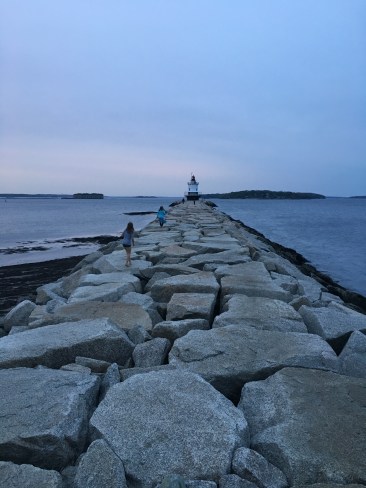
At the beach, we left our shoes by the car and spread out, one daughter gathering shells and sea glass, the other carrying her camera. Away from the city’s hurdy-gurdy, the ocean  – sky, sand, stone, gull, the steady and infinitely changing waves – churned, at once noisy and calming, a place we had never been and yet was familiar, expansively glorious.

We leapt over enormous chunks of pink granite to an old lighthouse while the sun tugged the daylight over the horizon. Afterwards, all of us laughing while I drove through the dark, I told the children we would stop in Pierre, South Dakota, for gas. With our three drivers, we’d switch off until we hit the north California coast. Even when we returned to my brother’s New Hampshire house, late, the little girl tired and nearly asleep, we were still laughing, the world wide-open and full of possibilities, as if my little car with its two bright headlights could trek all around the the globe and ferry us back to home.

…where we choose to be–we have the power to determine that in our lives. We cannot reel time backward or forward, but we can take ourselves to the place that defines our being.

Sena Jeter Naslund, Ahab’s Wife, or The Star-Gazer

IMG_3134

Cape Elizabeth, Maine/Photo by Molly S.


Now, Stop & Admire the Scenery, for a Change

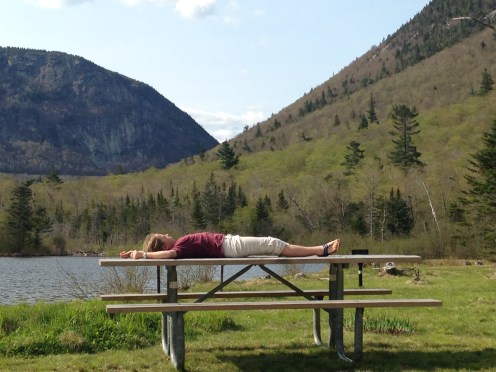
Yesterday, my daughters and I drove from Vermont and crossed over the White Mountains,  in a route I love and have travelled for years. This time, though, with a daughter’s friend, we stopped at a place in the mountains I’ve always rushed by, at fifty or sixty miles per hour. The point is near enough to the end (or, backtracking, to the beginning) of the trip that I’ve never wanted to pause.

In a meadow along the Sacco River, with enormous granite mountains steeply rising on either side, the area was exquisitely beautiful. The river flowed clear, clumps of bluets bloomed in the emerald grass, and the mountains held us like a pair of immense hands. In the bitter depths of winter, hail, snow, fiercely unrelenting winds pummel these slopes, but  this spring May afternoon, I remembered my childhood infatuation with Johanna Spyri’s little orphan Heidi.

As a mother, years later, when I read the book to my first daughter, I was appalled I had missed the heavy-handed Christian urging in this novel; this book was radically different from the book I had read over and over as a ten or eleven-year-old child. But was the book really different? What sang to me in the story was an orphaned child who loved her grandfather, a bed of fresh hay, the shimmering constellations, toasted cheese sandwiches and mountain meadows of wildflowers. Through her life’s circumstances, she experiences loneliness, cruelty, abject misery, and yet love of the mountains draws her beyond her own particular unhappiness: love of beauty and the inherent goodness in people is the staff of her strength.

Sanctimonious? Need not be.


But she had to go to bed first, and all night she slept soundly on her bed of hay, dreaming of nothing but of shining mountains with red roses all over them, among which happy little Snowflake went leaping in and out.

– Johanna Spyri, Heidi


IMG_1234

White Mountain National Forest, New Hampshire

Reading, Now and Then

Back when I was in high school, I copied Salinger’s Seymour Glass and wrote quotations on index cards and thumb-tacked the cards all around my desk. Some days, it feels like veritable centuries have passed since my high school days, and I’ve long since abandoned that practice. But every now and then, reading, I come across some of those lines I favored, and I’m often struck by how much I still admire whatever I was reading then.

What’s changed is me. What’s changed is that I no longer primarily understand with my head, but all the way down to the roots of my abscessed tooth, or twined around the scars of my caesarians, or in the pronounced veins on the backs of my hands.

Isn’t that one of the beauties of literature? Some places I’ve returned to from my childhood are far smaller and paler versions in my adult life than my memory held. But books? So many are infinitely better, this time around…..

We shall not cease from exploration, and the end of all our exploring will be to arrive where we started and know the place for the first time.

– T.S. Eliot

IMG_1224

Lake Elmore, Vermont