September 1.

Geese are bunching together and flying south. They’re hightailing it out of Vermont, following their instinctive, ancient pathways.

My youngest and I eat dinner on the back porch — chard and carrots dumped into noodles, stirred with spoonfuls of a chili garlic sauce. I ask about her first days as a high school junior. As I listen, our littlest cat pushes his nose against the screen. It’s growing late, and there isn’t much daylight remaining. When she leaves for a walk, I wash up our few dishes, listening to a podcast my father emailed.

How utterly complex this world is.

Afterwards, I wander out with the compost bucket and then stand in the garden. The sunflowers are crazy tall this year. Also, utterly amazing.

“The greatest sources of our suffering are the lies we tell ourselves.” 

― Bessel A. van der Kolk, The Body Keeps the Score: Brain, Mind, and Body in the Healing of Trauma
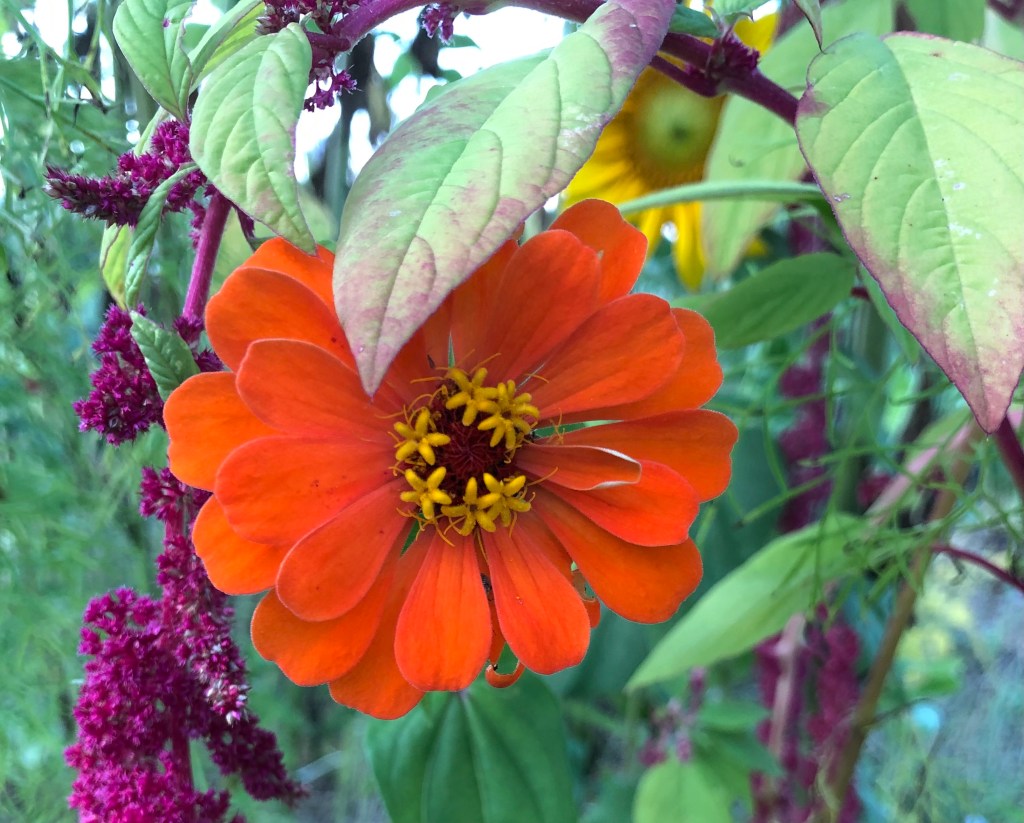
Garden, Hardwick, Vermont

Poetry, For Now.

Talking with friends by the side of a road, I notice a flock of Canada geese in the field across the road.

My friends tell me hunting season is just a few days away. The geese should move along.

My friends leave, too, one by one, and I linger with one woman, talking about farming in Vermont, an acquaintance we believe may have gone down the rat hole of QAnon, our elderly parents who live thousands of miles away. We branch into motherhood and gardening.

At the end of August, my youngest starts 11th grade today. The cats and I are up long before dawn this morning, the days dwindling at each end rapidly now. Next spring, with its promises of coltsfoot and trilliums seems forever away. I stand at our kitchen counter, drinking coffee, reading the New York Times.

Here’s a poem, not offered as an antidote to so many families, all over the globe, just solidarity.

Hope has holes

in its pockets. 

It leaves little

crumb trails

so that we, 

when anxious,

can follow it.

Hope’s secret: 

it doesn’t know

the destination–

it knows only

that all roads

begin with one 

foot in front

of the other.”

–Rosemerry Wahtola Trommer
Hardwick, Vermont

Petal. Stone. Blood.

Just before school starts this year, we spend a Sunday driving to the other side of Vermont, down along Lake Champlain, and crossing at the Crown Point bridge. There’s little traffic anywhere. We stop in Bristol for coffee, and then I keep driving, my friend and I in the front, our three daughters with their long legs sprawled in the back.

We’re headed to Fort Ticonderoga. Our daughters are taking an intensive history course this year, and I’m thinking the girls view the trip at first as a combination of the dusty past and an Instagram opportunity. Very quickly, we realize this is a site of stone, metal weapons, rammed earth, strategy, and bloodshed.

In the day’s sultriness, we wander behind the fort and discover the Fort’s immense gardens, now given over almost entirely to flowers. There’s few visitors and apparently no staff.

Below us, the lake lies still as a photograph, blue surrounded by the green hills. The crickets unfurl their slow late summer song. We’re in absolutely no rush at all, lingering among these flowers petals while, up on the hillside, someone bangs a constant dirge on a drum.

This ruined temple

should have its sad tale told only

by a clam digger.”

— Basho
Mount Defiance, New York

Sunday Morning Reading.

On my drive a few weeks ago to New Hampshire, I listened to Donald Antrim’s essay in The New Yorker about his hospitalization shortly before he published a memoir about his mother’s death. He was eventually treated with electroconvulsive therapy, partly at the urging of David Foster Wallace.

In this sticky August weekend, I’m reading that memoir, The Afterlife.

Here’s a line from this fiercely written book:

People are fond of saying that the truth will make you free. But what happens when the truth is not one simple, brutal thing?”

— Donald Antrim
Greensboro, Vermont

Vermont Day.

Soccer practice begins. School looms. In the night, I wake and wonder what does any of that mean anymore? What is this strange time? Sleepless, I read The Farm with a cat on my feet. Through the open window, the humid night swallows sound, the crickets’ nighttime singing almost a whimper. Unlike the raucous spring mating season, late summer sounds dwindle.

But the season is fat, full. I dream of delicata squash lying on the ground, beneath their wide leaves.

*

My youngest sits on the couch beside me, with a bag full of pens and paper that her uncle bought her for school. She snaps open her binder and replaces last year’s ragged dividers with unmarked manila pages for this year. On the tags, she writes CALC, then APUSH, outlining her junior year courses.

I pick up my knitting — yarn I’ve unraveled from a previous sweater I never finished. Maybe this project will remain on the needles forever, too.

*

Sebastian Junger, one of my favorite writers, collaborated on a documentary, The Last Patrol. Combat veterans take a long foot journey, searching for what’s good about America — particularly relevant these days.

“The public is often accused of being disconnected from its military, but frankly it’s disconnected from just about everything. Farming, mineral extraction, gas and oil production, bulk cargo transport, logging, fishing, infrastructure construction—all the industries that keep the nation going are mostly unacknowledged by the people who depend on them most.” 

― Sebastian Junger

Our World.

Last night, I attended a Development Review Board meeting where only I appeared in person. The other participants all dialed in via their laptops. When we finished, I closed the windows and then walked out, standing for a moment on the steps of the two-story building that had originally been built as the town’s high school. The door in the empty building had been open when I appeared. I closed it behind me.

It’s a strange way to hold a meeting. One small bit of strangeness in a year and a half now of utter weirdness.

Driving home, the air is otherworldly with smoke from fires on the other side of the continent. My daughter and I stand in the garden, and she wonders what the air smells like — it’s not the familiar scent of smoke from our chimney, or the neighbor’s stove. Nor is it pestilent, like a house burning down.

I weed a little while she tells me about her day. Dusk moves in. In the sweet, warm evening, we swim.