The contours of your heart…

Not February, a long time ago, at our house…

Prying an aluminum safety-seal off a bottle, I remember drinking a tiny plastic bottle of cherry-red juice as a girl when a soft piece of aluminum was the top: once you peeled it back, you were committed to drinking the whole thing. In our sugar-free house, we rarely drank sweet things. This was somewhere in that vast expanse of the Midwest, land of a long-ago sea. In our parents’ green Jeep, we hurtled along I-80, two kids in the back and another up front in the middle between my parents. The Jeep had no radio. In a fit of enthusiasm, my mother had bought a transistor radio that she insisted would work. My dad insisted it would not, despite my mother unrollling the window and jamming the antenna into the wind. (The radio did not, although she did play music at a campground picnic table. We insisted she turn it off: too suburban, mom…)

In the floor of the Jeep’s backseat compartment was a hole where a screw must have fallen out and disappeared. In these pre-seatbelt years, we sometimes lay on the hot floor and stared down through the hole at the interstate whizzing beneath the wheels. A steady blow of hot air blew upwards.

Midwinter now in Vermont, that eternal season of accumulating snow and intermittent dazzling sunlight. My parents, bickering or laughing in their front seat domain where the three of us kids were clearly only intermittent visitors, were enmeshed in their crazy lives, scooping us along in their journey. As for us kids, the void of that quarter-sized hole in our family car and the pleasure of those unexpected sweet drinks, the promise, perhaps, of a swim in a campground pool later that evening, defined those summer days.

Now, decades beyond that cherry drink, I see my own rugged journey spanning decades, my daughters always along and still along, as we’ve come together and parted and reunited with so many people over these years…. In the end, perhaps, what remains with a child might simply be that special drink, not the mighty panorama of ancient geology or the American landscape of truck stops and diesel fumes and KOAs, not even my parents’ own struggles to figure out their lives — where are we going? what are we doing? — that, in my parenting turn, I’m hammering out, too.

From the inimitable essayist Leslie Jamison: “Don’t assume the contours of another person’s heart. Don’t assume its desires.”
What’s at the heart of a story?

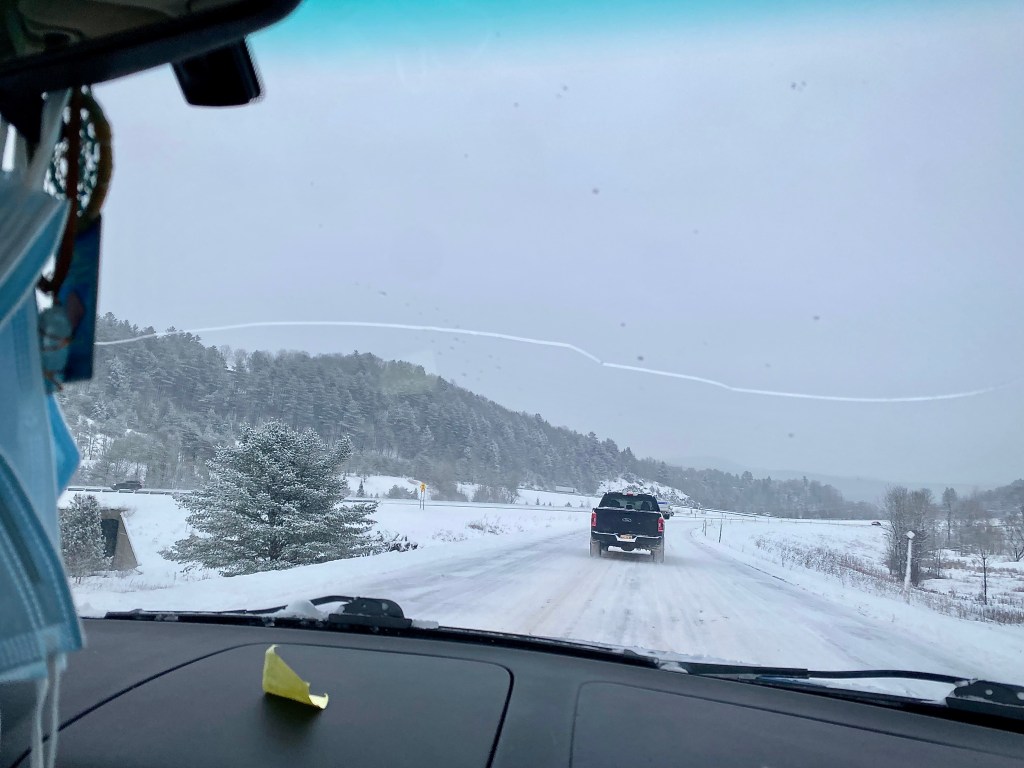
Crack in the windshield, the snowy interstate, the winter metaphor for this cancer journey.

25 hours. Here’s a smattering of highlights… A hard-knuckled drive on unplowed and marginally plowed roads, a side stop to avoid a collision on the exit ramp. Who knew these things gathered such snow? The town lights dimmed by snowfall. On a hotel’s second floor, I lay in bed talking to my siblings while my daughter ate chicken curry. In the bleach-smelling night, I limped up and turned off the heat, stood at the wide window looking out at the neon lights across the midnight-empty highway. The storm had ceased; the neon gleamed GARDEN, so brilliantly red and commercial that, in my sleep-addled mind, I couldn’t pair that word with loamy soil, coiled earthworms, the promising nub of May sugarsnap peas. Unable to sleep, I lay awake, parsing together a story: hook, conflict, and what does resolution mean, anyway? What’s at the heart of a story?

In the early morning, two full lanes of traffic streamed towards Dartmouth Medical Center. On the short cold drive, we drank hot coffee. From here, the story unfolds into the parking garage, blue paper masks, the complexity of so many stories, with so many words. The words alone are brand-new to me — Doxorubicin, Methotrexate— and I labor to learn these, to put pieces of what I can know of my story together. The wide halls in this building soar high, softening voices as the daylight falls down. Always, I hold in my body this conflicted and twisted sense of how much I do not want to be here and how immeasurably grateful I am to be here — but more, too, the profound and sacred sense of so many people, patients and families and the immense staff, each with their own mighty stories, living these stories, in pain and in joy.

In the infusion room, where I sleep and sleep, this time no longer needing small talk, I wake and watch the juncos and chickadees, the nuthatches, flitter in and out of the hydrangea bushes with their brown last-year’s blossoms, perch on the feeders the nurses fill and tend.

The interstate home is clear. The cats yowl for dinner. My house is warm, the dishes washed, the hearth fed. February. The story spins on.

A Handshake and a Promise.

I leave dinner with neighbors and friends and walk home, down through the village. It’s late enough that the few restaurants in town are closing down, a few lingerers at the bars while the waitstaff wipes down the tables, doubtlessly thinking of their own homes and nights ahead.

Knowing I would savor this walk, I brought my hat and a coat, and the night is warm enough. I’d been offered a ride — “it’s dark!” — but me who is afraid of so many things (rushing semis, rats) has no fear of this autumn dark, this small town. I pass no one, not even a dog walker.

End of October, and I labor through the daily chores, now shoveling ashes from the wood stove, putting away the summer’s chairs and garden tools. My daughter phones with a homework question. Over us, the ineffable holiness of the passing of both of my daughters’ grandmothers this year, the old women who had distanced themselves from their granddaughters. What will this mean for my young women? At dinner, whisperings about the election. Which way will this split?

Just beyond the village, a U-Haul idles, lights on. As I walk nearer, I squint in the brightness. U-Haul, those rental trucks that have appeared intermittently in my life. The last time was that sleety winter day when a couple loaded up barrels of syrup from our sugarhouse driveway. I was in a desperate time in my life then, selling what I could to pull up stakes with my daughters and light out for new territory. I took a chance on this couple, watching them head down the slushy road with our liquid gold with nothing more than a handshake and a promise between us.

As I walk by, the U-Haul driver doesn’t look up, reading his phone, maybe a map, maybe a love note. I keep walking. As for that couple, the handshake and promise were gold. A week later, the check arrived in the mail.

A real clusterfuck of thinking…

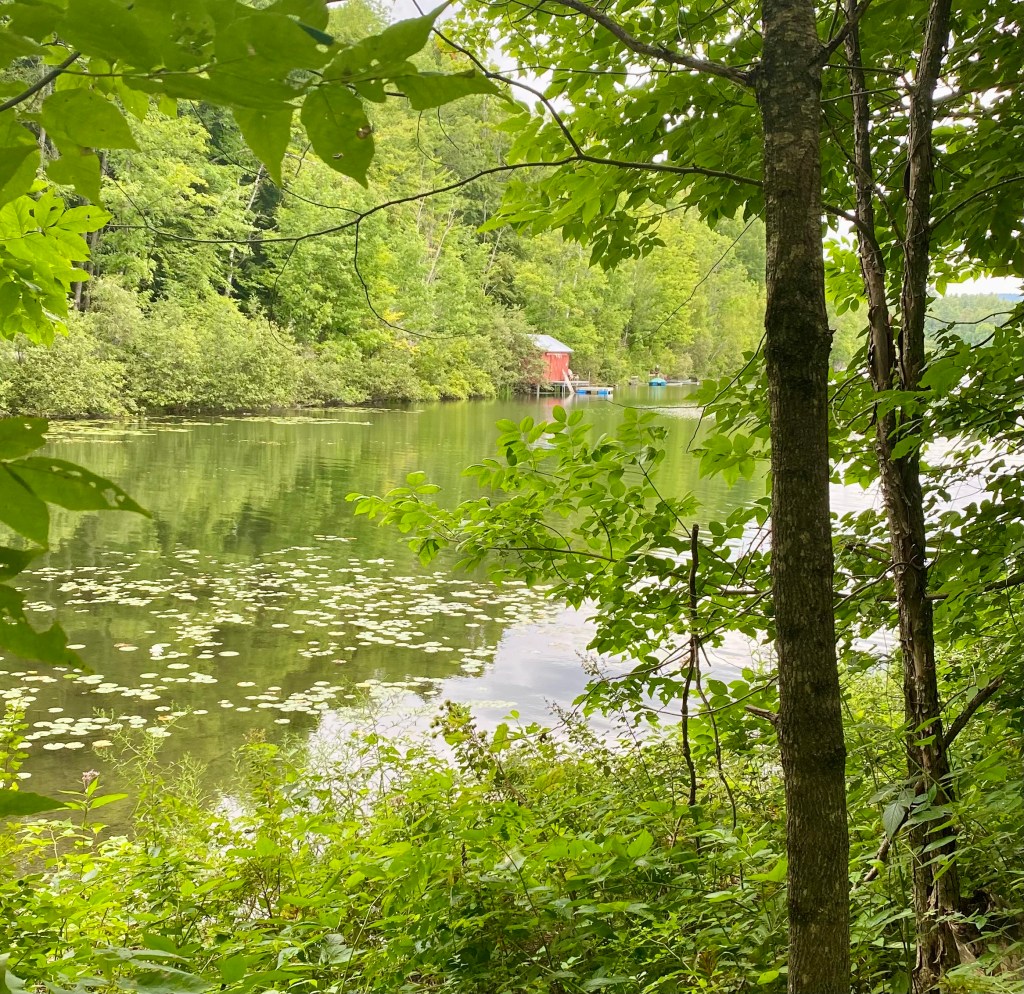
Hurrying from one thing to another, I detour to my favorite swimming pond, under these overcast skies. A woman and a little girl are swimming. There’s no one else around, and the woman and I chat about the fish nibbling our toes. The girl sits on a floatie shaped like a chocolate ice cream cone and looks skeptically at us, as if her mother and I might be making up everything. Maybe, in truth, our toes are bleeding from fish fangs. The child is taking no chances. She leans back on the floatie and stares up at the sky. Her mother gently pushes her from shore.

I swim out.

My head is jammed with the conversation I just had over Pad Thai, three of us women, about writing and Vermont and friendships, about money, of course, always about money, how money winds into decisions we make. These are old conversations, worked out in new ways. As I drift out in the cold water, I keep thinking about all the material I’ve been reading about rivers and history, about farming and logging hands on the land, 100, 200 years ago, how what made sense then (sense? perhaps even seemed downright innovative, bordering darn smart) has piled up over these generations of rivers, now dredged too deep, the roads and the towns built far too near.

Because my mind works in metaphors, I keep thinking how years pile up mistakes, one after another, a real clusterfuck of thinking. There’s no one else around in the water save for me and the mother and girl. They’re both lying on their backs on the ice cream floatie now, circling around, the mother’s heels trailing in the water. All those summer days I spent at the beach with my daughters, with plastic shovels and buckets, with the sleeves of red cups that I used at the farmers’ market back in the days when I sold homemade root beer floats, $2.75 per cup…. The kids are now all (mostly) grownup, as happens. Maybe those years were nothing more than a light way to pass the days, insubstantial as dreams.

I swim out as far as I can bear in the cold water. When I return, the beach is empty. Clouds have pushed down low, and the sand is clammy. On my short walk back, two bikers ask me for directions. Go west, I advise. That’s the way out of here.

Human chaos, the desert.

Galisteo, New Mexico

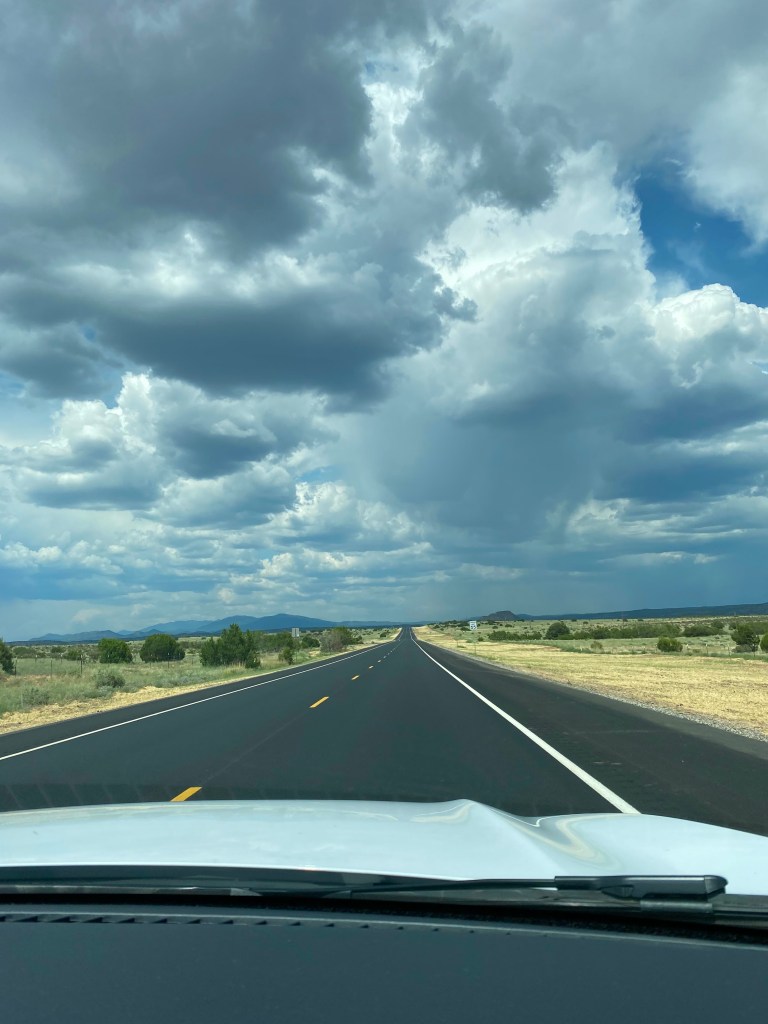
My daughter sends word of rain and more rain in our Vermont world. Meanwhile, on the other side of the continent, visiting my father in New Mexico, we’re amazed by the hues of green. The desert’s rainy this year, too. In the afternoon, I work outside while a storm blows in. In New Mexico’s wide skies, sooty clouds may lower and threaten and yield not a drop of water, blowing elsewhere, breaking or not.

In this quiet, edge-of-the-greenbelt place, news comes to us, the President now ill, an election teetering any which way. We do the everyday familiar things — drink coffee and eat dinner, play cards, talk about my mother’s recent death, about each one of us. After dark, the two girls and I stand outside in the dark in the cool rain, breathing in that ineffably sweet fragrance of the rain-damp desert. Wind shakes the junipers. Here, at fifty, I seem to be carrying a goblet of my life, the wind in the junipers one of the very first sounds I remember as a little girl, so many trips crisscross between Vermont and the desert, the enthusiasm of these young women with me who have seen so much of this world already, so eager they are for more, more of life. Later, when the girls are whispering and laughing in bed, the rain falling, the breeze blowing through the window, I feel that endless ancient desert around me, the calling coyotes, dwarfing for this moment even our human chaos.

Dad and Father’s Day.

When I was a kid, in moments of stress or elevated high jinks, my dad’s sense of humor rose. He was prone to things like putting grapes up his nose while my mother wasn’t looking to make us kids laugh. This was the camping trip to the Grand Canyon, when the clutch went on our old Jeep, and my dad was fixing it whatever he might have had at hand — a pliers and a fishing hook , maybe two rocks rubbed together in prayer, for all I know.

That same trip, someone was on the lam who had once also been a Navy Seal. We hiked into the canyon, passing sharp shooters at the rim. Don’t look, my mother said. Sometimes I wonder, Whatever happened to him? Did he have kids?

My parents never hesitated to get out our atlas, the essential road tripping gear. Looking at the map with my youngest recently, I chanced on Medicine Bow, Wyoming. We camped beside a man who lived in his canvas tent. While we were hiking, a lightening storm blew up, and my father hustled us down. As a kid, our sometimes peripatetic life was status quo, all kinds of living mixed in. I could list a 100 things without stopping that my dad taught us, all darn useful — like read Plato and follow water when you’re lost in the wilderness — but the one I keep returning to these days, now that I’m along in my life, is his utter persistence. A parent now myself, I think of him in the Grand Canyon with three young kids and a skeptical wife, with hardly any money and a broken-down Jeep. He patched it together. We kept on with that journey, thousands of miles, all those nights in the desert under the stars. At the wheel, he drove that Jeep for many more years.