Kid Project

Deciding she wants to improve her cursive handwriting, my daughter writes a careful sentence in her notebook and hands it to me. I’m sitting beside her on the couch, reading Volkswagen Blues. In my clumsy cursive, I pen an answer to her sentence and hand the notebook to her.

As we fill a page back and forth, a curious thing happens. My handwriting, never stellar anyway, unwinds into a nearly illegible scrawl while hers, tidy and careful, improves.

One little moment of her childhood, of my motherhood.

At five this morning, my teenager and I shovel out her car — so many inches of fine, perfect snow. When she leaves, I keep shoveling by the light of the living room window. Today, snow will fall all day, and maybe we’ll remember it as the day we baked blueberry pound cake and the trampoline frame disappeared in the snow.

Or not.

But for a few moments, sweating from shoveling, my hat pushed back, I stand listening to my breath and the far-off sound of a snowplow, in those millions of snowflakes, twirling their way to earth.

He wanted to know what kind of people had decided, in the early 1840s, to give up everything and travel across most of a continent simply because they had heard that the land was good and life was better on the shores of the Pacific. What sort of people had had the courage to do that?

“Ordinary people.”

— Jacques Poulin, Volkswagen Blues
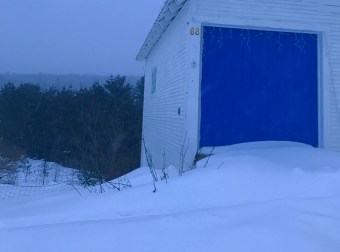
IMG_4497.jpg

Pre-storm photo, January 2019


Vermont Travels

Early this Sunday morning while the girls were sleeping and dew lay slick in the garden, I was reading Rinker Buck’s The Oregon Trail, his new book about traveling across long stretches of the Oregon Trail in contemporary America. By the time the kids were up, I was itching to read parts of the book to my girls, as Buck’s brother Nick reminded me in many ways of my own brother Nik.

I said, Girls, it’s settled. We’re headed out west next summer in a prairie schooner.

One of the girls remarked somewhat disinterestedly, I thought we were driving the Toyota to Alaska, and why are we out of bagels again?…

In rural Vermont, so much of our travels are undertaken in a car. Today, with effort, we loaded the canoe on the car, drove to Number 10 Pond and unloaded the canoe. We had the loveliest paddle. People were swimming far out in the pond, and they called cheerily to us, hello, hello! and a little Jack Russell terrier yipped at us from a peninsula. My older daughter, in the canoe’s rear, guided us into a patch of water lilies, and while she meticulously photographed the aquatic flowers, I lay on the canoe’s bottom and watched the cumulus clouds drifting. Then it was back in the old truck again, with the transmission’s curious tendency to lurch out of third gear as we rattled along. All this time, though, we held the pond within us, its cool surface pinged with skittering water bugs, and the clouds reflected in its green depths.

Buck writes:

In a covered wagon, while riding slowly out in the open air, every blade of grass, every fence post and farm, or the mallard ducks rising from the streams, assumes a visual and olfactory intensity that you can never feel while trapped inside a speeding car. While on a wagon seat, the land embraces you, emotionally. The rumbling wheels, the creaking top, the pull of the driving lines in your hands multiply the pleasure of travel. A part of me would always long for that strength of feeling again, and no other form of travel could match it.

–– Rinker Buck

IMG_1988

Waterlily by Molly S.