Small Celebrations.

Each morning presents a new skein of yarn, knotted and jumbled as if carelessly carried in the bottom of my backpack, beneath leaking and softening apples, a sandwich wrapped in wax paper whose crumbs have escaped, the shuffling of notebooks, pricks of pens.

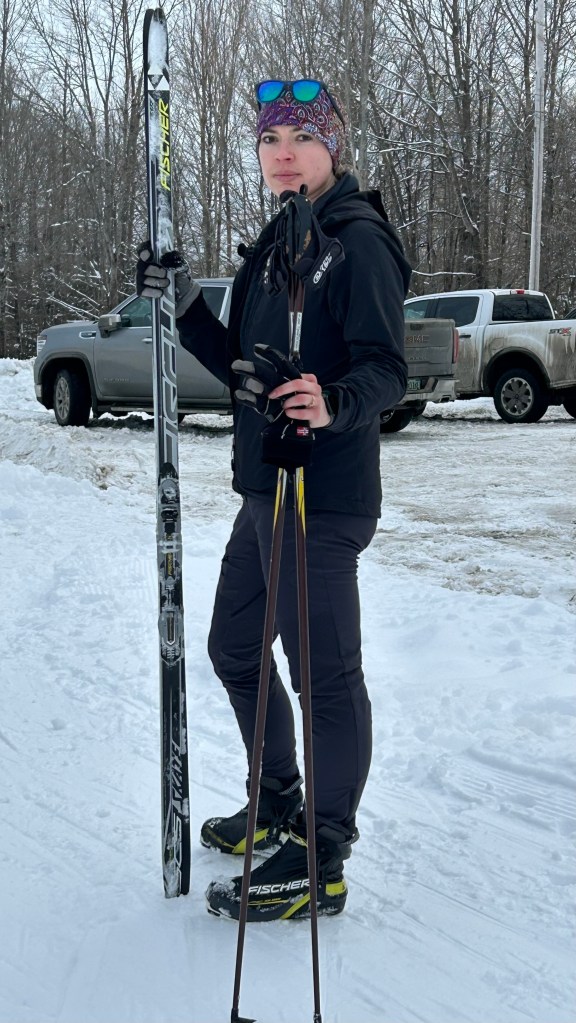
A friend asks me to xc ski this weekend. I pause and then warn her of possible abject failure. Can I balance? Can I even snap boots into bindings? Talking, I think of my ski boots in the upstairs closet. A year ago, a knitting companion asked to borrow needles: an inconceivability. A year ago, I couldn’t walk up my house’s wooden staircase, let alone swing open the closet door and shuffle through needles. I might as well have considered mining for gold with a plastic spoon. Pulling together boots, skis, poles: that alone would mark a kind of success. I am a lousy skier, but the glide of ski over fresh snow has given me so much pleasure. I imagine again stopping at the trails on my way home from work, how the cold winter twilight gleams on snow.

A theme that emerges in my writing over and over is order versus chaos. How laboriously I endeavor to keep the chaos from my life, from vacuuming the ashes and bark shreds around my woodstove to ordering my work life. Be productive. Get my work done…

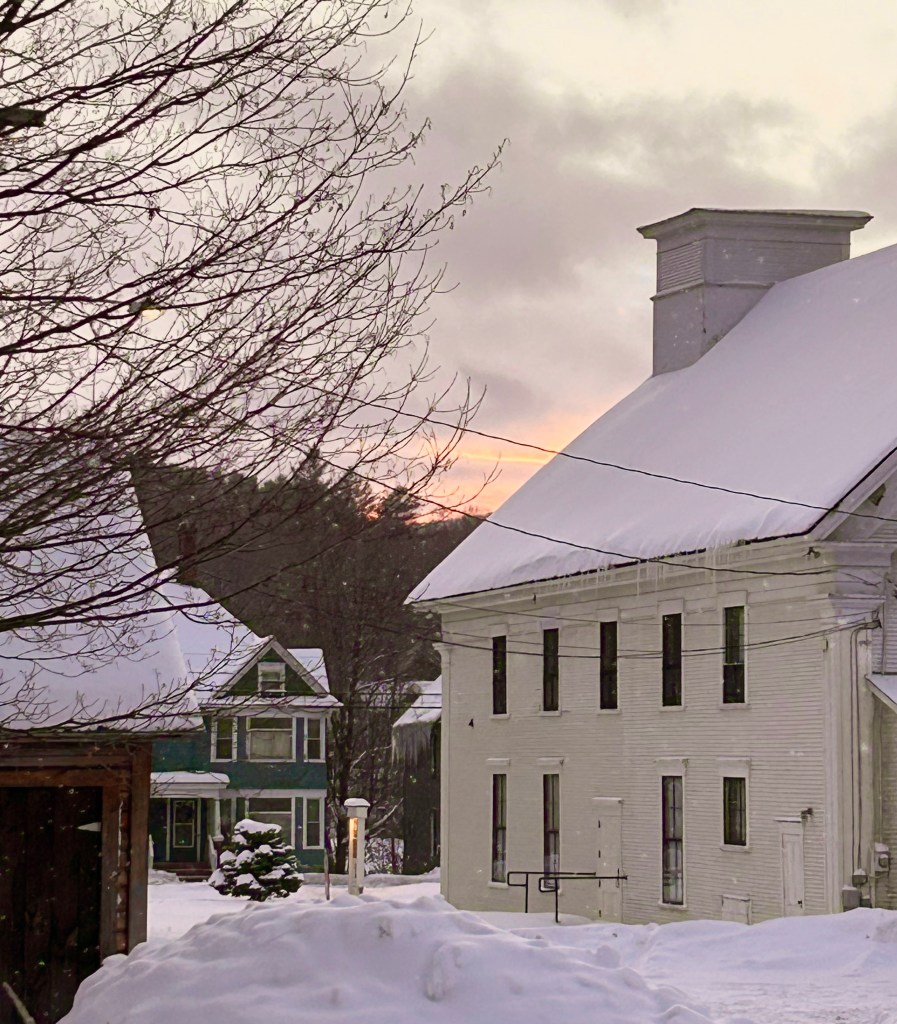
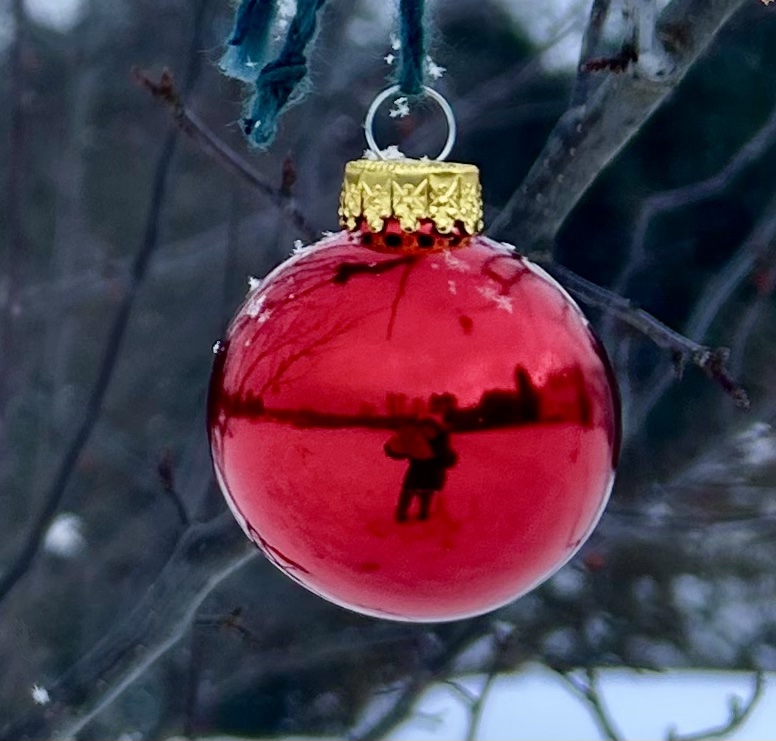
When I first emerged from surgery and chemo this summer, I flung myself into living with buoyancy and joy. Now, I am in the longer stretch — grateful to be here, but mindful of sinkholes. A longstanding quarrel in town rises up again and grabs at me. I remind myself, this was not my doing and not my requirement to undo. What I do, instead: I force myself up from the couch, lace up my boots, and walk. In town, I fill my backpack with library books, zip my coat against my throat as the gloaming sprinkles down. I take the longer walk home through the neighborhood built near the coal-dark Buffalo Mountain, these houses built for Hardwick’s granite workers, a hundred years and more ago, once filled with hardscrabble people from other places, seeking not a fortune but a livelihood. The kind of work where a slip or accident had horrible consequences. I pass a house with a family of small children, strung with glowing lights, sleds jammed in snowbanks. The empty house where the old woman with the two barking dogs disappeared in my illness, and another empty, for sale. On my road, I’ve strung red globes in an apple tree, bits of brightness, small celebrations, better than order.

The oncologist… “knows not to describe everything all at once.” — Marion Coutts, The Iceberg

Stopping in the Snowy Forest.

In the woods, I hear voices and pause, thinking a cluster of children might emerge over the hill. Instead, a flock of clangorous geese wings low overhead, then a second V, a third. Town traffic sounds filter into the woods. I am not in the deep wilderness, not so far from high school and road and village, but for this hour, it’s just me and the sweep of wind and drifting snow and the human and dog prints of whoever walked here before me.

As a kid, my father was never one to be daunted by adversity. Evenings, he often set down his coffee cup and took us on walks to the library or around the block, and around the block often meant across a thin-grass soccer field to the woods. Who owned those woods, I never knew. We jumped across the stream and along worn logging roads, past the piles of New Hampshire boulders and stone walls in the forest where fields had dominated not so many years ago. The woods were alive with rabbits and deer, birds and ferns. We wondered about the Natives who lived here and the colonists who cut down the trees, and then the trees grew up again.

On this twilight Monday, I lean against a hemlock, snow in my eyelashes, remembering when my daughters filled their snowsuit pockets with tiny hemlock cones. Intentionally or not, my father instilled love and not fear of the forest in his kids, the understanding that our feet could carry us to unexpected and miraculous places.

Here’s that classic New Hampshire poem threading through my childhood, my daughters’, and so many others:

Stopping by Woods on a Snowy Evening

By Robert Frost

Whose woods these are I think I know.   

His house is in the village though;   

He will not see me stopping here   

To watch his woods fill up with snow.   

My little horse must think it queer   

To stop without a farmhouse near   

Between the woods and frozen lake   

The darkest evening of the year.   

He gives his harness bells a shake   

To ask if there is some mistake.   

The only other sound’s the sweep   

Of easy wind and downy flake.   

The woods are lovely, dark and deep,   

But I have promises to keep,   

And miles to go before I sleep,   

And miles to go before I sleep.

Gifts at the Back Door.

I arrive home in the dark and find one of my red deck chairs at my kitchen door, a white container set on its seat. It’s not late but dark already. On my way home from work, I’d walked along the river and walked further than usual. When I’d returned to my car, darkness had fallen.

I’ve been living in or nearby this village for thirty years. I’ve seen a share of miserable things — from addiction and homicides to petty cattiness — and its goodness, too. How, in times of trouble, folks appear with aid. No questions, often very few words. My god, the grace of this.

Scorched earth is how I consider myself these days, not so many days post-chemo, post-surgery, leering up on a year’s anniversary since I learned I had cancer. See how I write this? Past tense. And yet, transmogrified is a word I used with a friend. How this disease has transmogrified my being.

In the dark, I unlock my door, set down my backpack, a pile of library books, a bag of apples. My cats mewl for their cat supper. The container has soup, barley and beef and spinach. The woodstove has gone cold, my jacket drips rain on the floor and my cats’ dense fur, darkness presses against the windows. And yet, serendipitous soup. I take a spoon from the drawer. As for figuring out the rest of my life, or this week, or even this evening — I let that go.

From my library book stash, Sally Mann:

“As for me, I see both beauty and the dark side of the things; the loveliness of cornfields and full sails, but the ruin as the well…. The Japanese have a phrase for this dual perception: mono no aware. It means “beauty tinged with sadness,” for there cannot be any real beauty without the indolic whiff of decay. For me, living is the same thing as dying, and loving is the same thing as losing, and this does not make me a madwoman; I believe it can make me better at living, and better at loving, and, just possibly, better at seeing.”

This Glorious Autumn Light.

My sister, a caner survivor, once told me that a cancer diagnosis was a great leveler. This was years before my own cancer experience, and, sure, I had an intellectual understanding of this. Lymphoma schooled me in many ways, among these that I live in my body. Such a simple, profound thing. I had never lived in a body that couldn’t walk up the stairs in my own house, not just because of a sprained ankle or a new baby in arms, but because of weakness in my bones and flesh. I had never considered that I might never be able to enter the bedroom whose walls I painted, where I have slept for so many years.

These days, after a summer devoted to learning how to eat and sleep again and to walk those stairs, outside as much as possible in this gloriously sunny, perishingly dry Vermont summer, I no longer embody the near-translucence of cancer-and-chemo patient. Such pleasure I have when people ask why I’ve cut my hair, and I can reply that I didn’t snip, I lost. The hair I’ve lost is now returning in a metaphor that I can’t ignore: softer but with my childhood cowlick.

Disease hasn’t magically transformed me; if anything, my thorns have proliferated. But here’s a thing: the world where I live is descending into spectacular autumn. Sure, some years the fall foliage bursts brighter than other years, but always, always, heartstopping in beauty. Autumn’s a reminder of my mortality, your mortality, the dearness of this fleeting world. A reminder to pause in our gardens, on our house steps, the sidewalk, whatever trail we may be following. Take a moment. Breathe in, out, in….

From Stephen Jay Gould’s essay “The Median Isn’t the Message”:

Of course I agree with the preacher of Ecclesiastes that there is a time to love and a time to die—and when my skein runs out I hope to face the end calmly and in my own way. For most situations, however, I prefer the more martial view that death is the ultimate enemy—and I find nothing reproachable in those who rage mightily against the dying of the light.

Moonrise, More.

Barn door view.

An old friend unexpectedly appears at my door one evening as I’m folding laundry. We sit on my back porch and drink hot honeyed tea and watch the just-beyond-full moon slowly rise. September, the night’s chill creeps in around us. I grab my hat and coat and brew more tea.

All this fall, I’ll be thinking of a year ago, when I was getting sicker and sicker, with no real understanding why until that terrible night in the ER when a scan revealed cancer, so much cancer. Heading towards a year later, I’m admiring the moon sail over the mountain ridge and up through the trees. We keep talking and talking. It’s not so much the words that stitch us together but our chuffing breath that hangs in clouds between us, a howling neighborhood dog, a rustle in the ravine of a wild creature.

After my friend leaves, I wander around the moonlit garden, hands in my coat pockets, the tall amaranth a shadowy forest beside the closed four o’clocks. Frost is not far in the offing.

Inside, a daughter has texted me….. where are you?… Outside, breathing in the moonlight. Still here.

Instructions on Not Giving Up

More than the fuchsia funnels breaking out
of the crabapple tree, more than the neighbor’s
almost obscene display of cherry limbs shoving
their cotton candy-colored blossoms to the slate
sky of Spring rains, it’s the greening of the trees
that really gets to me. When all the shock of white
and taffy, the world’s baubles and trinkets, leave
the pavement strewn with the confetti of aftermath,
the leaves come. Patient, plodding, a green skin
growing over whatever winter did to us, a return
to the strange idea of continuous living despite
the mess of us, the hurt, the empty. Fine then,
I’ll take it, the tree seems to say, a new slick leaf
unfurling like a fist to an open palm, I’ll take it all.

~ Ada Limón

August Light.

A neighbor paints her house turquoise with salmon and forest-green accents. The colors are up for discussion on our short dead-end street; myself, I love this blue and speculate how cool it would be to transform our houses in a Vermont village version of San Francisco’s Painted Ladies.

Mid-August (already?!), rain has ceased. Our lawns are all cropped short and no one’s mowing. Late afternoon, watering the perennials I planted this summer, I eat sun gold tomatoes in the garden, the sandy loam warm beneath my feet. This summer, endeavoring to heal from lymphoma and surgery, I retreated into my garden, writing, walking. Pay attention, I cautioned myself. Take time to visit my neighbors and talk about shades of blue.

Survive cancer (and cancer treatment), and you discover the world has the same facts (the electric and property tax bills, the need for steady income, spilled oatmeal in an upper kitchen cabinet, a hole in the chimney that needs repointing; these chores jostle on my post-it lists) and the questions that muse through my mind in yoga practice and wick away (why?: an apple tree shedding leaves, a clandestine coffee klatch, my recurring expectation that I may see my dead mother around street corners….)

Vermont’s radiant summer rolls into balmy autumn. The rain may commence at any moment, or might hold off until snow and sleet. The winter will be whatever it will be. In my own realm, I soak up this end-of-summer stillness, water the new transplants, wake each morning, yet alive. A low bar, or, conversely, the highest I’ve set for myself yet.

Prayer

Whatever happens. Whatever
what is is is what
I want. Only that. But that. ~ Galway Kinnell