The full extremes.

The days are hurrying right up to that mark of a year of healing from chemo. After that final treatment, I lived into a little lull where I allowed myself to believe that all would be okay again, but the need for surgery roared up, too. Much as I fought against this — and, honestly, my fighting was from fear of a horrible outcome and, perhaps even more, if I’m dead honest, was my terror of YET MORE PAIN — but as I said, much as I fought against this, I eventually ended up back at Dartmouth in a hospital bed, my daughters beside me wondering when the heck this was going to end. That huddle of surgeons appeared. It was, after all, a teaching hospital.

I said no. The surgeon said, I put you on Tuesday’s schedule. Doubtlessly, he was satisfied to finally, after those months, to get to work repairing me. I stared out the window and knew there was no way I would ever make it home. So I said yes.

But a year… a year ago, I was somewhat seeing a man who was more interested in me than I was in him. I was interested in admiring the daffodils and learning to walk again. I was interested in never returning to the hospital again. I had other things on my mind, too. I was rewriting a book, and, since I had lived, I had to start earning a living again.

It’s been a remarkable year, suffused with radiant joy, with gratefulness to walk and eat and read and write and sleep—without pain. And a year filled, too, with the darkest thoughts I’ve ever experienced, as if the cancer had broken every inhibition, allowed me to feel and fear all the rottenness I’ve kept away for so long. This is not something I’ve written about here, but I keep bearing in mind my oncologist’s prescription: Go and live your life, Brett. A year later, the word that surfaces is fragility. I live in a world that bandies resilience—resilience of soul, resilience of Flood Ready Vermont!, resilience of community and systems. A year later, I know intimately the thinness of energy and health, the scantness of my days, your days, our days. All of it, I know; live all of it, such largess.

“The society to which we belong seems to be dying or is already dead. I don’t mean to sound dramatic, but clearly the dark side is rising. Things could not have been more odd and frightening in the Middle Ages. But the tradition of artists will continue no matter what form the society takes. And this is another reason to write: people need us, to mirror for them and for each other without distortion-not to look around and say, ‘Look at yourselves, you idiots!,’ but to say, ‘This is who we are.” — Anne Lamott

Holy Nightsky.

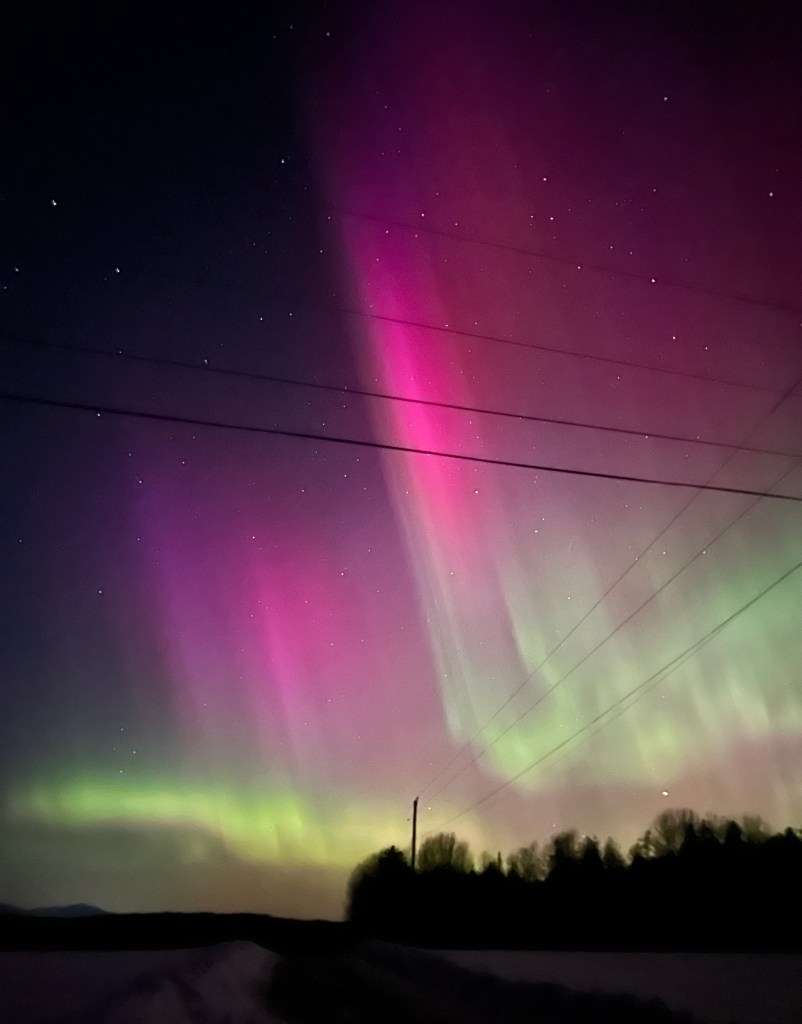
10 degrees on a starry night, my daughter phones me while I’m cramming more wood in the stove. She’s on a dark-soaked back road, the northern lights resplendent, and urges me to go in search. Up Bridgeman Hill, she tells me, with the ridgeline view.

So, bundled in coat and hat, I drive through the little village and up the hill where the town lights cannot touch. In my headlights, wind scatters snow gathered from the wide hayfields, winter dormant. I pull over at the hill’s crest where two farms join. I get out of my car and walk down the road. The limitless sky gleams ruby and emerald, an immense shaft of white light luminescent. In the east, the black spreads profoundly, the stars so radiant I imagine I could reach out and grasp these gems.

John Donne wrote that illness is a “holy room.” My oncologist taught me that we are all the ailing; if not now, to come. Mortality’s cut makes zero discrimination. A cancer diagnosis gained me admission to inner chambers. Unwanted—let me reiterate again, I did not request admission. But I hung up my coat in the anteroom and set my hiking boots against the wall, and I walked barefoot and thirsty into the nexus, me and that fiercely multiplying lymphoma. The lymphoma and me — one of us was not going to survive this go-round.

In the night’s darkness, the rushing wind tore at my cheeks and hurled ice in my eyes. In the distance, a cow barn glowed with light, a scatter of houses in the valley. Around me, that immense and mysterious beauty over small human beings, at whatever mundane chore or decency or devilment we conjure, be it the evening milking or washing supper dishes or plotting a wrong against another.

The sharp-clawed cold shoves me back towards my car, back towards the village and my hot woodstove, my little house in the great holy room of this planet, this universe, this precise moment.

“It seemed like I was doing something ludicrous, trying to build a permanent work of literature out of broken little whimpering bits about the most ephemeral experiences when I was still mostly broken and half-ephemeral myself.”
― Anne Boyer

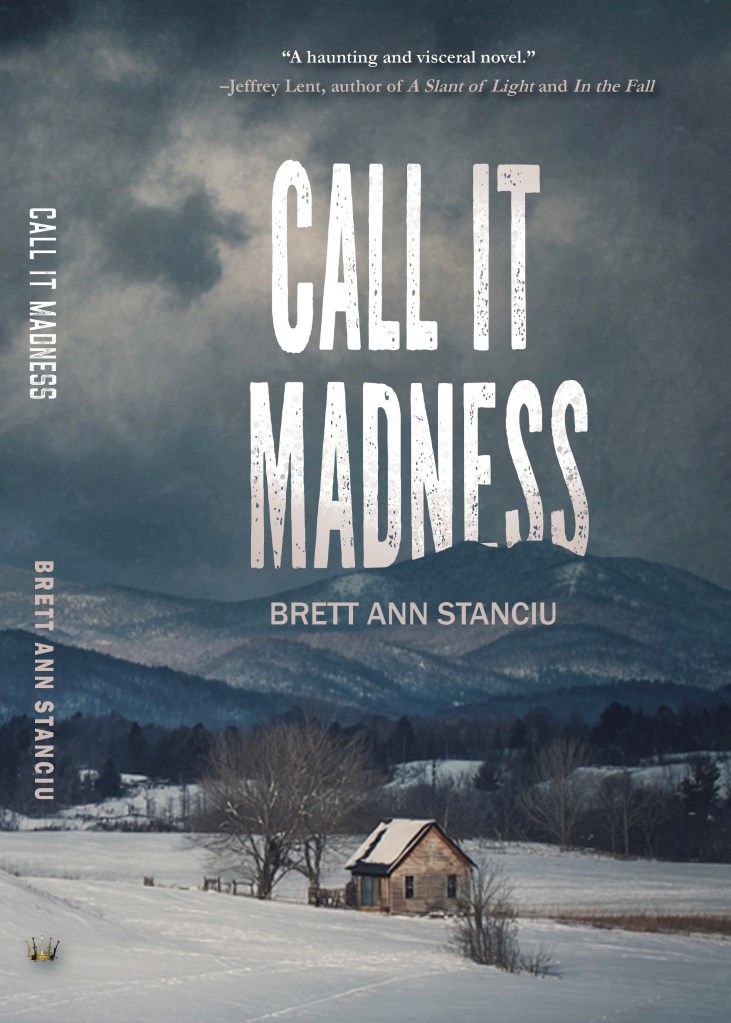
Call It Madness

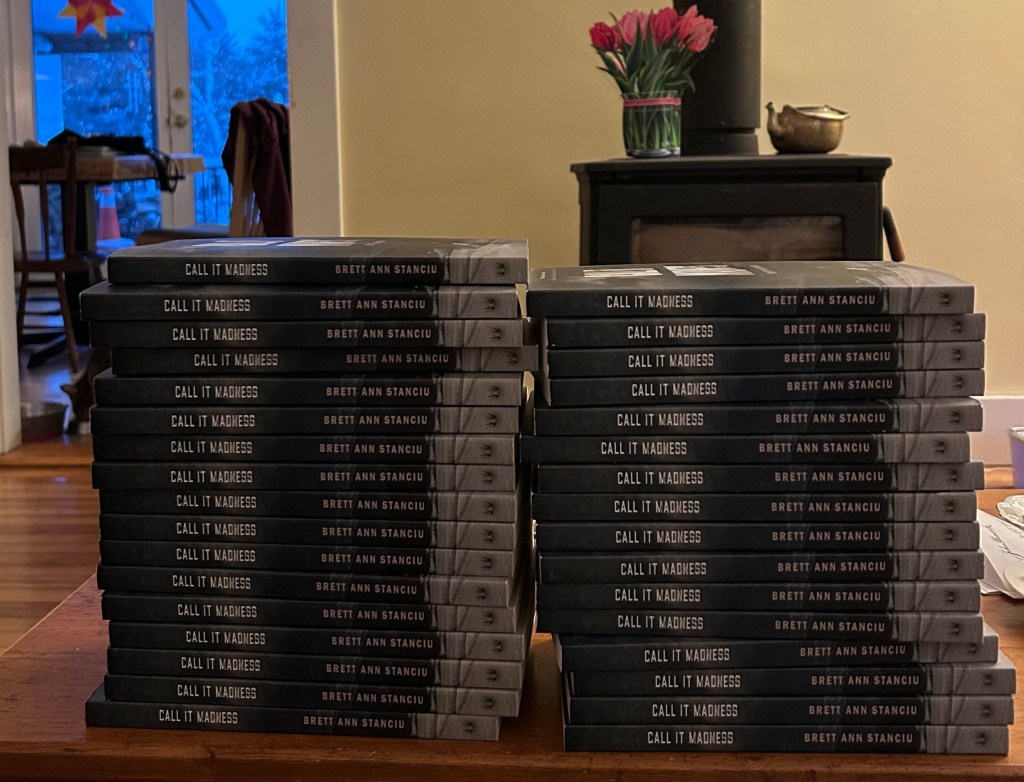
My newest novel’s advance copies arrived in a great big box at the post office that I hefted on my shoulder. The postmistress said, “You wrote another book? How cool is that.” Indeed. Then she wondered if I could carry out this box that she described as nearly large as myself. I laid the box on the passenger seat and then walked across the street to the co-op where I bought an orange and peeled it and ate the sweet sticky fruit in a drippy wet snow.

Call It Madness? A novel about a young woman who realizes her mother had spun lies all her life—a grandfather who hadn’t died, a beloved house that hadn’t sold, only tumbled apart with rot and rodents. How does she get out of the madness-making of family and salvage some shreds of happiness?

June 30 the book will be released from Regal House Publishing. You can find it at my beloved local bookstore, the Galaxy Bookshop, or from the big A here.

Here’s the opening page….

White Quartz

2016

I didn’t know what made my parents drive from Bellingham to faraway Vermont the summer I turned four. I had never met my great-grand-father Opa until that afternoon my mother rolled our station wagon down Breadseed Lane. Earlier that day, a stranger had helped my parents change a flat tire on the New York turnpike, but the spare was a misfit. For hours, our car had been thumping while I stared through the backseat windows at the trees and fields passing by, pondering the puzzle of that strange word breadseed. Could seeds blossom into loaves?

We hadn’t stopped for lunch, and I was hungry. Was this Opa character cooking us dinner? Turned out, he was not.

In a rain that was just beginning to let up, the old man stooped in his yard beneath an enormous pine tree, fists curled behind his suspender buckles. I was not quite yet four, remember, and I knew suspenders only from picture books. In a strange coincidence, I had asked my mother for a pair the last Christmas. She had laughed and said suspenders only existed in fairy tales about grandfathers who were woodcutters and chased away starving wolves.

I loved that trip so much that the next summer I begged to return to Opa and his house that smelled of sugary rotting apples. I whined, Please, Mama, please. Which apartment we lived in then I’ve long forgot-ten, but in my memory, I’m sitting on the floor. At the end of the galley kitchen, a glass door streams in cloudy light. I’m watching the hem of my mother’s skirt graze her bare knees. The polyester skirt is one she wore for years, zigzag black lines over white. The hem has opened and hangs down, its frayed edge unraveling into threads. She’s smoking, the cigarette held impatiently in her teeth, and ashes drift down in the murky light. That morning, my mother tells me that Opa died soon after we left. The house was sold.

Touching the Earth.

Right at the solstice, frost.

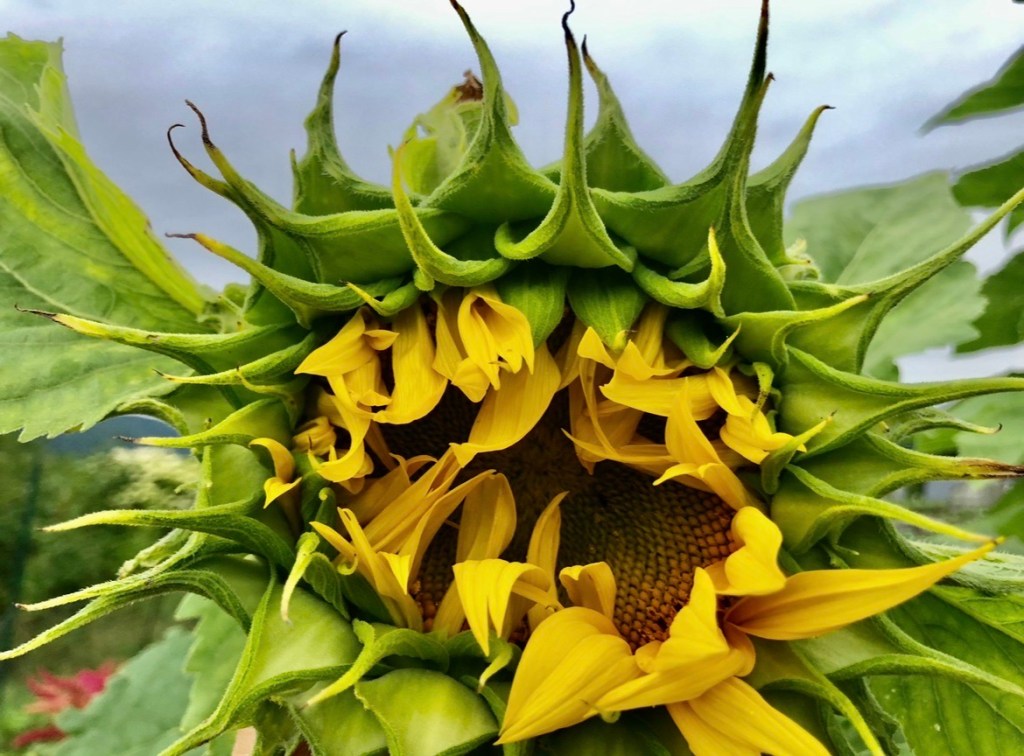
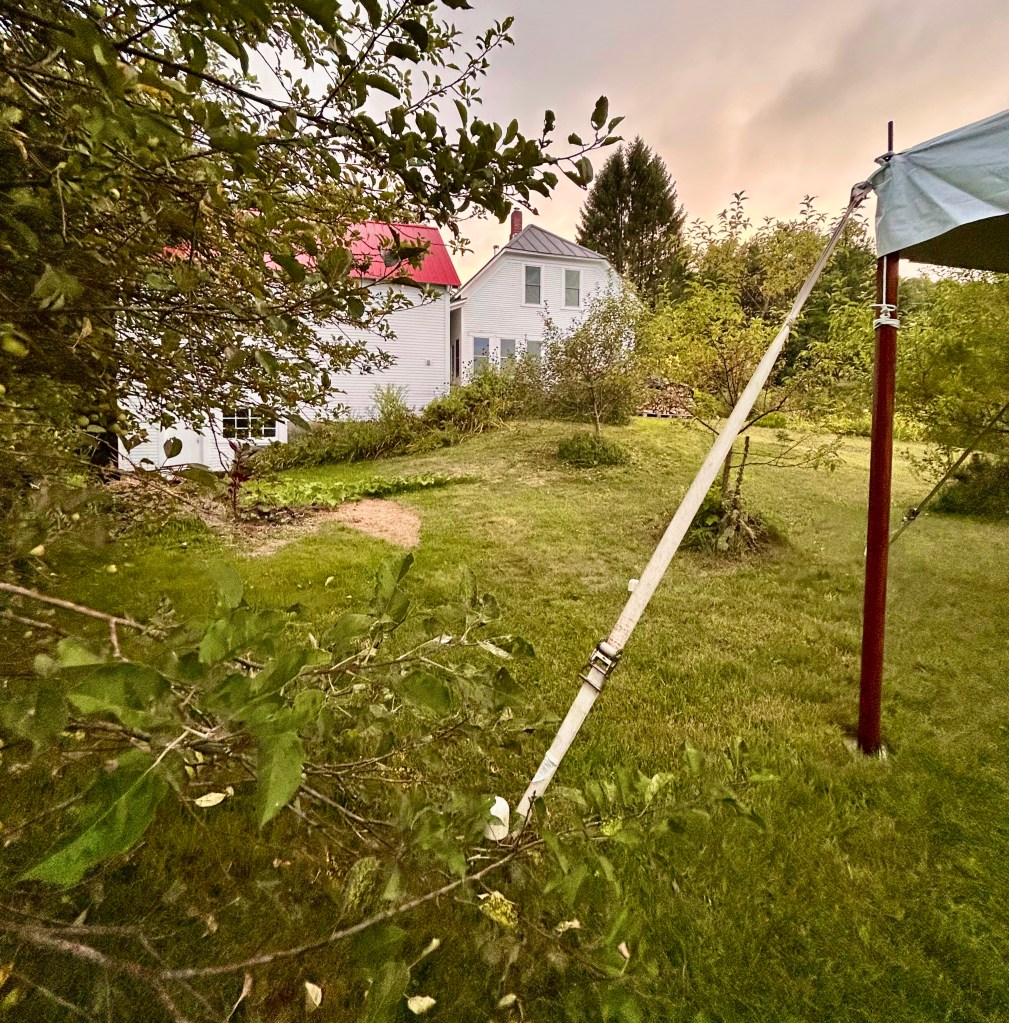
My garden planting this spring was a combination of friends who appeared and weeded and planted, of the sunflower seeds I sowed and the woodchucks ate and I replanted and the woodchucks devoured again, of volunteer calendula and love-lies-bleeding and towering gold sneezeweed, and the pepper plants from a friend that produced in enthusiastic abundance.

Hurray for the garden. These evenings when I light the first wood stove fires of the autumn, my cats chew shreds of birchbark, sprawl before the warm stove. Hurray, they purr in their cat way.

Season’s change again, so familiar and yet different, each day fresh and welcome. Season’s change for me, too, some days filled with friends and colleagues, other days I hole up and get my work done. Writing now about cancer, I imagine holding this keen awareness of my mortality, of the perishable world, in my hands: a tender-eared rabbit, a vicious rat, or maybe simply a handful of sunlight.

In the deep fall
don’t you imagine the leaves think how
comfortable it will be to touch
the earth instead of the
nothingness of air and the endless
freshets of wind? And don’t you think
the trees themselves, especially those with mossy,
warm caves, begin to think
of the birds that will come – six, a dozen – to sleep
inside their bodies? ~ Mary Oliver

Hunger.

Curious cat named Acer

A few years back when my youngest was doing odd jobs, she came home with four strawberry plants someone had given her from a garden she weeded. Naturally, I planted these in our garden. The plants spread and have produced beautifully this year. I crouch beside these weedy plants and devour red berries. The crop is so small no berries ever make it into the house. Since it’s usually just me here these days, I eat in the garden. I’m famished for this sweet food. I devour the strawberries, juice dripping down my chin.

I’m ravenous for the sharp June sun, for this morning’s cold dumping rain, for my daily midday reading break, for the purring cats who clamor across my keyboard. Healing from cancer, I’m supposed to sleep (get seven to nine hours!) but, come that glimmer of gold at the horizon, I’m finished with bed, hungry for coffee, oatmeal, maple syrup. Eager to finish my novel revisions.

In those months of chemo, I’d worried my mind and imagination might dull, my fierceness lessen. Six weeks out from surgery, I’m diminished in body but a peculiar power blooms in me. A determination to do what I want. An impatience with artifice. Don’t waste my time.

And yet, the old haste that plagued my days and nights has quelled. Stopping by my neighbor’s, I sink into her armchair, set my feet on her footstool, listen, let the day’s exhaustion drape around me. That fatigue is now familiar to me as the blanket a stranger gifted me at the beginning of this cancer journey. We talk and talk, then wander outside and keep on with these conversational matters, the color of paint she’s considering for her house’s clapboards, how to encourage Columbine to grow among the phlox.

This time, I really want to listen…. I’ve spent my life mistaking instinct for fact, subjective experience for reality. What a waste of time here on earth to spend it as a slave to one story, how boring and repetitive, how many of our days are spent in chains.

From Sarah Gilmartin’s Service.

The Essentialness of Beauty.

A numberless day in my hospital stay…. I’ve noted the passing days by the perennial garden below my window. Each of these gauzy rainy days, the greenery brushes out further. The crabapples bloom. On the hillside, emerald stretches over branches, a multifaceted palette of leaves.

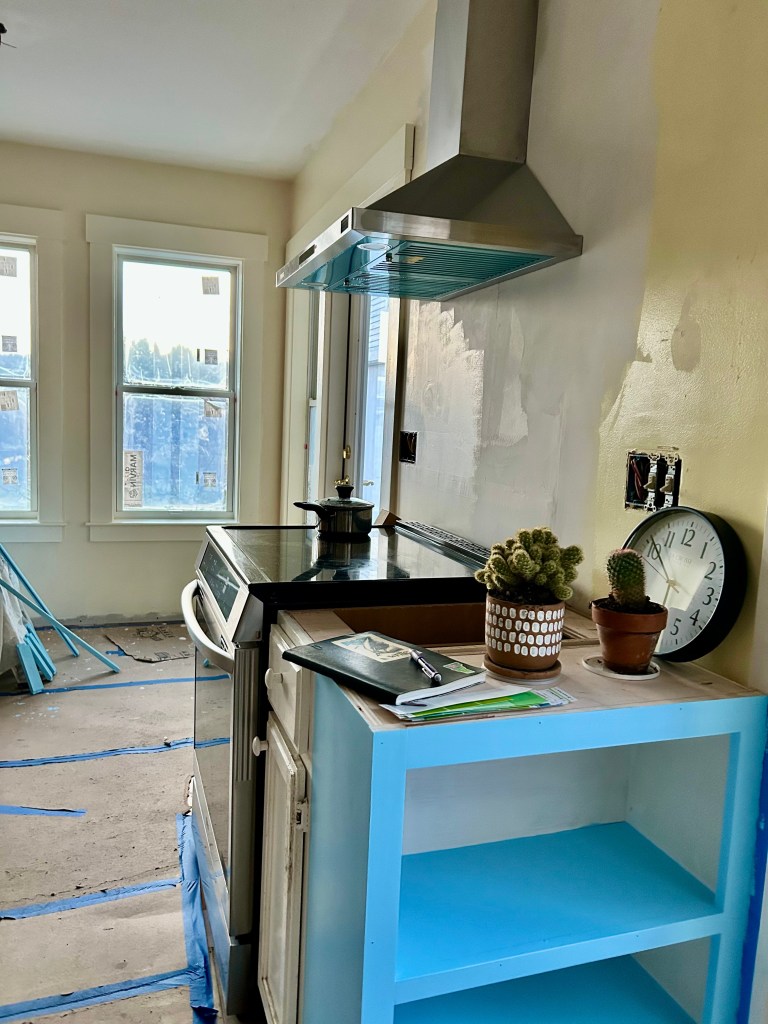
As for me — survived this surgery (hurray, yes) — and I’m now cared for by family who cycle in and out, messages and emails and gifts from friends, kind and competent hospital staff. My great thanks to readers to have reached out to me, or simply read my words. Surgery, indeed, for a laywomen like myself, is an oddity. Scalpel to flesh cannot be an everyday occurrence in a life. I relied on the surgeon’s precision. Grateful, grateful, I am for these skills. Soon, I’ll be home again, in the everyday world of my bright kitchen, our cozy front porch, garden. The lilacs will bloom.

One of our house’s great gems is the lilac bushes that span three sides, in varying lengths. The first spring we lived here, I invited friends for dinner. They got out of their car and stood in the driveway, reveling in the lilacs’ perfume.

While here, I picked up a copy of Loving Frank, Nancy Horan’s fictionalized love story of Frank Lloyd Wright and Mameh Borthwick, which ended in a horrific tragedy. Here’s a line from the incomparable Wright worth thinking over: “The longer I live the more beautiful life becomes. If you foolishly ignore beauty, you will soon find yourself without it. Your life will be impoverished. But if you invest in beauty, it will remain with you all the days of your life.”