Mixing Memory and Desire.

Note the wood smoke from our chimney….

Note this photo was taken yesterday afternoon, when I walked outside and nearly froze the soles of my feet. Note snow surrounded our house this morning….

Note that spring comes hard, hard, in Vermont. Jumping the starting block a few days, I keep thinking of T.S. Eliot’s lines:

“April is the cruelest month, breeding

lilacs out of the dead land, mixing

memory and desire, stirring

dull roots with spring rain.”

The first time I read these lines was in high school, digging into the poetry stacks in the school library, mesmerized by lines like Let us go then, you and I, when the evening is spread out against the sky….

Later, later, spring will bloom in all its tender-petal beauty. But for now…. T.S. Eliot knows the score in Vermont.
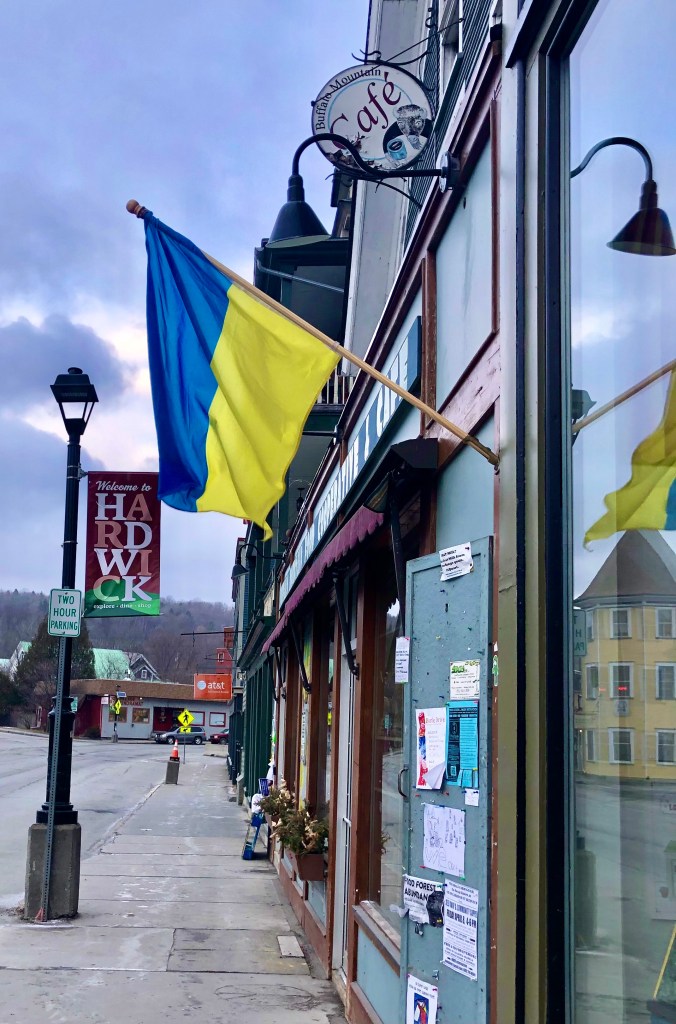
Somewhere in March.

Hardwick, Vermont

Mud season is fierce this year. The school busses cease running on some roads. Families share photos of kids waist deep in mud ruts. Time, more than all the gravel in the state, is more likely to true up the roads than anything else.

Mud season is the odd shoulder season in Vermont. The skiing winds down. There’s no good biking. The tourists are all in sunnier southern locations, and Vermonters muddle along.

All day long, the prettiest and lightest snow falls — nothing serious, nothing much at all — just a scattering of the purest white and enough of a chill that the wood stove is welcoming when I come in with cold cheeks and armfuls of wood. I put a quiche in the oven and head out for a walk. The snow has (mostly) melted here now, and so my paths through the fields and woods have opened up again. Behind the elementary school, the turkey vultures circle over my head. They’ve just returned from their winter sojourn, to their long-time nest in a stand of white pines. I know what they want; there’s no secret here.

I hurry down the hill and along Main Street. A woman stands outside the laundromat, hands in overall pockets, staring up at the drifting snow. She raises one hand to me. I do the same, round the corner, and head home.

Gloves. Rain. A Few Sentences.

I spend some phone time with a woman who works for Delta Airlines, straightening out a cancelled ticket I need refunded. While she does whatever she needs to do on her end, I lean my head against the glass kitchen door. A light rain falls. I’ve just come in from moving firewood from our stacks to the porch, and my sweatshirt is sprinkled with damp bark shavings. I’ve forgotten my gloves on the back step.

I guess this woman is working at home as the phone line is quiet around her voice. She takes her time, sorting through my request and answering the questions I keep asking about airports and taxes and if she has any suggestions for better flight prices. (Nope.)

We exchange a mutual thanking each other for our patience, and inevitably our conversation tips over into the world’s instability. She tells me about her son, a college student majoring in history, and reminds me that human history is infinitely complicated. Finished, she’s on her way to some other phone call, with someone who might be impatient and angry, or perhaps someone funnier or more eloquent than me.

Through the glass, rain falls steadily on my gloves.

March in Vermont is wet and cold. This morning, stepping out for kindling, I stood in the dark listening to robins singing in the day. I remembered to bring in my sodden gloves.

Invisible Child.

Everyday, the light shrinks a little, contracts inward. My oldest daughter and I take a walk after dinner in the inky dark. A cat crosses the street and disappears into the night. This time, too, will pass. We who live here know this — have no other option, indeed, but to endure this — but the short days contract us, too.

In the night, I wake and read before the wood stove with the two blissful cats. Page by page, I work through Andrea Elliott’s Invisible Child, a brand-new copy from the library. Save for the clicking of our wood stove as it heats and cools, expands and contracts, our house is utterly quiet at night. Narcotized by the heat, the cats sleep too deeply for purring. I’m working the next day. A list in my poor handwriting awaits me in my notebook, the tasks I’ll diligently accomplish, one by one. Some are tedious — chores I’ll reluctantly do. But I cleave to that list, my daily rod — bread and butter and bacon for my household, and my soul, too. Around us, chaos and Covid. But for this time, cats, warmth, and words.

In self-defence, you know, all life eventually accommodates itself to its environment, and human life is no exception.” 

― Jacob Riis, How the Other Half Lives

Lamoille River, Hardwick, Vermont