At the edge of damage…

A few days of radiant sunlight and steady breeze, a burnish on my cheeks: solid medicine. It’s spring.

In rapid succession now, the coltsfoot, the lungwort, Siberian squill, my mini daffodils bloom. Each day I remain out of the hospital feels like a victory, a day worth savoring. Afternoons, evenings, I lie in bed reading Dostoyevsky.

There’s this line from a Louise Glück poem I mull over as I walk around my budding forsythia, the Daphne I planted last summer that survived the winter. The line is: “Nothing can be forced to live.” In these lengthening days, I wonder if perhaps my attitude has been skewed for years, gritty-mouthed and wry, one foot behind me ready to flee, the other toes nestling into the garden. Mid-April, and green shoots and velvety petals thrust from the earth. The honeybees swarm. The groundhogs feast and dig. The children ride bikes.

We’re early enough in the season that I can yet pick out this patch of Chionodoxa, the lilac buds. My sandy Vermont hillside thrusts towards life. A poem my friend Jo sent my way, and I’ll send yours is below. Swan’s words about the crack in our world — how much these resonant with me. Now, in my days and nights after chemo, as I begin putting my life and soul back together, I remind myself (as my siblings remind me) to lean into my cracks, to embrace the holes and the whole of my life.

BOWL

BY HEATHER SWAN

for my mother

From the mud in her hands,
the bowl was born.
Opening like a flower
in an arch of petals,
then becoming a vessel
both empty and full.

Later, in the kiln
it was ravaged by fire,
its surface etched and vitrified,
searing the glaze into glass
as its body turned
to stone.

It is at the edge of damage
that beauty is honed.
And in Japan,
the potter tells me,
when a tea bowl
cracks in the fire,
that crack is filled
with gold.
What’s at the heart of a story?

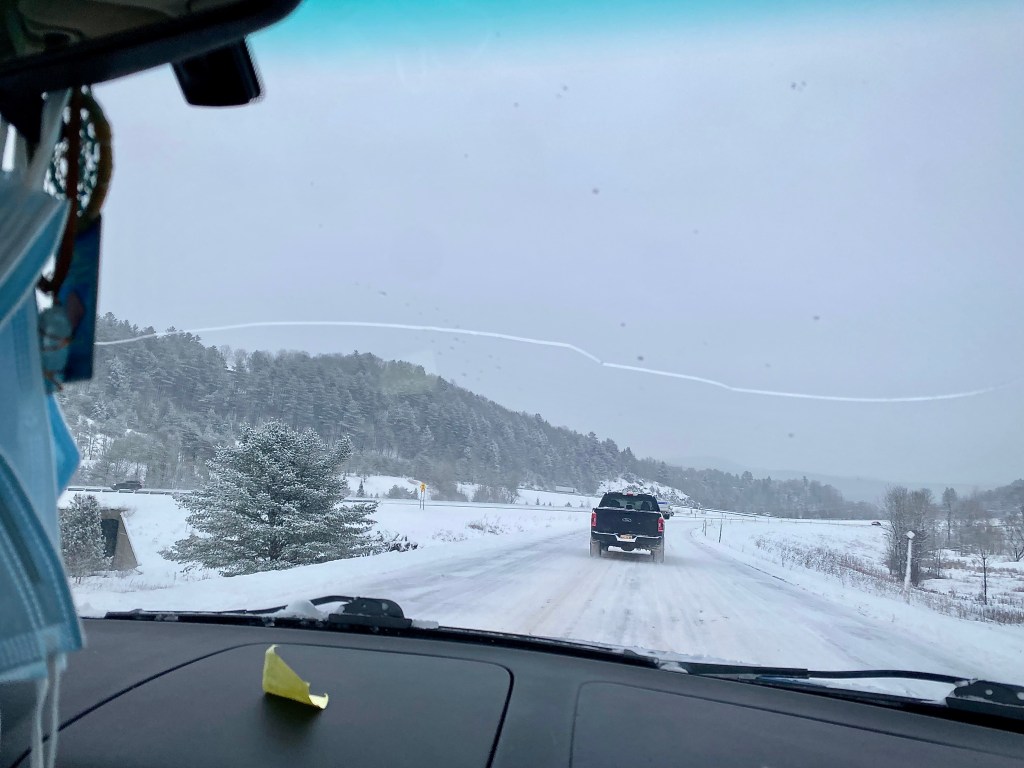
Crack in the windshield, the snowy interstate, the winter metaphor for this cancer journey.

25 hours. Here’s a smattering of highlights… A hard-knuckled drive on unplowed and marginally plowed roads, a side stop to avoid a collision on the exit ramp. Who knew these things gathered such snow? The town lights dimmed by snowfall. On a hotel’s second floor, I lay in bed talking to my siblings while my daughter ate chicken curry. In the bleach-smelling night, I limped up and turned off the heat, stood at the wide window looking out at the neon lights across the midnight-empty highway. The storm had ceased; the neon gleamed GARDEN, so brilliantly red and commercial that, in my sleep-addled mind, I couldn’t pair that word with loamy soil, coiled earthworms, the promising nub of May sugarsnap peas. Unable to sleep, I lay awake, parsing together a story: hook, conflict, and what does resolution mean, anyway? What’s at the heart of a story?

In the early morning, two full lanes of traffic streamed towards Dartmouth Medical Center. On the short cold drive, we drank hot coffee. From here, the story unfolds into the parking garage, blue paper masks, the complexity of so many stories, with so many words. The words alone are brand-new to me — Doxorubicin, Methotrexate— and I labor to learn these, to put pieces of what I can know of my story together. The wide halls in this building soar high, softening voices as the daylight falls down. Always, I hold in my body this conflicted and twisted sense of how much I do not want to be here and how immeasurably grateful I am to be here — but more, too, the profound and sacred sense of so many people, patients and families and the immense staff, each with their own mighty stories, living these stories, in pain and in joy.

In the infusion room, where I sleep and sleep, this time no longer needing small talk, I wake and watch the juncos and chickadees, the nuthatches, flitter in and out of the hydrangea bushes with their brown last-year’s blossoms, perch on the feeders the nurses fill and tend.

The interstate home is clear. The cats yowl for dinner. My house is warm, the dishes washed, the hearth fed. February. The story spins on.

Vessels, Rooms, the Unbounded Sky.

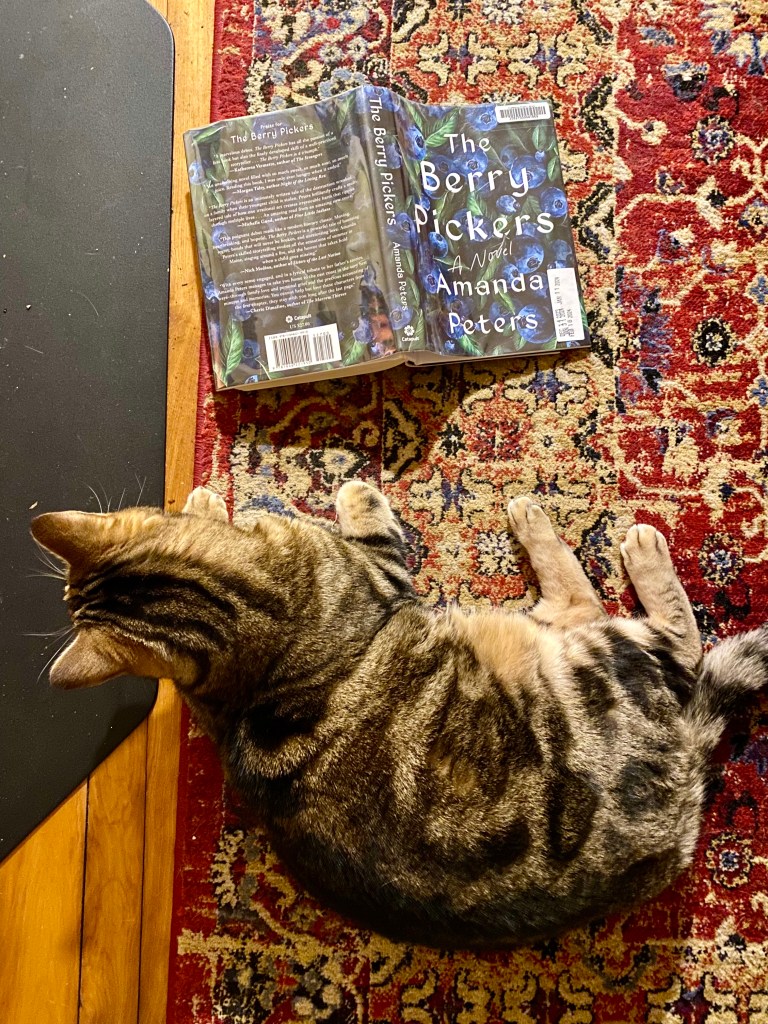
16 degrees on this sun-kissed Sunday, my cat considering the squirrels.

In cancer land, still putting my muscles together, I’m outdoors only with someone else these days, the long solitary walks yet a future promise, again. Early mornings, I brew coffee, fill the cats’ bowls with their breakfast. All day long, we’re filling and emptying things: water glasses and soup bowls and cat dishes (again), filling a notebook page with penciled words, a suitcase with my daughter’s clean clothes as she heads back to college, a new lightbulb in an empty socket.

Likewise, this disease has filled my body for months, now emptying; illness has slipped into every crevice in my family’s life, too, like the power of freeze in a river, rearranging the flow.

In a year that’s begun with so many families losing their homes on the other side of the country, the sunlight on this morning, a chilly walk this afternoon, the cold scraping at my cheeks – yes, yes – a scrap of gratitude for January Vermont sunlight. Here’s line from one of my favorite writers, Andre Dubus, who knew loss keenly.

“We receive and we lose, and we must try to achieve gratitude; and with that gratitude to embrace with whole hearts whatever of life that remains after the losses.”

Complex People.

I was on a Claire Dederer reading jag, stepping into her island home, soaking up her kids and her questions and her fierce writing. Witty, smart, edgy. Which led to me to the father of those children and his books. 

Bruce Barcott writes in The Last Flight of the Scarlet Macaw:

 “… a good portion of my life I believed that a law of benevolent action held sway in the world. This law maintained that if you did the right thing and worked hard, eventually things would work out; that the world generally tended towards fairness, decency, and wisdom. But of course the world doesn’t work that way. The people who learn that lesson through crushing experience and still refuse to bow to it astound me. They go on fighting, again and again and again. These people aren’t perfect. They aren’t simple heroes. They are complex human beings. And we need them. Because without them the world would be lost.”

‘I can feel my life start up again…’

We’ve crossed the halfway point of winter and can, again, believe in the possibility of crocuses, the promise of pearly-and-pale-pink apple blossoms. Monday morning, my friend Brad Ferland invites me onto his WDEV radio program Vermont Viewpoint again. I’m lucky enough to ramble on for a bit about writing, and I spoke a little about this blog. For those of you who are new here, I often write about what the seasons in Vermont mean to me. July is the Swimming Season. September the Season of Fat Sunflowers. February, in my mind at least, is the Season of Hope.

The days suddenly widen and grow. A sunshiny stretch like this, and my state’s collective spirit rises. February is still deep in the Woodstove Season, however, which means, as a writer, no need to worry about missing a few fine gardening hours. The clouds will descend again, and surely I’ll complain (again), but for now, with two days of radiance, savor. Savor.

I feel my life start up again, 
like a cutting when it grows
the first pale and tentative
root hair in a glass of water.

— Jane Kenyon

January: wonder & diligence.

Twenty-five years ago, on a frigid January night, I went to a birthday party and ate chocolate cake. I would have my first baby in a week, and I had gone at that pregnancy with wonder and diligence, heavy on kale and broccoli, scant on refined sugar. The cake was marvelous.

In this warm January, a friend lingers with me over coffee. Melting snow drips from the porch roof as we talk about travel, making art and making a living, parenting. I’m reminded of a line from Raymond Carver that the mightiest force in his life was his two children, Carver who wrote brilliantly about laundromat hours. Wonder and diligence. Our conversation winds around to The List, the eternal draft of chores and visions, the crossing off and adding on, the drafting and revising, the diligence that strings our days together, a crude framework of parenting.

End of January: the weather is slushy and icy, sunbeams a rarity, hardly the season of wonder. My firewood holds the month’s damp, as if resistant, too, to the lousy weather. I lay chunks of wood beneath my stove, drying them a little before I chuck them in, burn the wood to ash.

My little cat flicks his tail. A cardinal nestles in the mock orange’s bare branches, crimson feathers in the muted world. I lay my hand on my cat’s silky back, murmuring, “Well, what do you know….”

And a Raymond Carver poem:

“Happiness”

So early it’s still almost dark out.

I’m near the window with coffee,

and the usual early morning stuff

that passes for thought.

When I see the boy and his friend

walking up the road

to deliver the newspaper.

They wear caps and sweaters,

and one boy has a bag over his shoulder.

They are so happy

they aren’t saying anything, these boys.

I think if they could, they would take

each other’s arm.

It’s early in the morning,

and they are doing this thing together.

They come on, slowly.

The sky is taking on light,

though the moon still hangs pale over the water.

Such beauty that for a minute

death and ambition, even love,

doesn’t enter into this.

Happiness. It comes on

unexpectedly. And goes beyond, really,

any early morning talk about it.