January: wonder & diligence.

Twenty-five years ago, on a frigid January night, I went to a birthday party and ate chocolate cake. I would have my first baby in a week, and I had gone at that pregnancy with wonder and diligence, heavy on kale and broccoli, scant on refined sugar. The cake was marvelous.

In this warm January, a friend lingers with me over coffee. Melting snow drips from the porch roof as we talk about travel, making art and making a living, parenting. I’m reminded of a line from Raymond Carver that the mightiest force in his life was his two children, Carver who wrote brilliantly about laundromat hours. Wonder and diligence. Our conversation winds around to The List, the eternal draft of chores and visions, the crossing off and adding on, the drafting and revising, the diligence that strings our days together, a crude framework of parenting.

End of January: the weather is slushy and icy, sunbeams a rarity, hardly the season of wonder. My firewood holds the month’s damp, as if resistant, too, to the lousy weather. I lay chunks of wood beneath my stove, drying them a little before I chuck them in, burn the wood to ash.

My little cat flicks his tail. A cardinal nestles in the mock orange’s bare branches, crimson feathers in the muted world. I lay my hand on my cat’s silky back, murmuring, “Well, what do you know….”

And a Raymond Carver poem:

“Happiness”

So early it’s still almost dark out.

I’m near the window with coffee,

and the usual early morning stuff

that passes for thought.

When I see the boy and his friend

walking up the road

to deliver the newspaper.

They wear caps and sweaters,

and one boy has a bag over his shoulder.

They are so happy

they aren’t saying anything, these boys.

I think if they could, they would take

each other’s arm.

It’s early in the morning,

and they are doing this thing together.

They come on, slowly.

The sky is taking on light,

though the moon still hangs pale over the water.

Such beauty that for a minute

death and ambition, even love,

doesn’t enter into this.

Happiness. It comes on

unexpectedly. And goes beyond, really,

any early morning talk about it.

Monsters. Childcare.

I stand outside the town office building, eating leftover beet-carrot-garlic salad for lunch, watching the sky alternately break apart in sun or drop rain. If there’s a rainbow, it eludes me. A retired couple who lives up the street walks by, returning from their daily post office walk. We kick around the news: a petition to close the town’s elementary school and how last night’s snow turned to rain.

Slushy, slushy.

The wind kicks up a hint-of-late-February warmth, the way that month can smell of thawing earth, of the gradual thaw-and-freeze-and-thaw that morphs into spring. Midwinter here, the weather out of whack. The afternoon opens into sunlight. The sun’s rare January appearance carries me through the afternoon and into a cheerily ebullient Selectboard meeting, and home again along an icy road, the stars glittering over hayfields, to play cards with my daughter while the cats savor their feline leisure, sprawled before the wood stove.

I lay awake late reading Claire Dederer’s Monsters. Dederer writes:

… the genius is not you. Not me. The genius, as we understand it, is not the person who spends most of her time, and I mean that quite literally, thinking about childcare. My major artistic concern for the past twenty years has been childcare, it has preoccupied me more than any other subject; even now that my children are mostly grown I’m still not sure I managed it well, I lie awake worrying about it, and meanwhile old Pablo was putting out cigarettes on his girlfriend’s face.

Real Things.

Much as I pushed the hippie thing in my younger years, I’ve often sneered (albeit silently) at the tea drinkers, save for my pregnancy years. I’ve always been much more of a knock-back-a-couple-of-espressos woman. But this sodden late afternoon finds me leaning against my woodpile in the dreary rain, sipping steaming tea, remembering my girlhood love of The Secret Garden, Jane Eyre, and scorned Sylvia Plath.

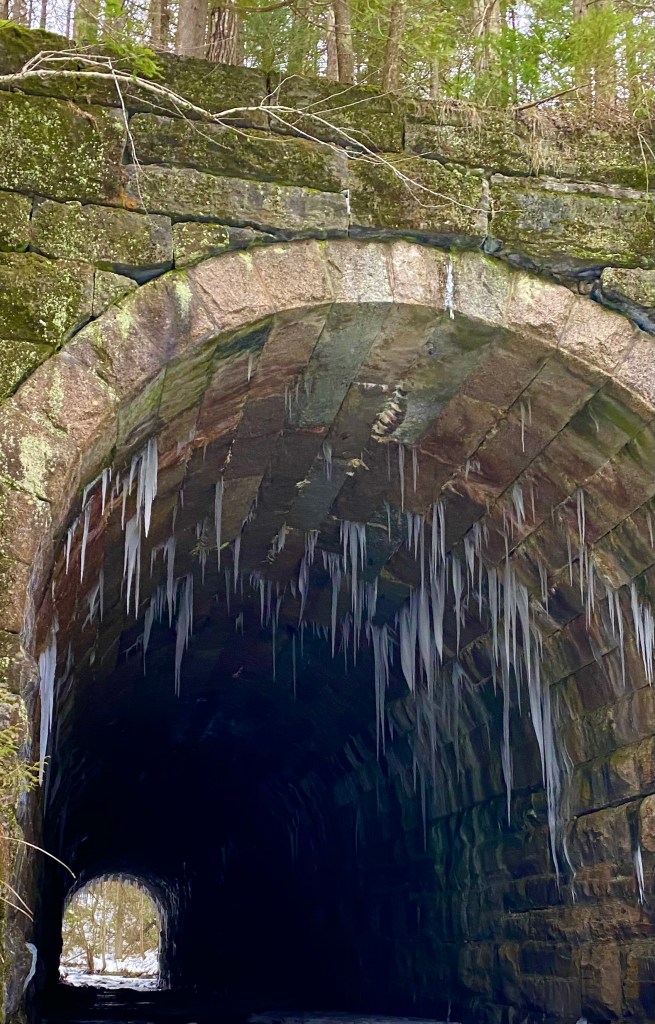
As for the photo above, our Christmas adventures involved inspection of the July flood’s toll on the rail trail’s bridges. Christmas Day, we followed the former railroad bed deep into the woods, where this enormous culvert was skillfully and laboriously constructed a few generations ago. For reasons that need no elaboration, this seems a fitting photo for the trailing end of 2023. Unless you know by word-of-mouth or friend, you could walk through these woods and never see this beauty. Which would be a kind of loss.

I’ve never been a fan of New Year’s resolutions or wishes, so easily broken. But here’s a small one: less of the superficial hashtag life. Hold scorching tea. Share a secret marvel with a stranger. Adhere to the tangible.

And last — I was lucky yesterday to be invited with Vermont Almanac editor Patrick White on Brad Ferland’s radio program Vermont Viewpoint on WDEV. It’s always a joy to participate in radio — especially with my friend Brad and talking about Vermont and writing.

Hope you’re all dry and warm….

Vermont Almanac.

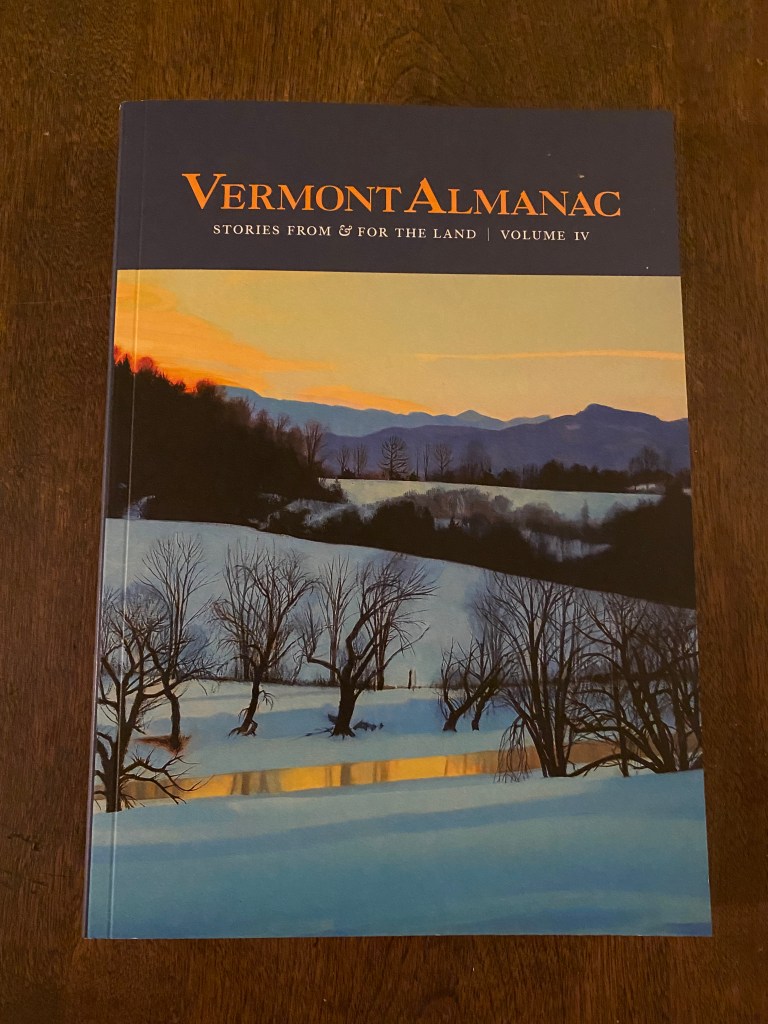
My copy of the fourth Vermont Almanac arrives in my mailbox. Remember real mail? I remember exchanging long letters with friends for years. Email is fine and dandy, but email has no smell. I open the book in my kitchen and breathe in the scent of ink and paper. I was fortunate to write and edit a bit for this issue.

These days, on my moonlit evening walks, living in Vermont is often on my mind. So much has happened in my own life and in this dear state: a summer of rain and wildfire smoke, a flood, beloved Montpelier drowned, a rise in violent crime. And yet, I’m tugged more deeply into this state I’ve called home nearly all my adult life. Reading this hefty book, I’m reminded, again, of how yankee ingenuity is so often yankee generosity, too. While our nation (and much of the globe) as a whole is navigating unsettled and often stormy waters, I’m heartened by Vermonters’ ruggedness, tenderness, and, so often, outright humor. Who could imagine a world without these fine things?

Hope is no mere aspiration that things will turn out well. Hope instead takes our hand, shines a light ahead, and pushes us onward into the messiness and uncertainties of life.

Bryan Pfeiffer, Vermont Almanac, Volume IV

Two Bald Eagles.

After losing Yahtzee twice and then again to make a third, I’m in the passenger seat, heaing north for no particular reason at all. I’ve forgotten the library books I meant to return, and my bend of mind is that it makes no real difference at all.

Just out of town, I spy two bald eagles on the reservoir, hunched on the beginnings of winter’s ice, unmistakable with their dark bodies, the white of their heads. We drive around a bend, disappearing up the road that’s so narrow and tight there’s no good place to stop. By the time the road widens, I know the way back is impassable through thickets. And so we go on. Talking, talking.

The eagles are perhaps the best of holiday metaphors, utterly outside the realm of any camera lens. (Please, my family might beg, could you lay off the insistence of seeing the world in metaphors?)

This, then: two mighty raptors, the season’s early ice, the rising moon. The evening now is cold enough that the moon sprinkles frostily. I dump the compost in the bin and crunch back over the scattered snow, hungry for the embers in my stove.

Yet once being born there is no turning back.

— Hayao Miyazaki

Duskier and Duskier.

Chickering Bog

My brother and I have this odd (and likely annoying) habit of repeating the same word or phrase back to each other. In a November weekend interlude, he says duskier, which sums up these November days. I toss it back to him — duskier — then add gloaming.

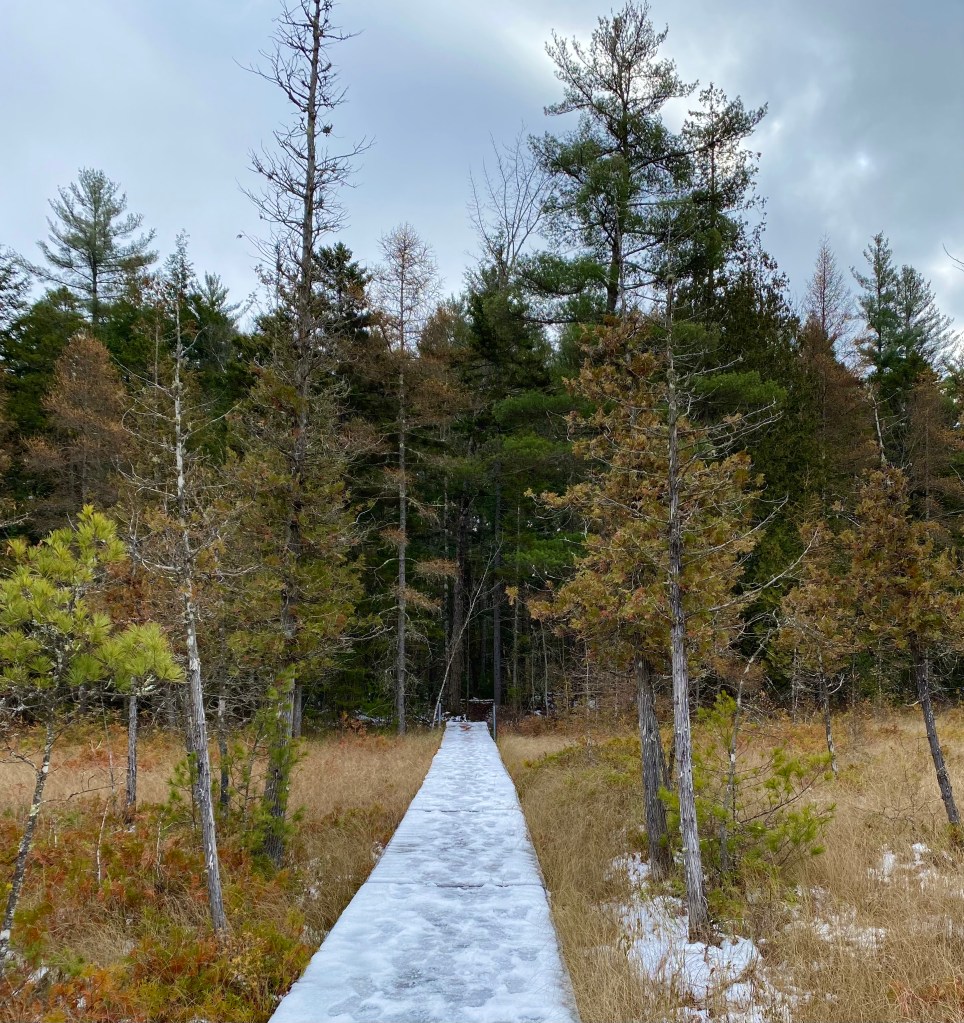
To break the gloom, we walk through woods not far from my house. Little streams run. Somone has built enchanting steps of fieldstones. At the path’s end, a bog stretches out, the tamarcks’ gold faded pale. Spring, summer, the birds sing wildly happy here. Now, the flutter of wings, nothing more.

There’s a place for all of this: silence and settling down, the drawing in for winter.

Come, for the dusk is our own….

— Lucy Maude Montgomery