Finding a Thread.

On my way home, I stop at Number Ten Pond. The water temperature is at that sweet spot, exactly perfect — and how often do you touch perfect? — and I wade right in. A woman stands in the pond, two children splashing around her. She laughs when the minnows bite her toes.

I swim far. In the pond’s center, I float on my back. With my eyes closed, my mind’s eye turns red, with blood or sunlight, who knows, and I’m no longer sure which way is up or down, water or sky. I’m distant enough from shore that only the loon call reaches me. By the summer’s end, these swims will add up to an invisible chain of experience: of water and weather, of whatever language drifts my way. July here, just a handful of fleeting days.

"Everything Is Made Of Labor"
Farnaz Fatemi

The inchworm’s trajectory:
pulse of impulse. The worm
is tender. It won’t live
long. Its green glows.
It found a place to go.
Arrange us with meaning,
the words plead. Find the thread
through the dark.

In the edge…

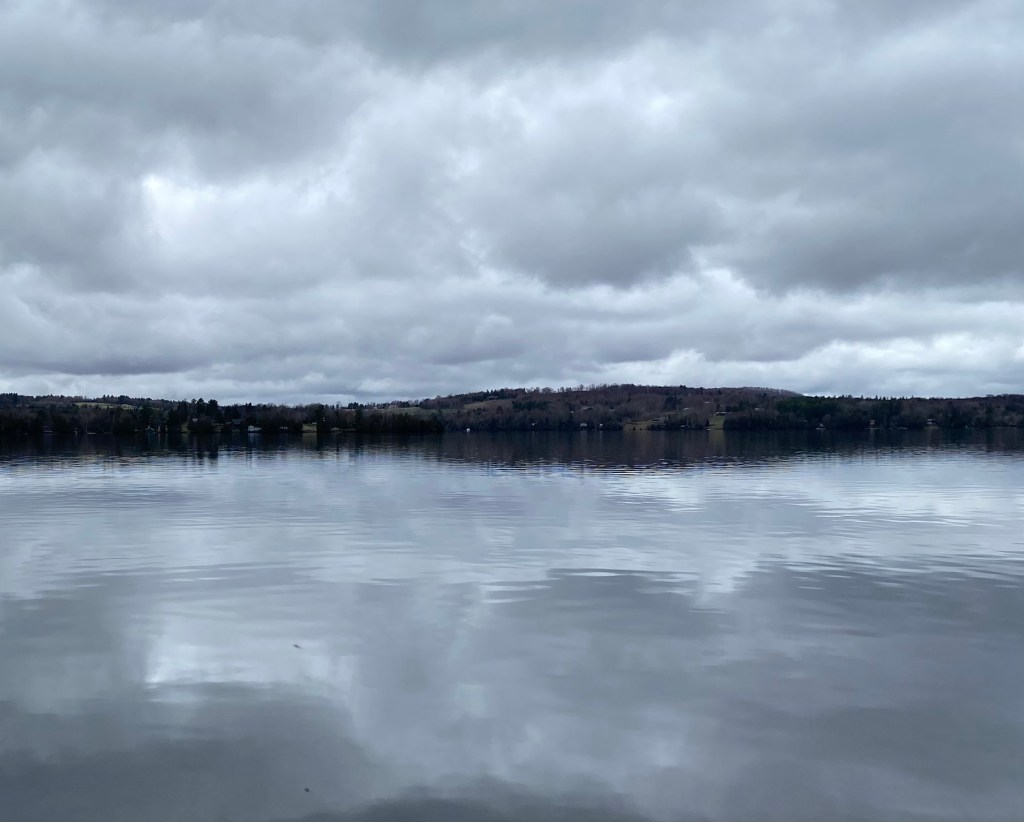
Midafternoon as a storm threatens in, I’m at a stretch of lakeshore where I’ve never swum, and I push in. I’m on the prowl for an eagle, which I never find, and the day has grown muggier than I imagined.

What a month of May this has been. My mother’s death ripples through the amazing forsythia and lilac season, through writing and the steady complexity of work I do for the local Selectboard. At a nearby farm, I buy hothouse basil and tomato starts. A woman I know slightly strikes up a conversation. In the past, our lives ran on weirdly similar tracks, involving divorce, sudden visits from the FBI, the miasma of disorientation. Now, we swap mother stories beneath an enormous lilac. I breathe in the blossoms’ scent.

A few years back, I volunteered in my youngest’s elementary school classroom to assist with a nature program that the kids loved. Naturalist and artist, the teacher kept using the phrase “in the edge.” She pointed out that life thrives at the crossing borders of field and forest, of riverbank, the edges of a homogenous world.

I’m in the edge these days. May’s heat notwithstanding, the water is bitterly cold. I swim out with my lousy swimming skills, my garden’s dirt washing away, the storm clouds hammering together over the glassine water, some of the day yet to come. On the shoreline again, sharp stones gouge my soles.

The Rules.

Stopping beside me on a riverbank trail, a stranger grouses to me about the overcast weather hanging chilly and foggy. I share my month of May story: in my second pregnancy, rain fell every day in May. I’d heard on NPR that a rainy May predicted a sunny summer. That summer, with a new baby, I remember as one of the sunniest. Oh, but fickle memory…. perhaps rain fell all that summer.

The stranger answers, the rules don’t matter anymore, anyway, and loops away on his run.

Oh, the rules do matter. But which rules? My daughter, on a university campus, sends news of our Vermont world fracturing. Meanwhile, around the globe, misery. There’s that old nursery rhyme about for want of a nail the horse wasn’t shod and the battle was lost. The horseshoe nail matters.

Here’s a defining rule: mortality reigns. More: month of May, the tangled wild honeysuckle in the ravine behind my house sprouts leaves. The groundhogs fatten.

In her room at the prow of the house
Where light breaks, and the windows are tossed with linden,
My daughter is writing a story.

I pause in the stairwell, hearing
From her shut door a commotion of typewriter-keys
Like a chain hauled over a gunwale.

Young as she is, the stuff
Of her life is a great cargo, and some of it heavy:
I wish her a lucky passage…

It is always a matter, my darling,
Of life or death, as I had forgotten.  I wish
What I wished you before, but harder.

— Richard Wilbur, The Writer

The dark blossomings of chaos…

Again, this metaphor lens (how is it possible not to see the world in metaphors?) Paul and John’s Long and Winding Road, Dante’s gloomy forest, Sylvia Plath’s bees and beekeepers…

I lead a friend into a forest, a piece of Nature Conservancy land on a dirt road. We’re talking, talking, my eyes searching the forest floor for ephemerals (the trilliums folded shut, trout lilies still only leafy, no blossoms yet). I take one wrong turn, a second wrong turn. I backtrack, looking for the narrow stone steps. Our walking and talking — and my eventual smartening up to pay attention — takes us to Chickering Bog. In this pristine place, it’s just us and frog eggs, fat tadpoles, crimson pitcher plants — the confluence of ancient and freshly brand-new.

The strange thing is, I’ve walked to this bog half a dozen times, easily. Yet never in April when the sunlight drops down through the trees’ bare branches, when the winter-fall of broken branches strews over the paths. Or maybe I’ve never been here with this conversation about things tiny and great. The glassy water shimmers so clear the bog’s mucky bottom tantalizes, unreachable, so many centuries of so much life.

At the journey’s end, at the dirt road’s edge, the sprinkled gold coins of coltsfoot, a purple sprig of flowering Daphne.

On the reading front…..

“We must therefore be willing to get shaken up, to submit ourselves to the dark blossomings of chaos, in order to reap the blessings of growth.” — Gregg Levoy, Callings

A great fountain of white gossamer…

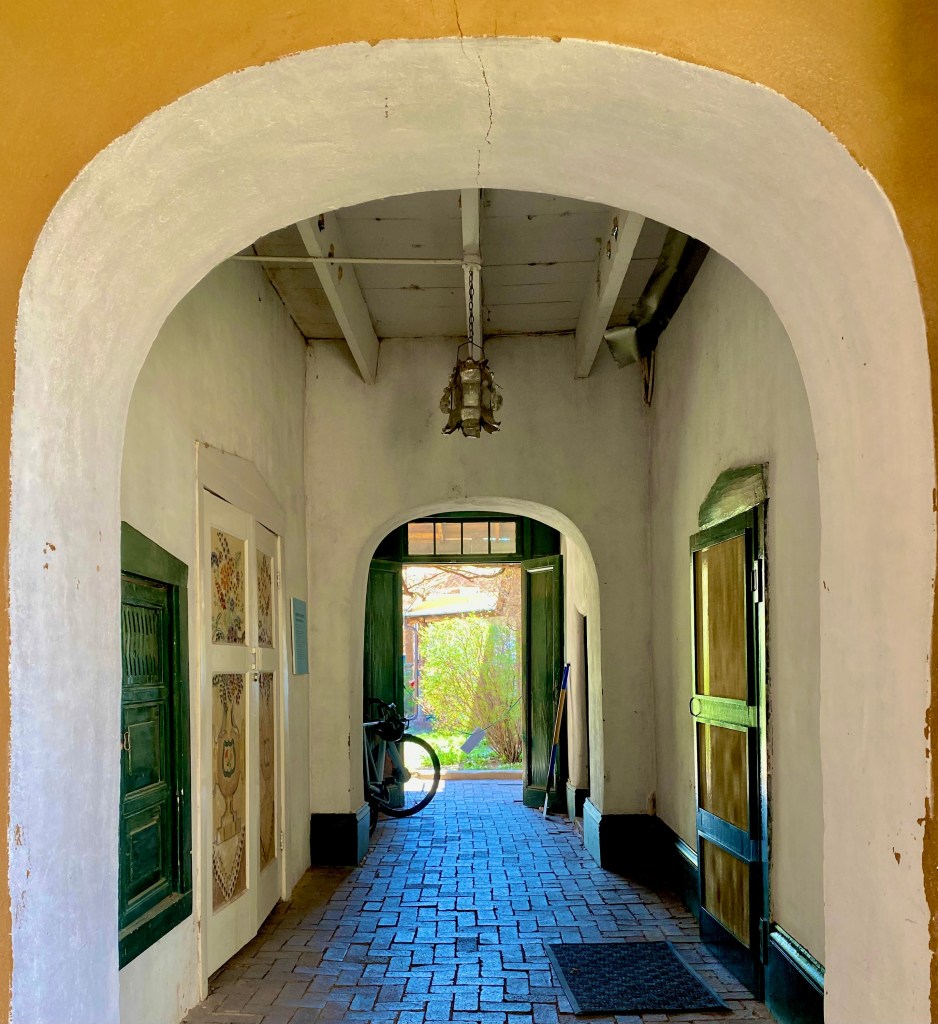
From New Mexico with its sheer light, I descend back to April Vermont, where miniature daffodils push their yellow faces through last year’s leaf mulch. How well I know Vermont spring — the sunny breezy days where the wind tosses the lake and the water is bluer than blue, the footpath sprinkled with the gold gems of coltsfoot.

After the desert’s sweeping beauty, Vermont is a mossy box, a jumble of the paint peeling from the back of my house, the bin of empty cat food cans in barn (quit kicking that dump run into the next week), the niggling college financial aid forms yet to be corrected, the working hours I string together, making some decent use of my time.

April is a month that goes on too long, lingers brown in northern Vermont, with its tease of green trout lily leaves, the flourish of wild ramps. Paradoxically, April has always seemed the most hopeful of seasons, too, the nesting songbirds sweeping out winter’s silence.

In the evening, my daughter and I walk her dogs across the cemetery to the ballfields. Off leash, the three of them run while I stand in the field’s center, listening to the robins’ chatter in the white pines. Back at my house, we stand by the woodpile, talking about little things — who will take the leftover garlic bread, did the butterfly bush survive the winter. The rising moon illuminates the clouding-up horizon with a glowing shaft. We linger, watching the full moon sail confidently, unstoppably, over the horizon. Later, I linger on the back porch, sipping tea. The moon has removed the lid of shoebox Vermont. The air’s sweet with wet soil.

Springtime, 1998

Our upstate April
        is cold and gray.
                 Nevertheless

yesterday I found
        up in our old
                 woods on the littered

ground dogtooth violets
        standing around
                 and blooming

wisely. And by the edge
        of the Bo’s road at the far
                 side of the meadow

where the limestone ledge
        crops out our wild
                 cherry trees

were making a great fountain
        of white gossamer.
                 Joe-Anne went

and snipped a few small boughs
        and made a beautiful
                 arrangement

in the kitchen window
        where I sit now
                 surrounded.

— Hayden Carruth

A little Madness in the Spring.

Post-eclipse, rain moves in, balmy tinged with cold. Rain will force spring’s green. Our lives spin on — of course, of course — but the eclipse and all its radiant glory trails us, the collective experience of the cosmos’ unflinching steadiness and how the heavenly bodies align, majestically moving in their infinite complexity. No stasis in this life.

Someone recently asserted to me the caliber of her character — I’m a good person — and the phrase lingers with me, far more a reflection of my wavering self than of the speaker. We’re so unlike the celestial bodies, our mortal bodies driven by gravity and time, but our actions dominated by our uniquely strange brew of our jumbled lives, passions, weaknesses.

The eclipse’s profound beauty for a few moments swept away the pettiness of our thin ideas, our nattering chatter about so much that, in reality, amounts to scant little. Perhaps the eclipse unified us not only by its luminescent beauty, but tugged out the finer strands of us, too.

For a day or two, Vermont was jammed with visitors from so many places. Vermont’s not unique with much that’s happened in recent history — floods and wildfire smoke, the pandemic, and division and division and division. My state also has some of the greatest privileges on the planet: absence of warfare, significant wealth. Let the eclipse bloom last long, carry us through a muddy spring and into summer, keep us questioning what our own goodness might mean, and how goodness transmutes into action.

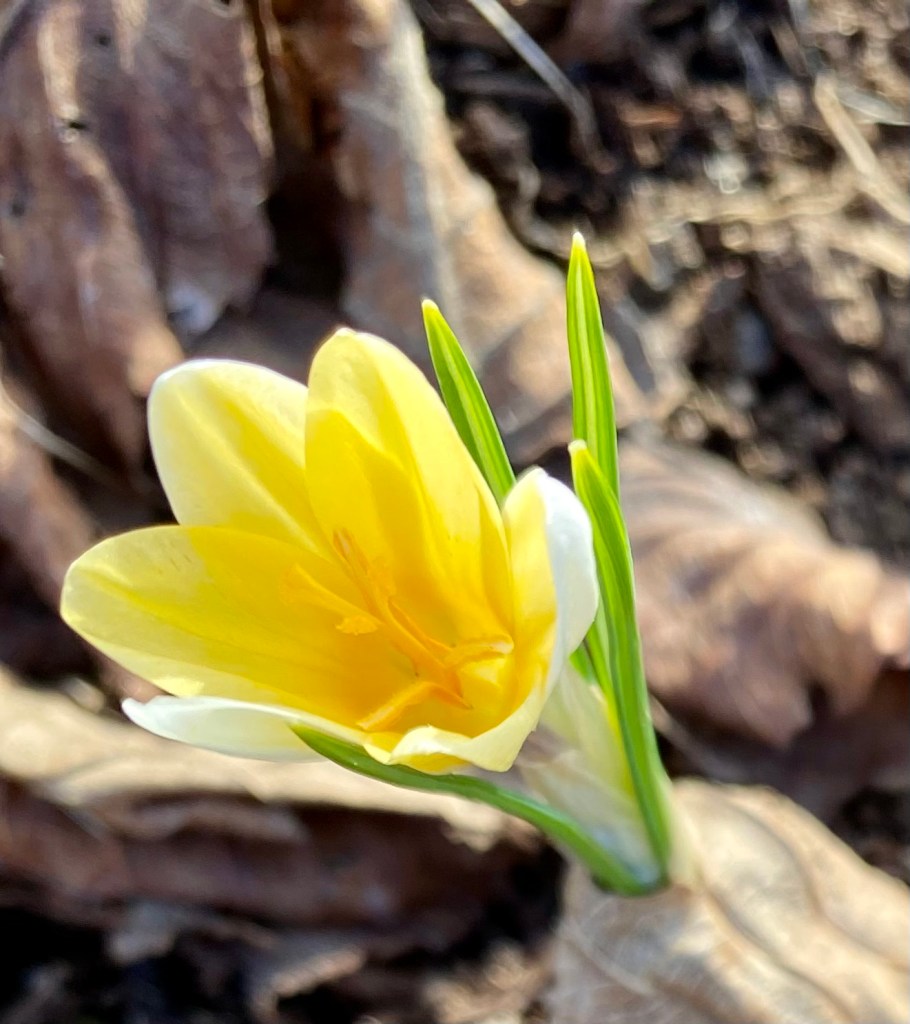
Last, not least: my giddy joy of gold crocuses. Chionodoxa, AKA glory of the snow, scattered over muddy hillsides, last year’s dull lawns.

A little Madness in the Spring
Is wholesome even for the King,
But God be with the Clown—

Who ponders this tremendous scene—
This whole Experiment of Green—
As if it were his own!

— Emily Dickinson