Song against Reductionism.

A pretty wet snow covers our muddy world — temporarily, for sure, a grace of sugar snow in a long mud season. Early March, and I’m already hanging the laundry out to dry, the pale green nubs of perennial bulbs pushing up through matted debris of last year’s leaves, broken twigs.

On a warm afternoon, I put the snow shovel away — my usual blind enthusiasm about spring! I’m the woman who rails against reduction, that the world can be defined as this or that. This world is nothing but gray, an unending smear of thaw and freeze. And yet, I’m wrong about that, too. Daily, the bird chorus gains, the winged creatures flocking in the box elders in the ravine behind my house, feasting at the feeder in the mock orange.

A poem from the late David Budbill:

“What Issa Heard”

Two hundred years ago Issa heard the morning birds

singing sutras to this suffering world.

I heard them too, this morning, which must mean,

since we will always have a suffering world,

we must also always have a song.

No one owns the mud, either.

As the snow melts, the mud comes up. A friend says, But it’s so dirty. I think, Bring on the dirt.

On a sunny afternoon, I disappear early, head out to those secret places where I know the redwing blackbirds sing. There’s nothing I can hold in my hand, nothing I can pocket to bring home and leave on the kitchen table for my daughter, no sign of where I’ve been or what I’ve done, save for the mud that sheds from my boots on the door mat. That, too, is my affair. I sweep it up and empty the dustpan over the back deck.

“Advice from Rock Creek Park”

What will survive us
has already begun
 
Oak galls
Two termites’ curious
self-perpetuating bodies
 
Letting the light through the gaps
 
They lay out their allegiances
under the roots
of an overturned tree
 
Almost always better
to build than to wreck
 
You can build in a wreck
 
Under the roots
of an overturned tree
 
Consider the martin that hefts
herself over traffic cones
 
Consider her shadow
misaligned
over parking-lot cement
Saran Wrap scrap in her beak
 
Nothing lasts
forever not even
the future we want
 
The President has never
owned the rain

— By Stephanie Burt

March. Flowers.

At the co-op, the words are: dirty March. So much snow, rain, the deep ooze of mud, what feels like the very faraway promise of green. Returning home, the teenager has burned herself reading on the back deck. One cat let the other eat his dinner and yowls plaintively, furiously, at household injustice. Stove ash and common dust have invaded the house. Sunlight spills through the windows onto the floor.

March: the season of radiant joy, sullen unhappiness. I lie awake and wonder about my own private death: next week, next month, or four decades from now? I decide the only reasonable course is to bargain for forty more years on this planet, and inevitably take what comes.

Thursday, the day dawns with the scent of loosening mud. The rain slides in. Midday, redwing blackbirds.

A good day for a poem:

Flowers, by Cynthia Zarin

This morning I was walking upstairs
from the kitchen, carrying your
beautiful flowers, the flowers you
 
brought me last night, calla lilies
and something else, I am not
sure what to call them, white flowers,
 
of course you had no way of knowing
it has been years since I bought
white flowers—but now you have
 
and here they are again. I was carrying
your flowers and a coffee cup
and a soft yellow handbag and a book
 
of poems by a Chinese poet, in
which I had just read the words “come
or go but don’t just stand there
 
in the doorway,” as usual I was
carrying too many things, you
would have laughed if you saw me.
 
It seemed especially important
not to spill the coffee as I usually
do, as I turned up the stairs,
 
inside the whorl of the house as if
I were walking up inside the lilies.
I do not know how to hold all
 
the beauty and sorrow of my life.

Green and Brown.

Greensboro Grange, Vermont

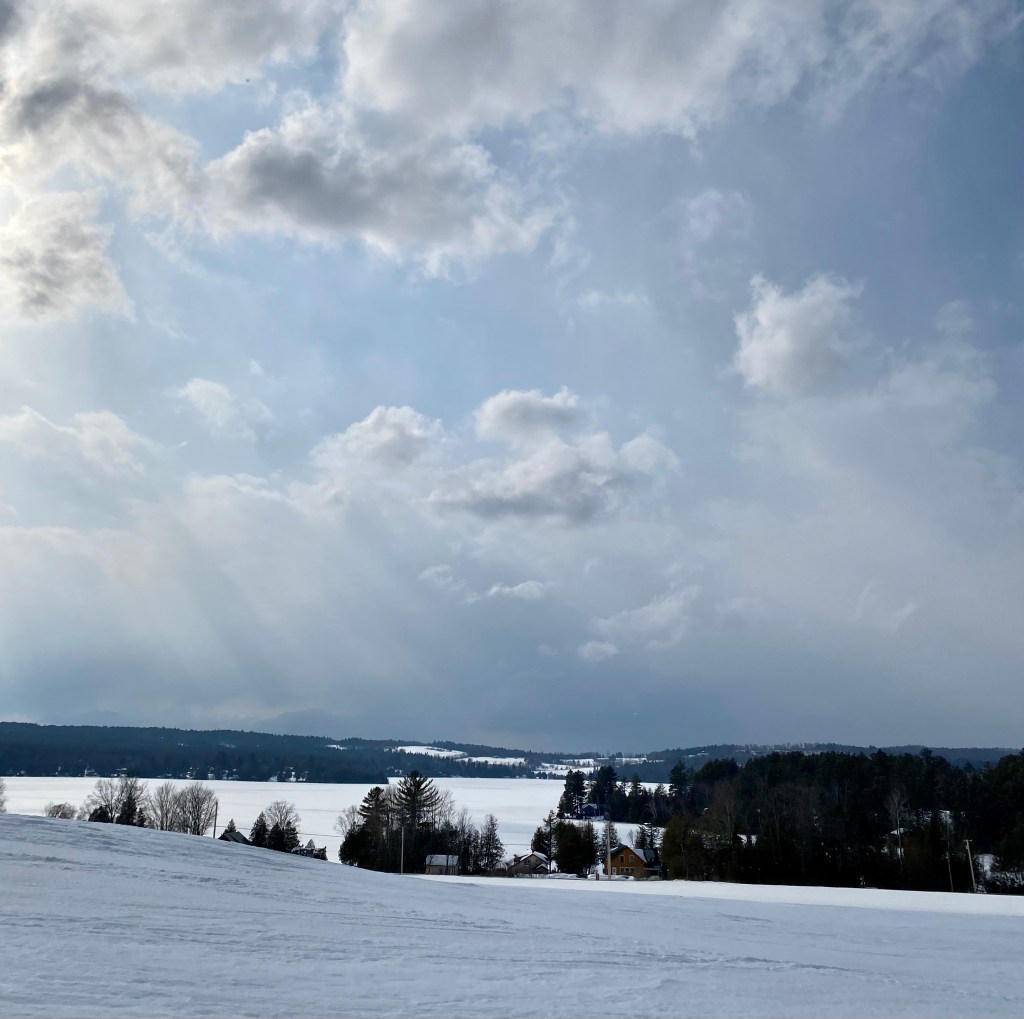
A flock of singing red-winged blackbirds kept me company yesterday on my short walk from the village along the frozen lake. Summers, sprawling houses fill with people from other places, more urban areas, but in this nether zone of late winter/early spring — the mud realm — it’s just me and the rain and the birds.

Of all the seasons in Vermont, this odd one seems the most miraculous to me. Out of dull brown, last year’s frost-killed season, tiny nubs of green appear. So much promise. Every year, this surprises me.


Some springs, apples bloom too soon.

The trees have grown here for a hundred years, and are still quick

to trust that the frost has finished…

You could say, I have been foolish. You could say, I have been fooled.

You could say, Some years, there are apples.

~ “Gather” by Rose McLarney

Somewhere in March.

Hardwick, Vermont

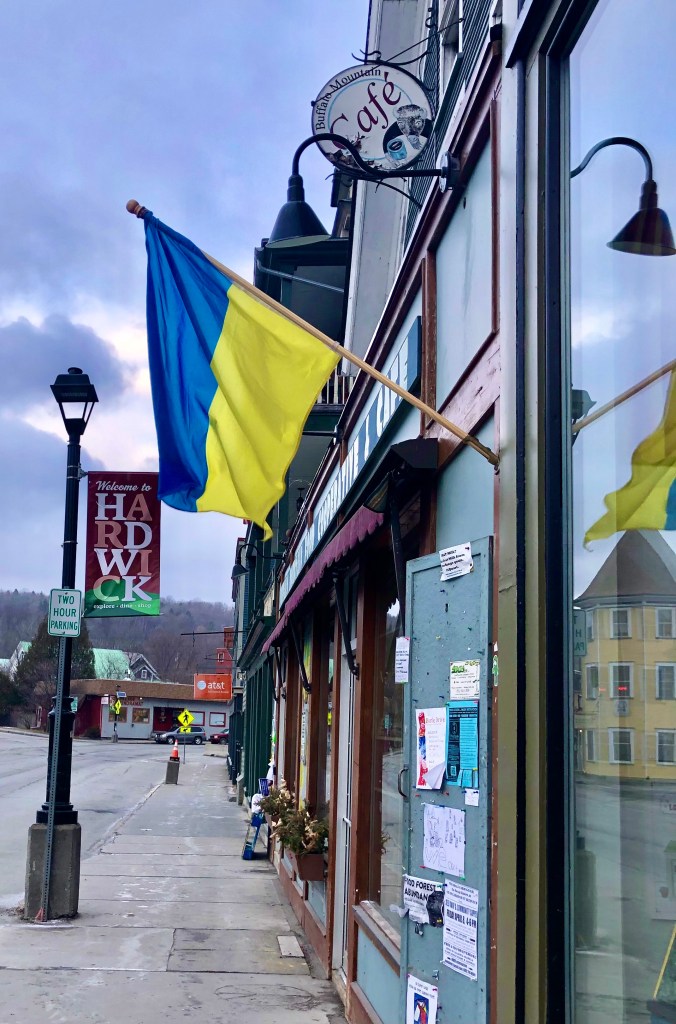
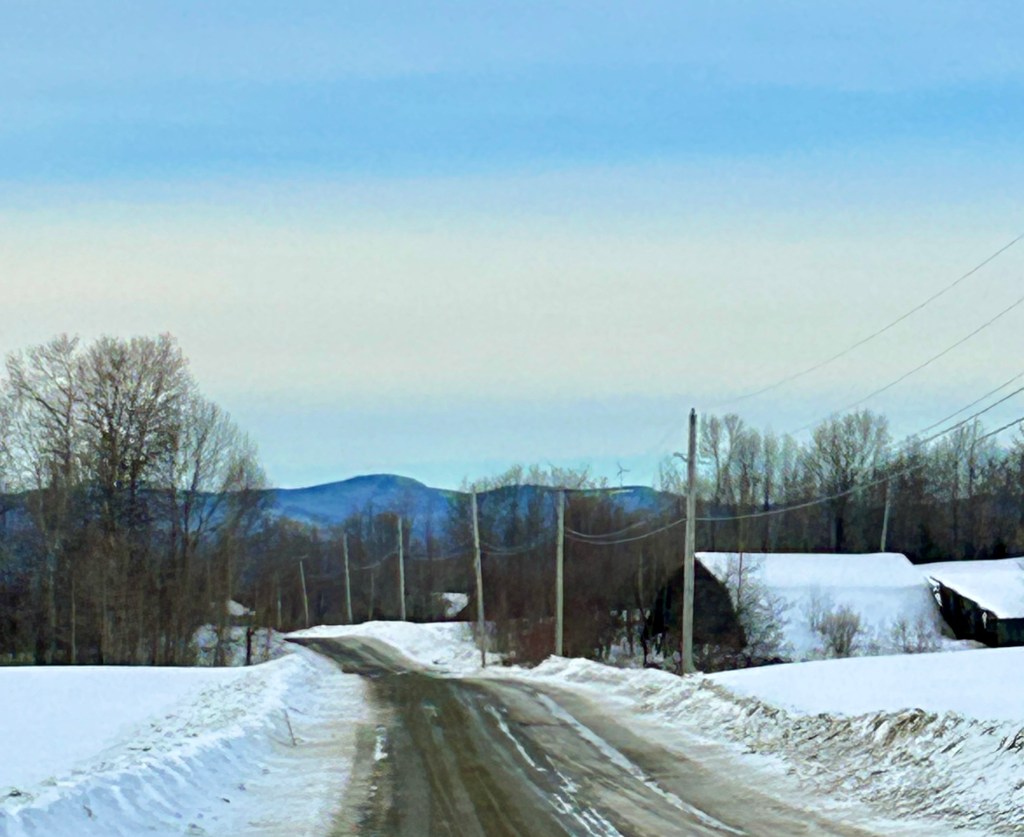
Mud season is fierce this year. The school busses cease running on some roads. Families share photos of kids waist deep in mud ruts. Time, more than all the gravel in the state, is more likely to true up the roads than anything else.

Mud season is the odd shoulder season in Vermont. The skiing winds down. There’s no good biking. The tourists are all in sunnier southern locations, and Vermonters muddle along.

All day long, the prettiest and lightest snow falls — nothing serious, nothing much at all — just a scattering of the purest white and enough of a chill that the wood stove is welcoming when I come in with cold cheeks and armfuls of wood. I put a quiche in the oven and head out for a walk. The snow has (mostly) melted here now, and so my paths through the fields and woods have opened up again. Behind the elementary school, the turkey vultures circle over my head. They’ve just returned from their winter sojourn, to their long-time nest in a stand of white pines. I know what they want; there’s no secret here.

I hurry down the hill and along Main Street. A woman stands outside the laundromat, hands in overall pockets, staring up at the drifting snow. She raises one hand to me. I do the same, round the corner, and head home.