Before Dawn, Children Sleeping

In On the Banks of Plum Creek, Laura’s beloved rag doll, Charlotte, is given to a spoiled neighbor’s baby. Charlotte had been a Christmas gift Laura’s mother had made her, and the girl sorely misses her doll. Later, she discovers her beloved doll, discarded and frozen in an iced-over puddle, and fiercely reclaims her. This all takes place in the chapter “The Darkest Hour is Just Before Dawn,” when Laura, her sisters, and mother are without Pa, and in need.

This morning, in my own pre-dawn house, while everyone was yet sleeping, I thought of Charlotte again, and how I’ve returned to that image all through the varied years of my life, looking for treasures to mend in frozen puddles. Sometimes I wonder where my own daughters will be, years from now, all grown up, enmeshed in families of their own. What have I made or given them that they would rescue from sleeting rain and mud? Something dear, I hope. Something beloved.

Darling Charlotte lay in her box under the eaves, smiling with her red yarn mouth and her shoe-button eyes. Laura lifted her carefully and smoothed her wavy black-yarn hair and her skirts. Charlotte had no feet, and her hands were only stitched on the flat ends of her arms, because she was a rag doll. But Laura loved her dearly.

–– Laura Ingalls Wilder, On the Banks of Plum Creek
IMG_0711


Sisters

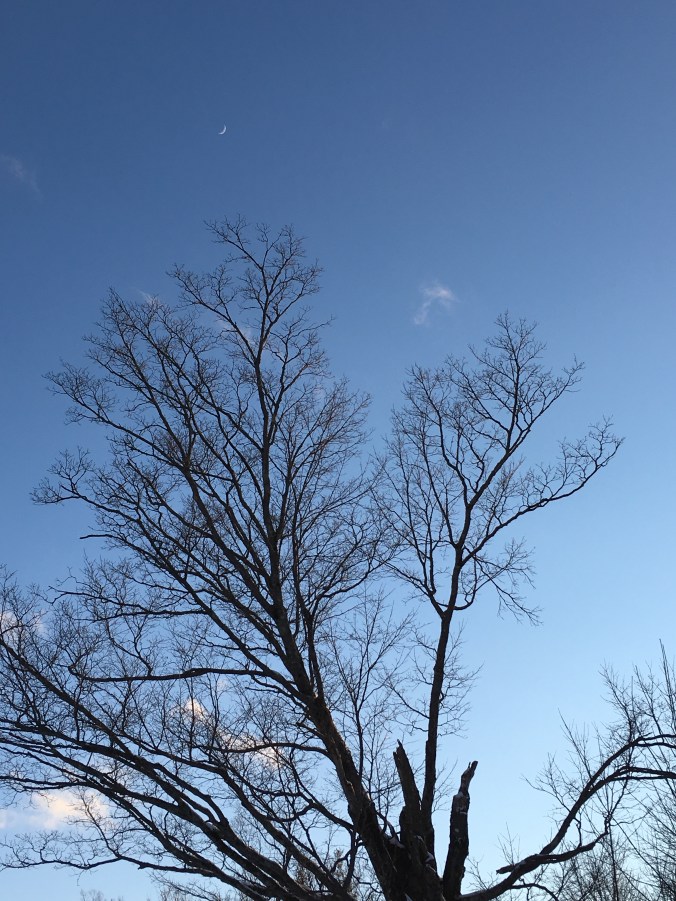
This evening, my older daughter got out of the car in our driveway and exclaimed, This is my favorite kind of moon! Inside, the little girl who had played a basketball game was ravenous. The girls had picked me up from a school board meeting, and the younger one, eating dinner in front of the wood stove, asked why a woman had said, Well, you two are definitely sisters. What does that mean? the younger girl asked.

What does bind a family together? Much more than the shape of a nose, or the hue of hair. Even more, I think, than a keening affinity for the moon, or a struggle to bend art. Our life is composed of many material things: our house, our garden, endless meals and piles of shoes, but also the things we can never hold in our hands. The way we argue fiercely at times but always apologize, how the younger girl laughed so happily this morning when I sleepily put a cup of coffee in the fridge. Oh mom! The way we desire for each other the kind of happiness where you can lie back and let that happiness hold you.

It was the sibling thing, I suppose. I was fascinated by the intricate tangle of love and duty and resentment that tied them together. The glances they exchanged; the complicated balance of power established over decades….

–– Kate Morton, The Distant Hours

IMG_0203

February, Vermont, 2016


May the Road Glaze Up to Meet Us….

No school today, due not so much to snow but to ice. While I was gone most of the day, literally sliding on Barre’s sidewalks, the kids were home. With great gusto, the teenager plowed the driveway, while the ten-year-old teamed up with the neighbor boy. In the afternoon, the boy’s mother and I went walking. I’m reading Rebecca Solnit’s Wanderlust: A History of Walking right now, and I realize my deepest conversations with this woman have been along our mutual dirt road.

Our relationship began before either of us had kids, meeting for the first time along the road when it had washed out in a summer storm. We have now stretched through births, illness, carpooling, innumerable passing back and forth of cake pans and eggs.

And yet it is always the road where we return. Today, with the road’s center sheer ice, she walked on one gravelly edge, I on the other, and we spoke across this narrow road. Back at my house, in the rain, the children had built a couch of snow complete with footrests. I watched the two children later from the kitchen windows, sitting on their mitten-made couch in their bright hats and snowsuits, chatting.

This constellation called walking has a history, the history trod out by all those poets and philosophers and insurrectionaries, by jaywalkers, pilgrims, tourists, hikers, mountaineers, but whether it has a future depends on whether those connecting paths are travelled still.

–– Rebecca Solnit, Wanderlust: a History of Walking

IMG_0698

February, Elmore, Vermont


Icicles as Building Materials

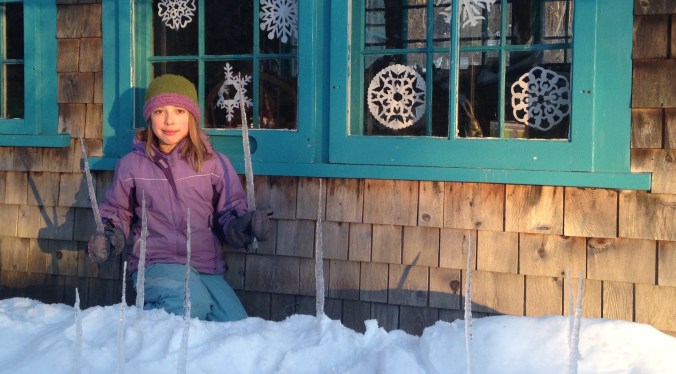
This afternoon, my 10-year-old daughter studiously collected all the icicles that she could reach from the house’s eaves. She then began her winter project of icicle house-building. The icicles have been slim pickings this year, and not for lack of interest. She cajoled her older sister, who had just returned from running, to stretch up and grab a few more.

Returning from a walk, I stood on the road, listening to my daughters at the house, discussing the different colors of ice. This weather, so pure and cold, reminded me of those long walks I took in those last few weeks before my first daughter was born. Every afternoon, I’d bundle up – me and the unborn baby I carried – and walk in what I remember as an especially sunny and cold winter. More than anything, I was most curious to meet this baby, to see this tiny person’s face: my child!

Our relationship has long since grooved into the varied terrain of mother and daughter relationships, far deeper, far richer, far more full than I ever could have imagined, sprawling beyond any cliched confines.

I have one daughter emerging into young adulthood, the other enmeshed deeply in the middle of her childhood. In the end? Who knows? How will these girls look back upon these years? But I hope they remember the loveliness of these ephemeral ice creations.

I do not miss childhood, but I miss the way I took pleasure in small things, even as greater things crumbled. I could not control the world I was in, could not walk away from things or people or moments that hurt, but I took joy in the things that made me happy.

–– Neil Gaiman, The Ocean at the End of the Lane


FullSizeRender

Mid-February, West Woodbury, Vermont

Youth

I’m reading Daniel Raeburn’s Vessels – his harrowing memoir about his first daughter, stillborn. Like the best of memoirs, this is not about a single, isolated event in the couple’s life: it is about their marriage in the wider sea of family and friends.

His wife, a potter, told him early in their relationship:

There are three tests for a pot, she said. First, when you throw it, it has to feel right in your hand. Then, after you fire it, it has to come out looking like something you’d want to keep. Then comes the third test: You have to live with it. You have to use it. This is the real test.

–– Daniel Raeburn, Vessels

Today, seventeen years into parenting, I’m home with a house full of teenage girls. Doesn’t that single sentence contain an infinity? Ten girls with their own long legs, ten hairstyles, ten unique pasts, ten pairs of eyes open to their budding womanly futures.

Like clay, our lives are slipping, hardening, crumbling, ever changing. Use it. Embrace it.

FullSizeRender

Birth

An image appears in art, over and over, of a human down a deep narrow well: trapped. What’s at the bottom? What’s at the top?

17 years ago, I had a prolonged labor with my first daughter, where, hours into it, I knew I was descending headfirst down a stone-lined chasm. In all that darkness, I saw only my outstretched hand, reaching down. At the bottom, I knew with a certainty, as clear as I have ever known anything, lay my death.

I never reached the end of that chasm that night. Instead, I met my daughter, born via emergency caesarian. When I saw her tiny, wrinkled body for the first time, held up for me in the surgeon’s bloodied gloves, her eyes were wide open, and I thought with a fierceness I have never relinquished, She’s mine.

These few lines are but a piece of her traverse into this earthly world, and my soulful journey to meeting her is as real as the glinting scalpel in the surgeon’s hand that released her from my body. So, as fiction writer, when I write of rock-lined tunnels or starless nights, I’m not fabricating stories from nothingness. The interior roads we take may be unseen to the eye but are just as vital, just as humming with mysterious life, as a newborn’s eyes.

…(my mother) was
bearing down, and then breathing from the mask, and then
bearing down, pressing me out into
the world that was not enough for her without me in it,
not the moon, the sun, Orion
cartwheeling across the dark, not
the earth, the sea--none of it
was enough, for her, without me.

–– Sharon Olds
FullSizeRender

Montpelier, Vermont