Birthday Present

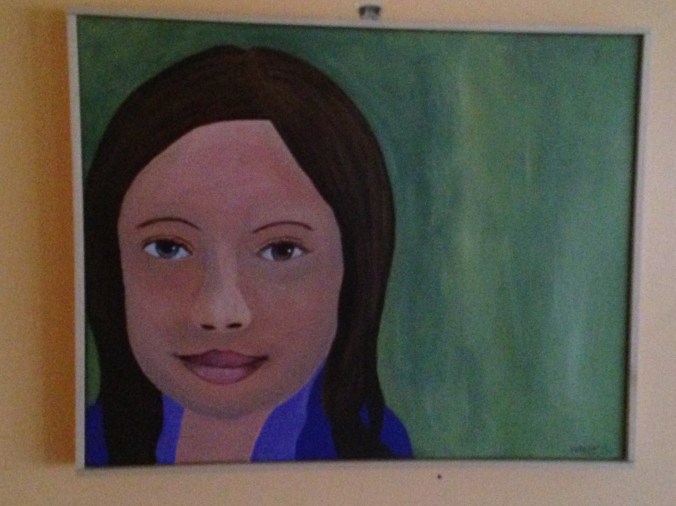
For my birthday present, my teenage daughter painted a portrait of her younger sister. Beyond the gesture of a gift, the painting pleased me immensely, as it captures my younger daughter’s level way of gazing at the world, a steadiness she exhibited since very early childhood.

This painting also illuminates my teenager, decidedly and unselfconsciously off-center, without glitz, deeply attuned to beauty. When I first became a mother, 17 years ago, I lived in a world of my own expectations – of what I wanted for my children. Oh naive woman, I think back to my younger self. Relax. Worry less. But, as a new mother, I had no idea I would someday receive this gift of windows into my daughters’ souls.

The truth is that life is hard and dangerous; that he who seeks his own happiness does not find it; that he who is weak must suffer; that he who demands love will be disappointed; that he who is greedy will not be fed; that he who seeks peace will find strife; that truth is only for the brave; that joy is only for him who does not fear to be alone; that life is only for the one who is not afraid to die.

– Joyce Cary

FullSizeRender.jpg

Inner Lives

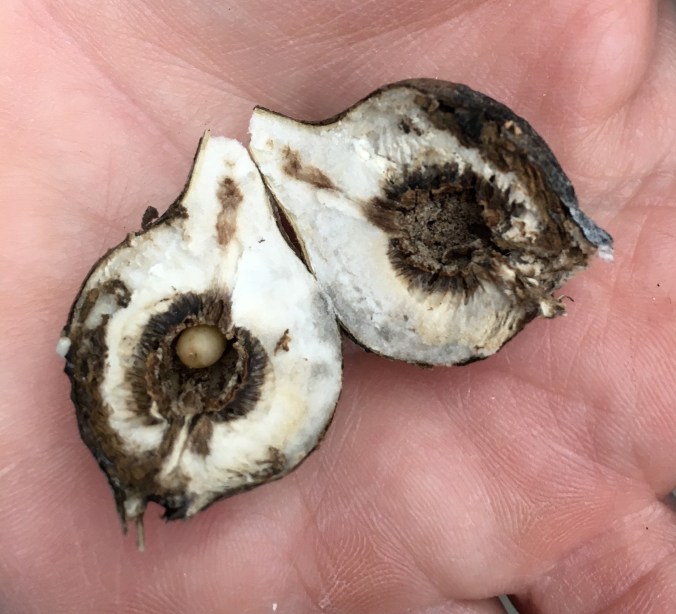
With the kids at school this afternoon, we gathered goldenrod galls. On an old board, I cut the galls open with a knife somewhat too dull for the work. Inside, we discovered the hidden world of the larvae, curled up in its spongy nest. All winter, these miniature creatures have lived in their solitary round homes, steadily growing, with a single shaft of light illuminating their passing days.

50 weeks – 50 weeks! – are needed to create this fly: roughly 350 days. Then, those that survive the winter, those that are lucky enough to be passed over by chickadees or curious children, live for two weeks: perhaps 14 days.

Our children, intently curious, good-humored in a light mist, have a life cycle fortunately (generally) so much different. How many long days and night have gone into my mothering? I wouldn’t begin to count. It’s not a mathematical equation.

Nor was it really mathematics we explored today beneath that rough covering. It was life.

BLUEBIRD

there’s a bluebird in my heart that
wants to get out
but I’m too tough for him,
I say, stay in there, I’m not going
to let anybody see
you.
there’s a bluebird in my heart that
wants to get out
but I pour whiskey on him and inhale
cigarette smoke
and the whores and the bartenders
and the grocery clerks
never know that
he’s
in there…..

– Charles Bukowski

FullSizeRender

Photo by Molly S.

Maple, Maternal

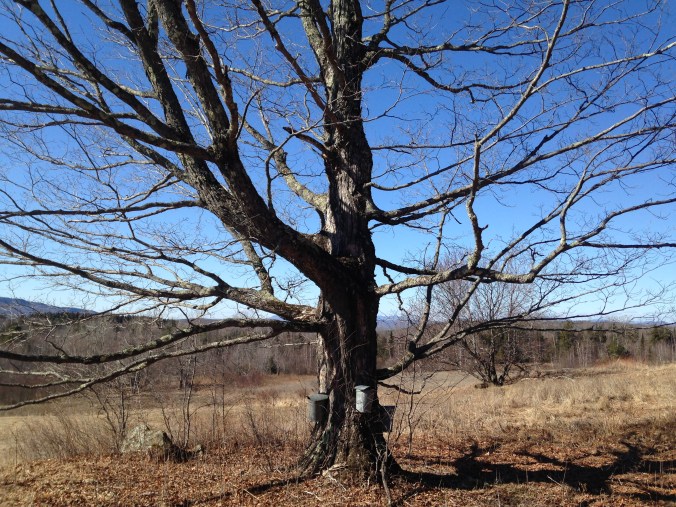
The granite foundation of a barn I never saw standing once spread across a field not far from our house. The barn burned before I lived on West Woodbury Road, and a number of years ago, the property changed hands. The new owners grazed cows in that field, and someone removed all the old granite blocks. Now, a young Menonnite couple and their two small boys live there. Last spring, they tilled an enormous garden and planted a huge strawberry patch. Those plants should produce this summer.

Over years, my growing daughters and I watched this field change. One summer afternoon, as we sat on the lawn of the long-abandoned farmhouse,  I noticed the electrical line stopped at the barn. I’d heard rumored the bachelor who last lived in the farmhouse had no electricity, but I’d never noticed that rural electrification must have brought juice right up to the barn and then stopped. The house was across the road. From when it was built until it was pulled down, electric lights never lit its rooms.

This spring, the young couple with their two merry-eyed boys tapped maples all along the road. Last summer, we saw them – father, mother in her skirts, boys in the bike seats – pedaling along the road in the well-lit evenings. May the sap flow generously for these kind people, from the trunks of these long-enduring, wide-reaching beauties. Today, I lay on the cold ground, staring up at that infinitely blue, March sky, world without end.

Whoever you are, go out into the evening,
leaving your room, of which you know every bit;
your house is the last before the infinite,
whoever you are.

– Rainer Maria Rilke

IMG_0875.JPG

West Woodbury, Vermont

The Great Wide World

Early this morning, on what promised to be an incredibly balmy Vermont day, I read with intense fascination a few pages my father had emailed me. The pages were from Sherwin Nuland’s How We Die, about a horrific and bizarre murder of a young girl. Having two daughters myself, I read with agony. In this excerpt, Nuland clips in a lengthy written piece by the child’s mother. She described her own sensation of warmth at the murder scene, and a calmness in her dying child’s eyes, as though the actual event of dying had been cosseted – or eased–  in some inexplicable way for the child and the mother present at her violent death.

While I have been fortunate beyond measure never to experience that kind of trauma or grief, three times in my life I have had a wholly mystical experience at pivotal junctures.

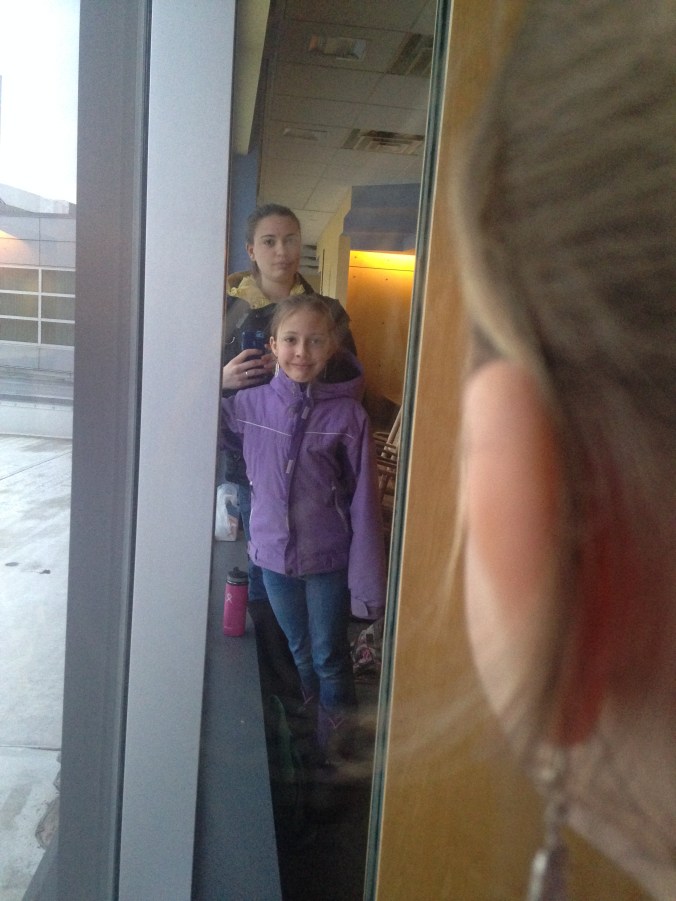
At the caesarian birth of my second child, lying prone on the table, I had a forceful urge to rise up and leave the room, that I would suffocate imminently if I did not move. With the anesthesia, of course, I couldn’t do more than raise my arms and head, and then abruptly I was external to my body. With a clear understanding that I was drifting towards the ceiling, as if I were a helium balloon, the voices of the operating room lessened, words receding into murmurs. I had a profound sense of calm, and I had no regrets about slipping away. Then I heard an infant crying, a thin, plaintive wail, and I thought (this seems quite odd now), Whose baby is that, crying and alone? I thought how cold it was in that room for a baby. Later, I thought I had pity for that baby, but perhaps, more accurately, it was empathy. Abruptly, I realized that crying baby was mine, and instantaneously I was back in my body in the OR, begging to hold my newborn.

I first met this daughter through sound, not through the flesh of a vaginal birth or a wet and squirming infant laid against my bare breast. Yet the bond between the two of us is impermeable. My impulse to nourish and protect this child – to mother her – is as mighty as any universal law, consistent as gravity pulling falling apples to earth. Repeatedly over the years, I’ve thought of that Shakespearian line There are more things in heaven and earth, Horatio,/Than are dreamt of in your philosophy. Those wonders, certainly, are far more faceted than simple pleasure, in our world filled with such joy and such incredible grief. And yet, reading this morning, again I realized how wide is our universe, infinitely wiser than its players.

As a confirmed skeptic, I am bound by the conviction that we imust not only question all things but be willing to believe that all ithings are possible.

– Sherwin B. Nuland, How We Die
IMG_0811

Photo by Molly S./Burlington Airport, Vermont
The Vermont Season of Pre-Spring

A number of years ago, I conceived an idea that our family’s financial salvation lay in wedding favors. With our maple syrup, colored card stock, a paper cutter, and raffia, I filled tiny bottles with syrup and bow-tied on little cards printed with hopeful things like Julie and Josh, July 8, 2001, Eat, Drink & Be Merry. Or: A sweet beginning. In the long run, my fortune didn’t lie there, but I met interesting people at profoundly pivotal junctures in their lives.

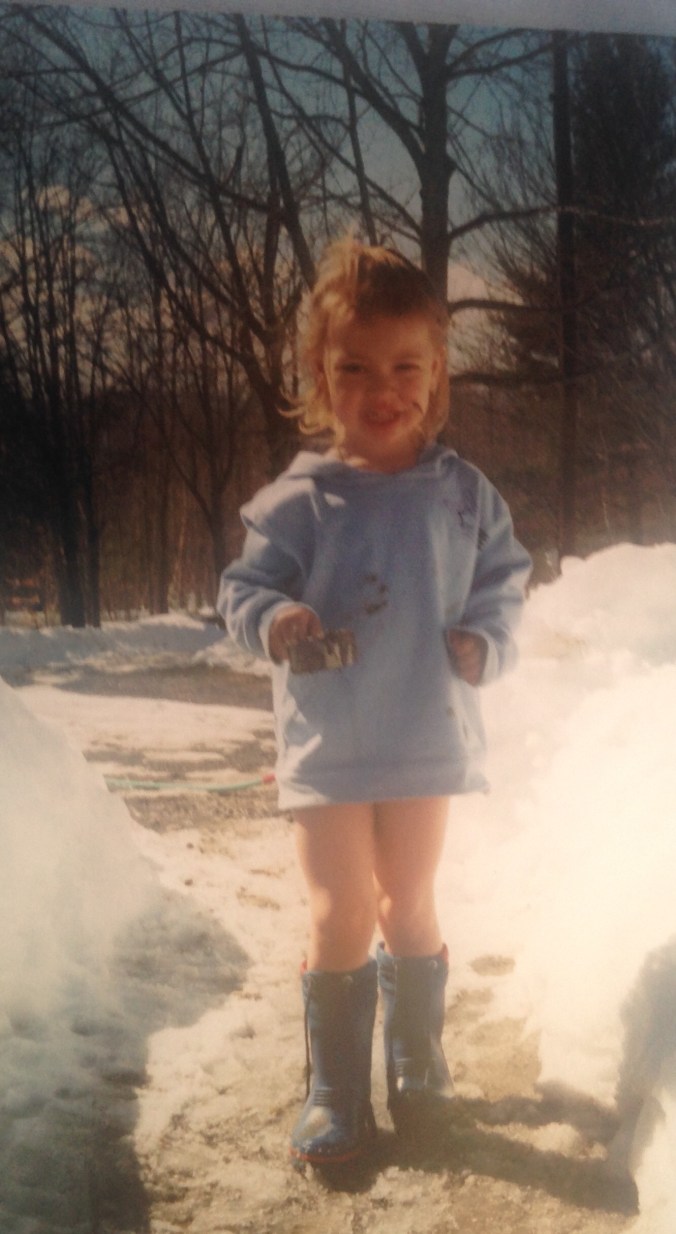
One April, in an intense mud season, a couple unexpectedly drove out to our house. We were deep in the midst of sugaring with a three-year-old. On our back road and driveway – and all around the house where the snowbanks were fiercely melting – lay mud that sucked at our knee-high boots with an audible glop. The winter had been its usual terror, and immense snowbanks mounded all around the house, interspersed by our trodden paths. My gorgeous little girl, with unbrushed hair, walked around shirtless in overalls and mud boots, a yellow plastic sand toy shovel in one hand.

The couple had heard about our wedding favors and had arrived to order in person. He and my husband talked about Ford pickups while I chatted with the woman. She kept looking around, distressed. It’s just so muddy, she kept saying. How do you stand it? Where she cringed from dirt and inconvenience,  I saw sunlight so intensely bright it lay like shining gold coins on the shallow dips of water that spread out all around our house, as though we were a ship on a rippling sea. I knew mud as the world’s thrust from winter to spring, the give from one season to another. My heart lightened with joy at the end of a bitter cold season and the imminence of wildflower season. I knew coltsfoot would shortly bloom.

…Soon it will be the sky of early spring, stretching above the stubborn ferns and
violets.
Nothing can be forced to live.
The earth is like a drug now, like a voice from far away,
a lover or master. In the end, you do what the voice tells you.
It says forget, you forget.
It says begin again, you begin again.

– Louise Gluck, from “March”

FullSizeRender


Hearth

This morning, the house grew cold as I let the fire in our wood stove dwindle. When it was nearly dead, I pulled apart the stove pipe and stretched my arm deep down its throat to loosen the rattling creosote. With a shovel, I removed the ashes from the stove, then vacuumed the damper vents at the back, so the air will flow again. In the baffles at the top, I reached between the metal and fireproof insulation and pulled out handful after handful of silty, warm brown ashes, silky as kittens. I kept thinking of Megan Mayhew Bergman’s story “Housewifely Arts.”

This evening, after a day of snow and freezing rain and sleet, our hearth is rich with heat again, the children sprawled luxuriously on the rug. One of the interesting aspects of writing is a tendency to turn things upside down and inside out. Our stove is not merely a source of heat, but also consumer of wood and air, creator of ash, its lungs linked to the chimney funneling through our house. I once spent the greater part of an afternoon with a heating specialist who explained the inner workings of a nearby hospital, the channels of electricity and oxygen and water and waste, the circulatory system of an enormous building, generally unseen but vital.

Maybe it’s a day like this, when winter relinquishes its hold reluctantly, hurling ice at our windows in fury, that brings us back to our hearth again, gratefully.

There is no need to explain to our daughter the death of her first dog. Poppy, better than any of us, understands the urge to have what you must have. She can still wring what she wants from the world. It has listened to her cries and delivered. She still trusts the raw pull of desire. One day it will tear her away from us, take her down a dirt road to a place she does not recognize, and there she will make her home. Away from everything she understands, and close to everything she wants.

– Megan Mayhew Bergman, “The Two-Thousand Dollar Sock”

FullSizeRender

Winter Garden, Vermont, 2016