Roadside Schooling

The kids and I stood at an exit off I-91 today looking for an old maple tree. The tree wasn’t hard to find, right near a park-and-ride, the fieldstone remains of a former barn or house nearby. My younger daughter noted the upper, dying branches of the tree had been wired together, and remarked that, rather than taking a chainsaw to the trunk, someone had taken the time to care for this tree. This ancient beauty may yet linger for years.

The evening before, we had listened to a poet read about this former Vermont farm, in his collection Vermont Exit Ramps II. At the terribly sad ending of this story about Romaine Tenney, I watched in the dim theatre as my older daughter’s mouth visibly opened in shock.

On our drive home, I realized how carefully she had listened to the poem, as she gave me solid directions. While the midmorning commuter traffic rolled in and out of the lot, we studied the mountains and the bend of the land, living in the facets of the past’s stone and trees traces, the sunny and breezy present, and the poem, binding the two.

Hello black fly. Thanks for the welcome.
Now I know what Romaine Tenney cursed
and loved here on Tenney Hill Road: the sting
inside blossoming, the black bother
at the center of the eye bent on spring beauty….

– Neil Shepard, “Romaine Tenney”
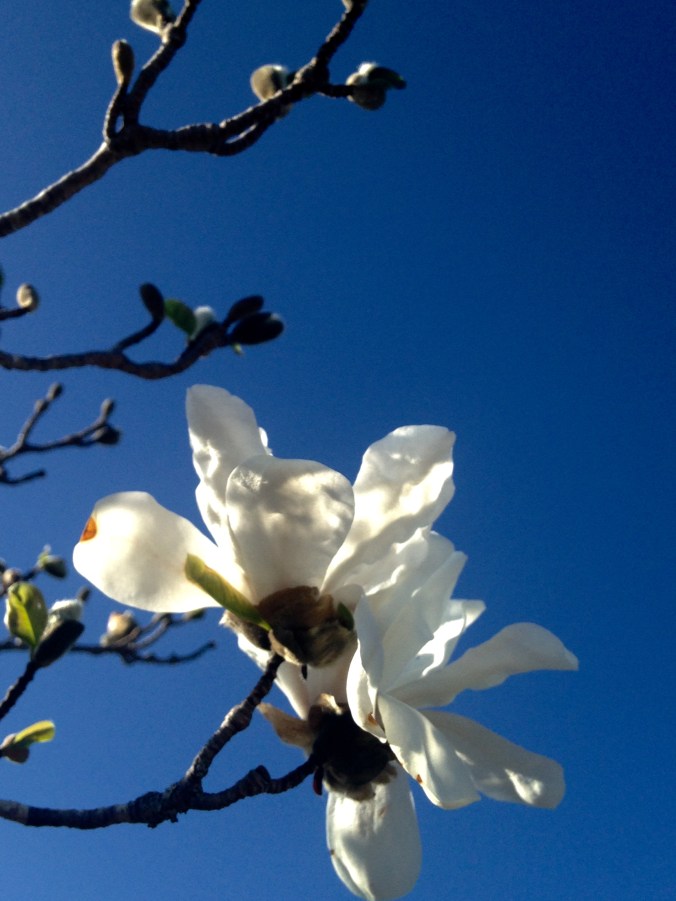
IMG_2245.JPG

Brattleboro, Vermont/Photo by Molly S.

Frog Chorus

I hate it when my daughters bicker.

Stop, stop, stop, I demand. Are you listening to yourselves?

They look at me oddly, and insist, This isn’t fighting, mom.

Recently, I’ve been forcing myself to close my eyes and simply listen to the cadence of their voices. Not the words, not even the tone, but only the rhythm and motion of their voices together. They pick at each other; they laugh; their voices dive at each other again.

Late this afternoon, I walked to our woods pond. Before I could even see the water, I heard the cacophony of frogs, so rusty this early in the season I might have mistaken it for a few stray geese. When the frogs heard my footsteps on dried leaves, they vanished under the water. I remained crouched for a good long while before the frog-chatter chorus cranked up again, a tentative bleat here, then another.

Walking back, I challenged myself to think of my daughters as those calling creatures and listen carefully to the song beneath their singing.

Old pond…
a frog jumps in
water’s sound.

– Basho

FullSizeRender

Woodbury, Vermont

Daughters

In my usual, take-your-kids-to-work-with-you way, the girls came, too, when I read at Vermont’s Norwich Bookstore, in the first real sunny day of spring.

Afterward, my daughters and I walked around Dartmouth College, where the enormous green was filled with students and flying frisbees. The young women wore strappy dresses; the daffodils spread their buttery petals; we ate homemade cherry gelato. All was budding and new in the world. Driving back along Vermont’s sparsely travelled interstate, we passed fields turning toward emerald from the dull brown they’ve held for weeks. The rivers and lakes had thawed, and flocks of birds darted in quick waves.

All the way home, needing no map, we laughed and told stories.

…You are born a woman
for the sheer glory of it,
little redhead, beautiful screamer.
You are no second sex,
but the first of the first;
& when the moon’s phases
fill out the cycle
of your life,
you will crow
for the joy
of being a woman,
telling the pallid moon
to go drown herself
in the blue ocean,
& glorying, glorying, glorying
in the rosy wonder
of your sunshining wondrous
self.

– Erica Jong

FullSizeRender.jpg

Hanover, New Hampshire

Sabbath Day

A breezy Sunday, full of intent talk and laughter, seedlings – onions, tomatoes, nasturtiums – sprouting by the day, leftover rainbow cake from a birthday, the neighbor boy who pogo-sticked down the muddy road.

Sunlight splashing in puddles from melting snow, brilliant as chips of broken mica.

… But once I held
a kingfisher
in my hands,
I touched its blue power.
That may be the only time
I ever do….

– Janisse Ray, “Kingfisher,” in  A House of Branches


FullSizeRender

Love Better

What makes a life? A friend of mine told me she once took stock of her life, tallying.

How to measure a life? By a house, bank accounts, grandchildren at the Thanksgiving dinner table? Or perhaps none of this. When I look at my sprawl of past and present, the one thing I think is: love better. The best and most fulfilling things I have done have been freely given. Perhaps this is why to love as a parent (while unbelievably difficult at times) is so fulfilling; any morsels of childish love passed back are pure gravy, savory sweetness.

I’ve never known love as greeting card, prettied up with pastel hearts. Love is as indomitable a force as a woman’s contractions in labor, bearing down to bring a new being into this world, or slender coltsfoot blossoms cracking apart winter’s ice. Love better: surely that would mean widening your heart in unexpected ways.

Today, in this April brown and beige world, I saw a cardinal fly into a thicket, a rare bright bird this far north. I went looking for the hidden little feathered creature. I knew it harbored in those tangled branches, its tiny heart hammering away fiercely in this cold.

And now, I have my own household of teenage girls to attend to, with their own laughing and open hearts……

Locking Yourself Out,
Then Trying to Get Back In

You simply go out and shut the door
without thinking. And when you look back
at what you’ve done
it’s too late. If this sounds
like the story of a life, okay….

I stood there for a minute in the rain.
Considering myself to be the luckiest of men.
Even though a wave of grief passed through me.
Even though I felt violently ashamed
of the injury I’d done back then.
I bashed that beautiful window.
And stepped back in.

– Raymond Carver

IMG_0969.JPG

April in Vermont

This Small, Good Moment

When I was 17, I was infatuated with James Joyce. I remember watching a documentary with a woman who knew Joyce and described the undercurrent of his life as filled with tristesse. I was learning French at the time and found that notion so romantic. What would that mean, to have tristesse in one’s life? Oh, naiveté.

As a young mother, I endeavored (oh, how hard I tried) to never let unhappiness or want cross my daughter’s life. I failed, of course, miserably and utterly predictably. Now, I’m at that place in my life where I know human life is filled with tristesse and also fear, longing, happiness, and laughter: an ever-changing sky boundless with wind and cloud, studded with arcs of rainbows, their roots eternally concealed.

Over and over, I have wondered what I could give my daughters instead, what arms might they raise against the inevitable slings and arrows of their earthly lives? At the very least, this: my own pleasure in this tangible world, in a handful of strawberries, a kite cartwheeling across the spring sky, a daughter’s haircut. In this moment, in this time together.


One of the things I know about writing is this: spend it all, shoot it, play it, lose it, all, right away, every time. Do not hoard what seems good for a later place in the book or for another book; give it, give it all, give it now. The impulse to save something good for a better place later is the signal to spend it now. Something more will arise for later, something better. These things fill from behind, from beneath, like well water. Similarly, the impulse to keep to yourself what you have learned is not only shameful, it is destructive. Anything you do not give freely and abundantly becomes lost to you. You open your safe and find ashes.

– Annie Dillard

FullSizeRender