Layers.

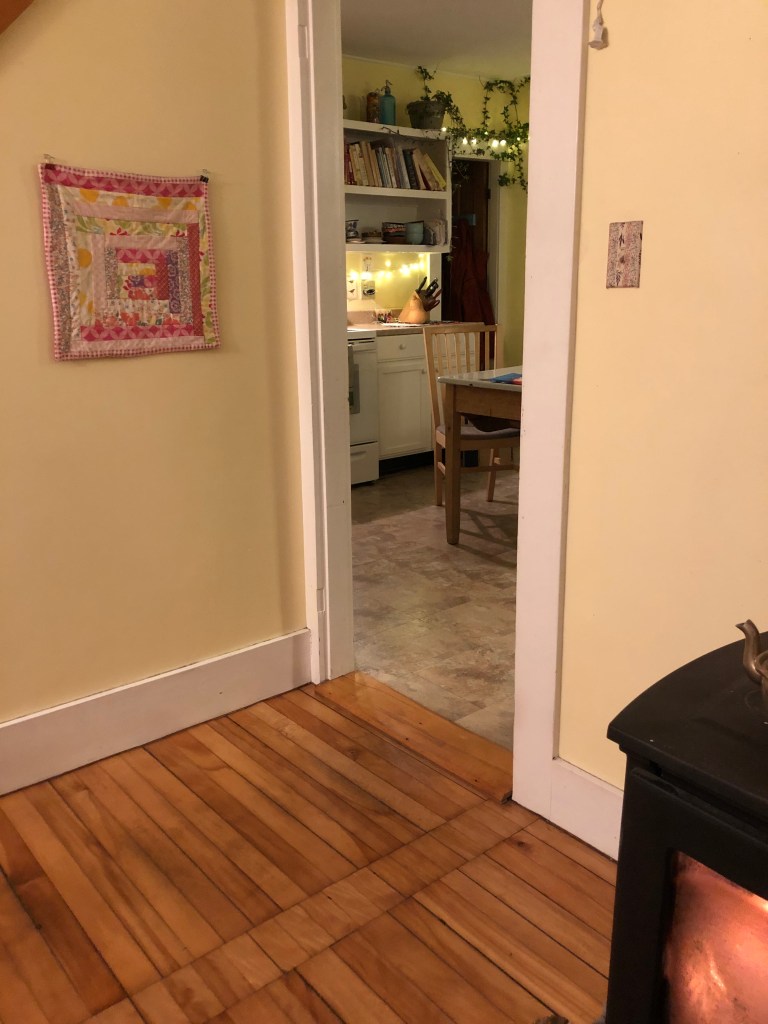
A week of sun ends in scattered raindrops and my hands dirtied with creosote from cleaning out my wood stove. The cats hunker against the wall, glaring at my labors, annoyed at the chill descending into their cat realm. My daughter, fluent in Cat Language, feeds the creatures small pieces of roast chicken. I brew more coffee.

Mid-March, the sudden season of reckoning: what is it I’m doing? This is the week of self-doubt and the week of the kindness of strangers, too. March has long meant the season of sweet maple and cold hands, of leaning hard into work, the season of faith that spring’s crocuses and snowdrops and ephemerals will return—that they always return—to remind myself that the wider world holds us inevitably, for good or ill and sometimes for both.

Cutting into with the ax,

I was surprised at the scent.

The winter trees.

— Buson

These Days…

Days and nights on the cusp of sugaring season. It’s been years since I made a living sugaring, but I haven’t forgotten the years the kids and I inhabited the sugarhouse for a month and more. Walking at dusk, as the night bites my eyes and the tip of my nose, I remember what close friends the weather and I were in those weeks of sugar and ash. The children were always in sodden snowsuits, or their fingers shivered from lost mittens, or their faces were crimson with heat, cheeks sticky with a maple patina. We ate oatmeal and nachos, drank coffee with syrup, baked pizza in the arch when the fire burned to coals. We were always hungry.

One night, a daughter sleeping against me in bed, I read a Louise Glück poem in the New Yorker while knitting a yellow bunny for that sleeping child’s Easter gift. I gobbled that poem, ripped it from the magazine, thumbtacked it over my desk. Forget it’s still February; the poem must be read.

March

The light stays longer in the sky, but it’s a cold light,
it brings no relief from winter.

My neighbor stares out the window,
talking to her dog. He’s sniffing the garden,
trying to reach a decision about the dead flowers.

It’s a little early for all this.
Everything’s still very bare—
nevertheless, something’s different today from yesterday.

We can see the mountain: the peak’s glittering where the ice catches the light.
But on the sides the snow’s melted, exposing bare rock.

My neighbor’s calling the dog, making her unconvincing doglike sounds.
The dog’s polite; he raises his head when she calls,
but he doesn’t move. So she goes on calling,
her failed bark slowly deteriorating into a human voice.

All her life she dreamed of living by the sea
but fate didn’t put her there.
It laughed at her dreams;
it locked her up in the hills, where no one escapes.

The sun beats down on the earth, the earth flourishes.
And every winter, it’s as though the rock underneath the earth rises
higher and higher and the earth becomes rock, cold and rejecting.

She says hope killed her parents, it killed her grandparents.
It rose up each spring with the wheat
and died between the heat of summer and the raw cold.
In the end, they told her to live near the sea,
as though that would make a difference.

By late spring she’ll be garrulous, but now she’s down to two words,
never and only, to express this sense that life’s cheated her.

Never the cries of the gulls, only, in summer, the crickets, cicadas.
Only the smell of the field, when all she wanted
was the smell of the sea, of disappearance.

The sky above the fields has turned a sort of grayish pink
as the sun sinks. The clouds are silk yarn, magenta and crimson.

And everywhere the earth is rustling, not lying still.
And the dog senses this stirring; his ears twitch.

He walks back and forth, vaguely remembering
from other years this elation. The season of discoveries
is beginning. Always the same discoveries, but to the dog
intoxicating and new, not duplicitous.

I tell my neighbor we’ll be like this
when we lose our memories. I ask her if she’s ever seen the sea
and she says, once, in a movie.
It was a sad story, nothing worked out at all.

The lovers part. The sea hammers the shore, the mark each wave leaves
wiped out by the wave that follows.
Never accumulation, never one wave trying to build on another,
never the promise of shelter—

The sea doesn’t change as the earth changes;
it doesn’t lie.
You ask the sea, what can you promise me
and it speaks the truth; it says erasure.

Finally the dog goes in.
We watch the crescent moon,
very faint at first, then clearer and clearer
as the night grows dark.
Soon it will be the sky of early spring, stretching above the stubborn ferns and
violets.

Nothing can be forced to live.
The earth is like a drug now, like a voice from far away,
a lover or master. In the end, you do what the voice tells you.
It says forget, you forget.
It says begin again, you begin again.

— Louise Glück

February Light.

I am not a dog owner, but my oldest has a dog now she adores, so walking and hiking with her I’ve discovered the world of the dog walkers. Midday in full sunlight, I wander along the lake. Great puddles pool on the ice. White-throated sparrows sing late winter songs. I head through the woods from lake to library through a few inches of soft snow. I’m wearing shoes more than boots, and crumbles of icy slush soak through my socks. At the library I sit on the steps and empty my socks of ice bits and shreds of cedar greens sprinkled in the woods from the last windstorm.

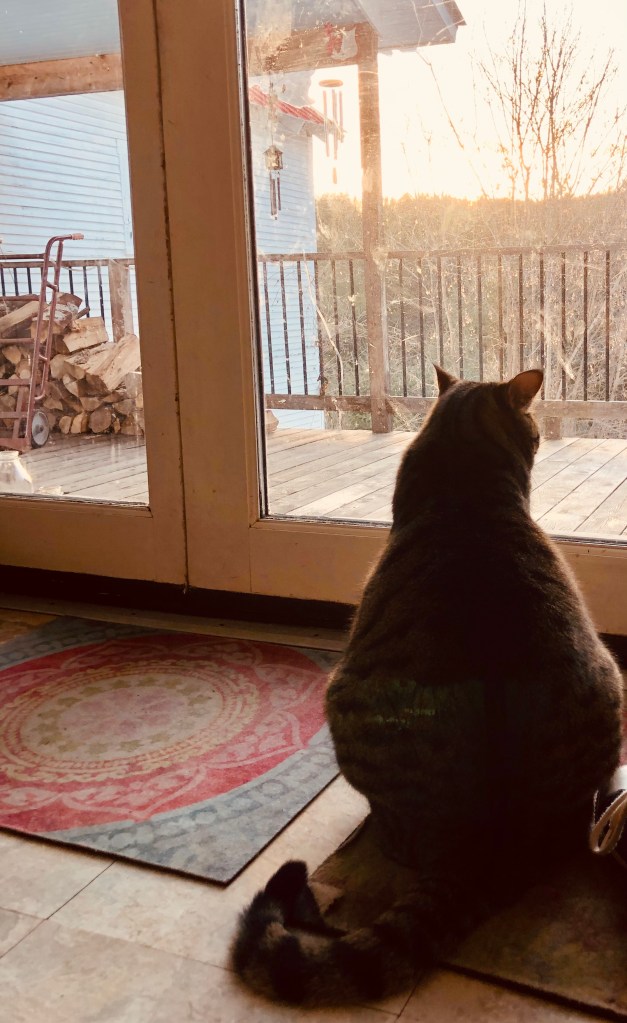
A little white dog runs up to visit, curious. As I bang out my shoes to the dog’s fascination, the dog’s owner and I chat about the birds and the sunlight, and then she leaves her dog with me and heads into the library. The little creature and I ruminate about the neighbors’ cat sitting in the window. Beyond the paved driveway, mud oozes in the sunlight. Sure sign of spring.

Last, The Writing Life column in Hippocampus ran my essay this month. The essay includes:

Without wealth — as most of us are — a creative life is a dicey proposition…

Wet Gloves, Grievances, Blessings.

It’s been awhile since I did a carpool or handoff along the road — once a mainstay of my life. Seems like I spent hours of motherhood waiting at some designated place. I leave early to have this little pocket of time, a few minutes, no more, to watch the sky darken. I bring a book, too, more out of habit than anything else.

Vermont highways are lonely and busy, with stretches of time where you can walk down the center line, and then times when you risk your life (actually) to walk those yellow strips. The girls are laughing when they arrive. I hand over my daughter’s gloves, warm from my car heater as I tried to dry out the wet remains of yesterday’s skiing. I stand talking, shivering in my sweater. I’m sweaty from skiing, and I’ve forgotten my coat. The girls are busy, busy, happy in a plan of their own, my daughter’s hair still in the braids I wove for her this morning.

The girls drive away. I head back to my car, sliding in my plastic-soled ski boots, and someone I’ve known for years pulls over and asks if I need help. Good lord, I laugh. Because our kids played together as toddlers, I feel I can start right in and so I do. I begin with the bathroom sink drain that I need to take apart, and how does anyone endure the college app process, and am I ever going to remember to clean the inside of my windshield, save for when the sun hits it and blinds me?

I’m really laughing by then, and she is, too. I lean against my car — again, shivering, shivering — while we exchange the usual kid and life updates of people who know each other but sometimes go years without talking. The cold air comes down in this sweet-spot crepuscular moment as the night slowly floods in. She leaves, and I stand for a moment, looking up for the first stars. Such little cares I’ve listed, the stuff of living, blessings more than grievances.

And then I’m on my way, too, leaving the river and road, at least for now.

Today…

All week, people have been dropping in at work, with ideas and needs and so much school board talk. A stranger dropped in yesterday and mentioned she expected to become a grandmother that day, possibly the next. Candlemas, the ancient festival, forty days after Christmas and its official end. February 3 marks my own holy day, the day my oldest joined us in the world and I crossed over into motherhood.

In labor, I walked outside in Birkenstocks and stared at the melting snow that was running in sunny trickles. Just days after she was born, a fierce cold sunk in to stay. The neighbors brought a blueberry pie. As a toddler, I called this child a wildcat. Now, all grown up, she’s still a cat, with a cat’s complexities — half-feral and blissfully domestic, fierce-clawed and loving.

With worry edging her voice, the stranger told me she expected her family’s birth to be healthy. These usually go well, she noted. I agreed, and we walked out together. The wind carried dry snow over the parking lot. She disappeared in her car, but I stood for a moment longer, remembering my daughter was born shortly before midnight. My long labor ended with a surgeon who held my vernix-smeared baby in his gloved hands so I could see her. Her eyes were wide open, and she looked directly at me.

listen,
you a wonder.
you a city
of a woman.
you got a geography
of your own.

— Lucille Clifton

The Horizon’s Edge.

Photo by Diane Grenkow

Many years ago, one of my daughters’ playmates wandered through our sugarhouse with a huge pine branch over her shoulder. My then-husband and I were working in the kind of frantic way we often did in those days, sap-turning-to-syrup boiling fiercely in the pans. The playmate was a slight and quiet child. She moved through us and then disappeared outside again, enmeshed in whatever imaginative world.

On this below zero morning, heading towards my oldest daughter’s birthday, this photo taken by my friend comes into my email, which reminded me how much of my approach to parenting little kids was let them wander around the world. More than a few times, that seemed to have evolved into a kind of what the heck is happening now sense from the kids.

Just for the record, we swam a great deal at this beach, too, although never in the frozen months.

The horizon’s edge, the flying seacrow, the fragrance of saltmarsh and shoremud;
These became part of that child who went forth every day, and who now goes and will always go forth every day,
And these become of him or her that peruses them now.

— Walt Whitman