Crossroads.

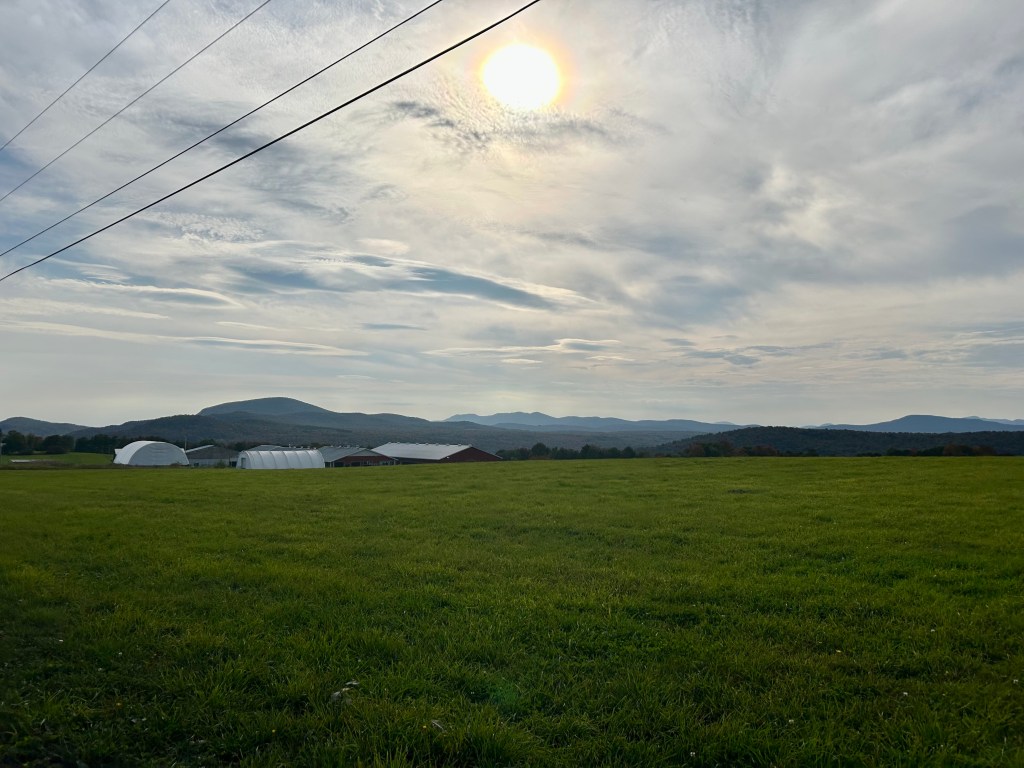
I park at a dirt crossroads this weekend beside a former tavern and walk up the hill to the Old West Church. The sunny afternoon speckles through the roadside maples, and I meet others doing what I am, in pairs or singly, and we greet each other, cheerily. At the Old West Church, I hear two terrific poets, but on my walk back to the tavern the line that runs through my head is from a Franz Wright poem, There is but one heart in my body, have mercy/on me, an incantation.

I keep thinking of my dead mother on this radiant Sunday, my mother who pulled her last breath a year and a half ago, hardly a hopscotch jump ago. In my mind, I’m building the architecture of what I’ve tagged as this Cancer Atlas I’m writing, scaffolding this book’s bones. The book is about the here-and-now, about living (at least for now) through a terrible disease, about walking along Vermont’s autumn-gold back roads, about pulling up this summer’s frost-killed pepper plants that produced so bountifully this summer. And my mother? As I work, I think so often of her, this woman both generous and mercurial, the double blade I harbor in my own heart. Gracious, how much she’d enjoy this picturesque walk. She was a woman who loved old churches, was fascinated by adjacent cemeteries, who would have relished the art in the tavern.

At the tavern, I linger in an open doorway, talking with a curator, drinking iced tea from a half-pint jar. My mother would have drunk the wine, feasted on the cured meat and seeded crackers. Dust kicks up in the road. Old friends appear, and we joke about winter’s ferocity. It’s always a crossroads, isn’t it?

“We are created by being destroyed.”
― Franz Wright
Start again…

Twenty years ago, I wandered on an early morning walk. Mightily pregnant, I didn’t go far, merely down to our sugarhouse and through the white pines. I looped back through the garden. I was about to have a second baby — that very day — and, second time around, I knew those solitary walks would — for an undetermined time — be a distant memory.

In a break in the rainy weather, a friend walks me through the cemetery, past the little league field, and down the hill into town. At Front Seat Coffee, she buys cookies, and we sit in the courtyard, eating and talking, the courtyard where I’ve passed so many hours with my laptop. Slowly, we walk back up the hill. Three robins perch on the elementary school’s fence.

Six weeks ago, another friend walked me to the Galaxy Bookshop, the first walk I’d taken to town since last November. I picked up a copy of Dostoyevsky at the Galaxy, and finished the novel in Dartmouth, waiting for surgery. The surgeons teased me, Why such light reading?

One more lesson from cancer: how intensified the world becomes. Slip back, start again. Repeat, repeat. But isn’t that one way of the world? There’s plenty more ways — a crash, a sudden halt, a perilous nonstop descent — but often our lives are fits and starts.

I remind myself, Try to learn something.

This day dawns overcast, broody with the promise of rain, the world lush with spring green and birdsong. To keep myself and my cats happy, I light a fire in my stove, brew coffee, consider the day. As I recover, my old demons of uncertainty have woken, too. My walking companion counseled me to narrow my energy to the actual day. Help was recently sent fortuitously to me; this morning, as I mixed powdered sugar and butter for cake frosting, I reminded myself, Be grateful; use your luck wisely. Savor this day.

At Twenty-Eight

By Amy Fleury

It seems I get by on more luck than sense,

not the kind brought on by knuckle to wood,

breath on dice, or pennies found in the mud.

I shimmy and slip by on pure fool chance.

At turns charmed and cursed, a girl knows romance

as coffee, red wine, and books; solitude

she counts as daylight virtue and muted

evenings, the inventory of absence.

But this is no sorry spinster story,

just the way days string together a life.

Sometimes I eat soup right out of the pan.

Sometimes I don’t care if I will marry.

I dance in my kitchen on Friday nights,

singing like only a lucky girl can.

A Thief Running Away…

Slacker, slacker, I’ve been about a few things in my life, the laundry folded and left in piles on tables, my blog idling, the emptied cans of cat food needing to be recycled.

These mornings, I’m up so early my glossy housecats are yet sleeping, curled in their cat balls, not yet grousing and purring for their breakfasts. A year ago, I believed I had finished a book; I had that draft in my hands. But a year later, here I am, drilling down, writing maniacally, to get all the way down to the end, in and out of chapters, between words, cutting and creating.

Walking to meet a friend after work, I suddenly see the whole shape — the beginning, the messy middle, the end — in the tangible image I’ve been searching for. That image is all through the book: now, some stitching together, a few crumbs for the reader’s delight.

Some of you have read clumsy drafts of this novel, and thank you, thank you. What a fool’s venture writing a book might seem. There’s never a guarantee of anything — of good work, of any money, of satisfaction. A year later, though, and I know this book inside out. I could recite sections, perhaps, if you and I spent time in a lock-up, although that, I hope, is unlikely.

Here’s what I learned this past year: worry about the few things that matter. Write as well and as hard as I can. Getting there, I think.

Here’s an article about human civilizations in Vermont that I’ve been thinking about all day, too.

A thief running away like mad from a ferocious watch-dog may be a splendid example of Zen.

— R. H. Blyth

The 10,000 Things.

The last night I am in New Mexico, I can’t sleep, so I slip on my sandals and walk. The moon hangs over my parents’ house, luminescent as a giant drop from a sun-shot waterfall. It’s dark yet, a cool-nearly-cold breeze stirring the desert. No human wanders at this early hour. It’s just me and the singing crickets and birds, the sun pushing a golden curve over the black mountains, the desert stirring in a language I have no words for: the rush of lizards and hustle of rabbits, the sharp-eyed coyote and fox, the wild sunflowers silently bending towards the rising light.

So many pieces to this journey — from the shuttle driver who happily counsels a passenger not to rush as “we’re in the Land of Mañana,” to the flight to Chicago where the Brandeis student beside me whispers about her fear of flying, to the stunningly beautiful flight over the Great Lakes through voluminous white clouds. I keep thinking how unworldly, but that word is ill-chosen. Better said would be of this world. Then the brilliance ends as we fly into the soot of the Canadian wildfires. All through this day, I read Lily Brooks-Dalton’s The Light Pirate (the novel Ben Hewitt told me read), this novel about a family and the collapse of our world, and the brutal irony doesn’t escape me for one moment that as I’m mourning and fearing those sooty clouds I’m entirely part of this 21st century….

In Vermont, my daughters greet me with their 10,000 stories and cheerfully announce I’ve missed the two good kayak days through the lily pads. The humid night air stinks of diesel exhaust. In the parking garage, I strip off my leggings. My youngest drives out of Burlington, along the river through the Winooski Valley, and through the state capital. The girls tell me sunflowers are blooming around the statehouse, and my daughter’s dog fell off a dock into a lake (what clumsy dog does that?) and the swimming has been stunning in Caspian, the water perfectly clear.

My youngest tells me about exploring Burlington with her sister. She says she can’t believe how lucky she is to move there this fall.

In this dew-soaked morning, I realize I haven’t missed the hollyhocks’ bloom. Lucky.

…. Seriously, can’t recommend The Light Pirate enough.

Because everything is changing…. We should all be curious about it, because the way we live has to change, too.

— Lily Brooks-Dalton

Birds are a Kind of Souls.

I’m sitting at the kitchen table talking with my daughter about past, present, future — one or all of those mixed in together; it’s late adolescent talk; the future hovers around us all the time, all day long — when I see a robin swoop up to our porch beam, its beak full of limp weed.

For the first time in the half dozen years we’ve lived here, robins are building a nest a few feet from our kitchen door.

In our other house, robins crafted fat nests in our sugarhouse and under our balcony. We witnessed baby beak feedings and collected blue ragged shells. Twice, a hawk ate fledglings — the course of nature, but sorrowful.

Rain has fallen all day. There’s an underlying promise of deepening green with the rain, but the hours have been cheerless and cold, filled not with any bad news but the accrual of petty things that drag at all our lives.

A robin stands on the porch railing, eyeing us through the glass door. Its mate flies in quickly, busy busy in the nest. Time is of the essence in bird movement. The robins are a little story come to stay with us for a short while.

Build and thrive, I think. Thrive.

“I was convinced that birds were kinds of souls. Not the souls of people but of previous birds whose mystery and beauty were so necessary on earth that God would not allow them to be anything in their second life but birds again.” 

— Howard Norman

A Thousand Things. Summer Moments.

On my way home from work, I stop in to visit a small building just recently finished. Inside, the room smells of freshly cut cedar. The visit is a pleasure, with a building well-designed and completed. Its owners will take joy here, that’s nearly certain.

I’m at the far end of the lake, and so I take the long way home over dirt roads. I make one more stop, where someone I knew years ago has finally begun building a long-planned retirement house. Building is both fast and slow these days — a craze to build and a shortage of materials. There’s no one at this site, and I stand for bit, admiring the view of the Black River valley. I hope this place gives the owners their share of joy, too.

Where I work now is the town where I spent so much of my daughters’ childhood summer days, swimming and hiking. There was plenty of joy in all those things, too. The afternoon is redolent with humidity, exactly as I remember in my childhood.

In this steamy afternoon, I have a little pocket of time before an evening meeting. In my garden, I pick two zucchini, some lettuce that’s gone to sour, and a red coin onion. My garden grows as tall as my shoulders, more wild than not. A light rain patters down. I weed a little.

A thousand things I’ve done today. Or nearly a thousand. In this little moment, I let my own racing mind go. The snails have gotten into the lettuce. I lift one and then, gently, set it back down again.

Let it eat on, I think. I’ve plenty to spare. Don’t be greedy, I admonish myself.