The Survivable.

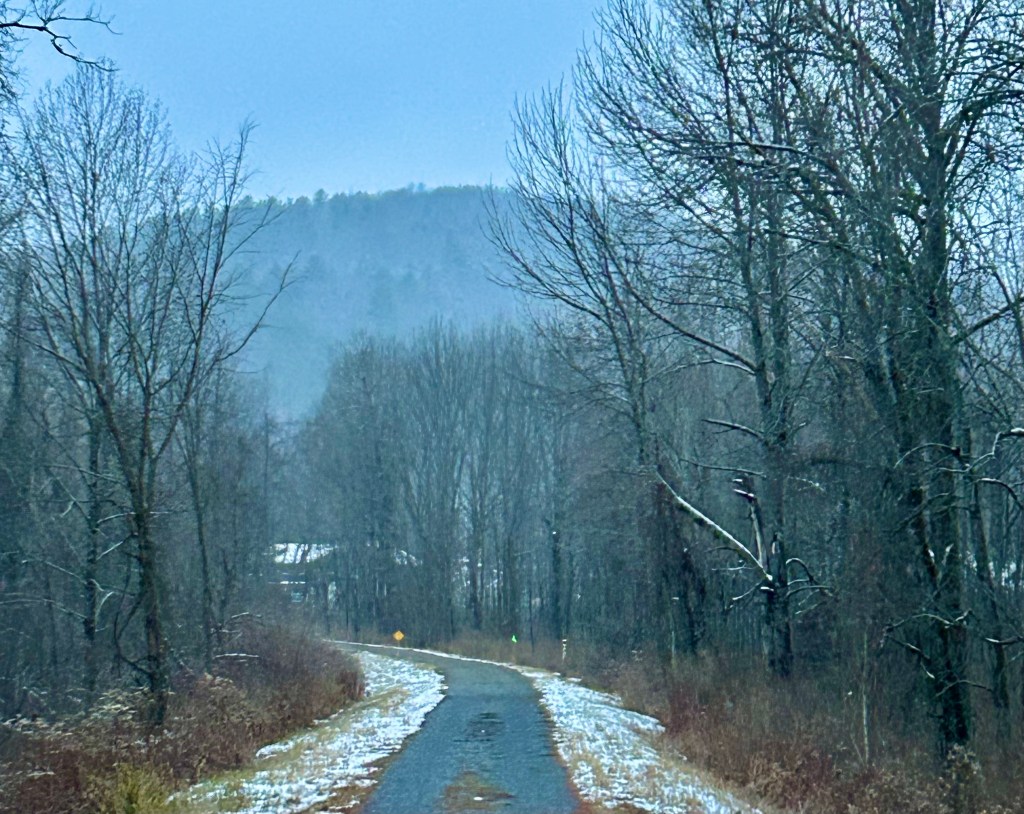
It’s dark as the inside of my fist at five o’clock. I’m driving into spitting snow, my brand-new studded snow tires grinding. My companion and I are talking about all kinds of things — how language shapes our worldview and the personalities of tuxedo cats and dentists. I’m driving more by faith than anything else, not particularly fast, headlight beams filled with snow. As if cued, a deer waits in the forested roadside. I slow, then stop, people and deer staring at each other. Then the deer vanishes into the woods.

On this backroad, I’ve passed no other vehicle save a UPS truck, so I wait for a moment for the deer to return, for a companion to leap across the road.

My passenger says, apropros of some conversational thread, that I’ve shed bad karma in my months of cancer treatment, of struggling to survive. My devotion has always been my pencil or keyboard, not the meditation cushion. And yet…

I roll my car forward through the swirling snow. I’ve long adhered to that ancient Aristotelian notion that action defines character. When I realized I had cancer, a year ago, I was rapidly veering towards sepsis. I could not indulge any opinion. To survive, I had to strip away illusion. What were the facts? What was the wisest way forward? None of this was simple.

Cancer narrowed my world. Through weakness and the possibility of a fatal infection, I was confined to my few downstairs rooms, to Emergency Rooms, and hospital rooms. But unexpectedly, cancer widened my life, too, gave me the gift of friendships forged in rough experiences, reinforced for me that this world is propelled by cause-and-effect, that actions have consequences, and that I often grasp only the slenderest knowledge.

New England November drives us into the season of early darkness, blackness so profound our eyes struggle to navigate. When I left Dartmouth-Hitchcock after that last long stay, I felt old, aged in bone and flesh, and concurrently, miraculously restored to my twenties, those years when my lust for living and creating was ravenous and I did not yet comprehend the immutability of time. At the end of this evening drive, I stand for a few moments in this velvety and freezing darkness, snow hissing on the hot car hood, a slender strand of white lights twinkling in my kitchen window. I clench my mittens in my cold hands. Around me, beguiling night.

“When you survive something that was thought to be unsurvivable, the obvious is gained. You have your life—you have time. But it’s only when you get there that you realize your survival has come at a cost.”
― Suleika Jaouad

And last… my story “Tiny Towns” appears in the new collection: 2050: Vermonters Take a Swipe at the Future. Reading tonight in St. Johnsbury….

Inoculation, Fallacy, and the Sacred.

A few years back, I did a joint reading with a woman who claimed she had discovered an inoculation for kids to prevent drug and alcohol addiction. She’s way more famous than me – and has made far more money – but the premise seemed prideful to me. There’s no shot against addiction, no simple fix.

For no particular reason, I was thinking of this on a recent walk. As part of my healing, I’m determined to walk every day, through rain, shine, or wildfire smoke from Canada. Sometimes with friends, sometimes alone. Late afternoon, I was on the wooded trails behind the local high school. Hermit thrush sang their endearing notes. I spent my childhood in the New Hampshire woods. As an adult, I backpacked. My former husband and I sugared for two decades and knew our maple acres in every variation of weather.

Not so many weeks ago, exhausted from chemo and surgery, I walked crooked over. Now, my boots confident on the path, I remembered those winter visits to the ER, more out of my mind than not with pain. A frequent visitor, I requested IV Zofran, Dilaudid, fluids, in that order. The scent of saline washing through the IV tubing became synonymous for me with the near promise of breathing easily again, the temporary ability to inhabit my body.

Dilaudid promises to make whole what’s broken. How well I know this enchantment. For anyone who judges this, I reply, you endure chemotherapy, you endure the way the lymphoma choked my innards, more brutal than childbirth labor. The narcotics pulled me back from pain into the world. There was that subzero night when we drove to the ER, and my daughter and her partner kept leaning against the ER’s wall heater, while the nurses buried me under heated blankets. And the balmy midnight I sat outside the ER entrance, high as hell again, listening to the heat shield rattle on my Subaru as my sister drove around the hospital. Those nights, the dilaudid nights, are all done. May they be finished, forever, for me.

These mornings, I take vitamins, mundane, boring. There’s that trite phrase that we’re all on a journey, but so much of our lives we simply click along. The lymphoma broke that clicking-along for me, the regularity of waking up and going about the day. Now, on these daily walks, I hold to this sacredness, this euphoria.

“One morning in April, I woke up a little sick. I lay there looking at shadows on the white plaster ceiling. I remembered a long time ago, when I lay in bed beside my mother, watching lights from the street move across the ceiling and down the walls. I felt the sharp nostalgia of train whistles, piano music down a city street, burning leaves. A mild degree of junk sickness always brought me the magic of childhood. It never fails, I thought, just like a shot; I wonder if all junkies score for this wonderful stuff.”

~ William S. Burroughs, Junky

Start again…

Twenty years ago, I wandered on an early morning walk. Mightily pregnant, I didn’t go far, merely down to our sugarhouse and through the white pines. I looped back through the garden. I was about to have a second baby — that very day — and, second time around, I knew those solitary walks would — for an undetermined time — be a distant memory.

In a break in the rainy weather, a friend walks me through the cemetery, past the little league field, and down the hill into town. At Front Seat Coffee, she buys cookies, and we sit in the courtyard, eating and talking, the courtyard where I’ve passed so many hours with my laptop. Slowly, we walk back up the hill. Three robins perch on the elementary school’s fence.

Six weeks ago, another friend walked me to the Galaxy Bookshop, the first walk I’d taken to town since last November. I picked up a copy of Dostoyevsky at the Galaxy, and finished the novel in Dartmouth, waiting for surgery. The surgeons teased me, Why such light reading?

One more lesson from cancer: how intensified the world becomes. Slip back, start again. Repeat, repeat. But isn’t that one way of the world? There’s plenty more ways — a crash, a sudden halt, a perilous nonstop descent — but often our lives are fits and starts.

I remind myself, Try to learn something.

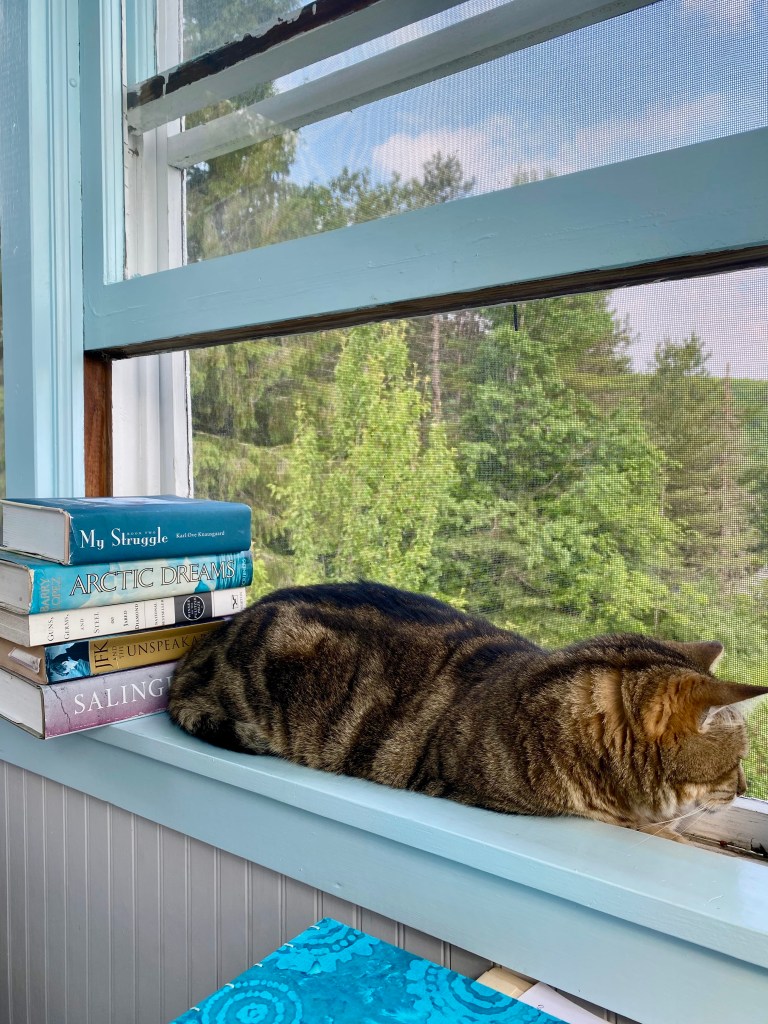
This day dawns overcast, broody with the promise of rain, the world lush with spring green and birdsong. To keep myself and my cats happy, I light a fire in my stove, brew coffee, consider the day. As I recover, my old demons of uncertainty have woken, too. My walking companion counseled me to narrow my energy to the actual day. Help was recently sent fortuitously to me; this morning, as I mixed powdered sugar and butter for cake frosting, I reminded myself, Be grateful; use your luck wisely. Savor this day.

At Twenty-Eight

By Amy Fleury

It seems I get by on more luck than sense,

not the kind brought on by knuckle to wood,

breath on dice, or pennies found in the mud.

I shimmy and slip by on pure fool chance.

At turns charmed and cursed, a girl knows romance

as coffee, red wine, and books; solitude

she counts as daylight virtue and muted

evenings, the inventory of absence.

But this is no sorry spinster story,

just the way days string together a life.

Sometimes I eat soup right out of the pan.

Sometimes I don’t care if I will marry.

I dance in my kitchen on Friday nights,

singing like only a lucky girl can.

Beyond words.

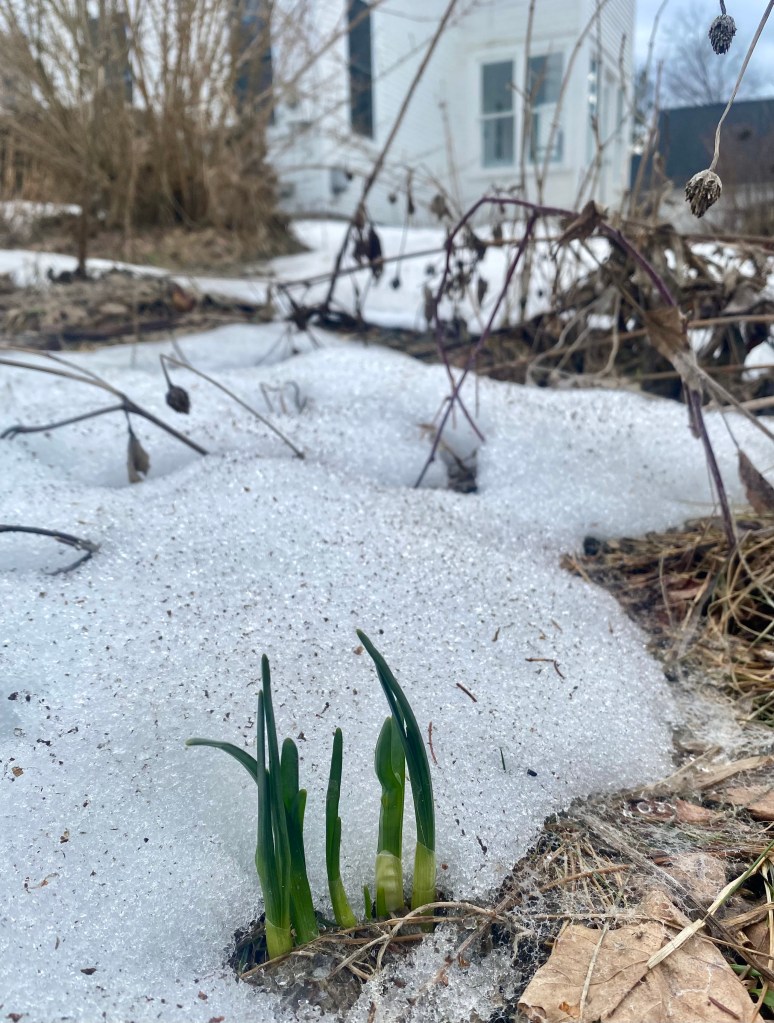
A few days of streaming sunlight. I wander around outside, over the crusty remains of snow, the thawing grass. The garden yet lies covered. A junco picks at seed scattered beneath the feeder. This far along in the chemo, staring at the end, I’m hard used up, muscles withered, fat trimmed near to my bones. But here, here, alive.

My life – physically, mentally, economically, spiritually – has been crumpled up by disease. Now, ahead, lies the unfolding, the remapping. A friend visiting with her three-year-old, with daffodils and chocolate, points out what I’ve recently reckoned with: that my fierce independence, my raving insistence to live my life, on my own terms and never shaped to the pattern of any man (as Tillie Olsen wrote), has long been my lifeline, the way through lean times, betrayal, uncertainty. But cancer, that mighty devil, flipped that in my face and revealed it as my hollow weakness, too.

Day by day here, determined to remain free from the hospital, to finish to the final drop this course of so-called treatment, glean back what I can salvage. Four months ago, I didn’t think I would live to see this season’s Chionodoxa blue flowers. This afternoon, my daughter and I remarked that the walnut tree I planted seven years ago as a mere twig has plump buds on its lengthy branches. Buds, blossoms, leaves. Beyond words.

“Why do you want to shut out of your life any uneasiness, any misery, any depression, since after all you don’t know what work these conditions are doing inside you? Why do you want to persecute yourself with the question of where all this is coming from and where it is going? Since you know, after all, that you are in the midst of transitions and you wished for nothing so much as to change. If there is anything unhealthy in your reactions, just bear in mind that sickness is the means by which an organism frees itself from what is alien; so one must simply help it to be sick, to have its whole sickness and to break out with it, since that is the way it gets better.” ~ Rilke

On Gaslighting.

Via email, my daughter’s school sends me a survey. The survey poses a question about what I desire for my student. The question is phrased in a way that reminds me of a question I was recently asked, by someone I hardly know. The question was unique; the questioner asked specifically about me and my life, and how I saw my life in the wider context of the town.

I’ve been thinking of that question since that conversation, returning to it in odd moments while opening my post office box or washing the oatmeal pot. It’s a question we might all want to be asking ourselves — not just what would improve our individual lives, but how do we understand ourselves in the landscape of where we live. Or maybe this is simply April musings, cusp of a storm that could go either way, rain or snow or perhaps simply wind, sweetened with the scent of thawing soil.

Here’s a few lines from a New Yorker article that seem contemporarily apt….

Gaslighting essentially turns its targets against themselves, she writes, by harnessing “the very same capacities through which we create lives that have meaning to us as individuals,” such as the capacities to love, to trust, to empathize with others, and to recognize the fallibility of our perceptions and beliefs. This last point has always struck me as one of gaslighting’s keenest betrayals: it takes what is essentially an ethically productive form of humility, the awareness that one might be wrong, and turns it into a liability.

Leslie Jamison