Is that church door open?

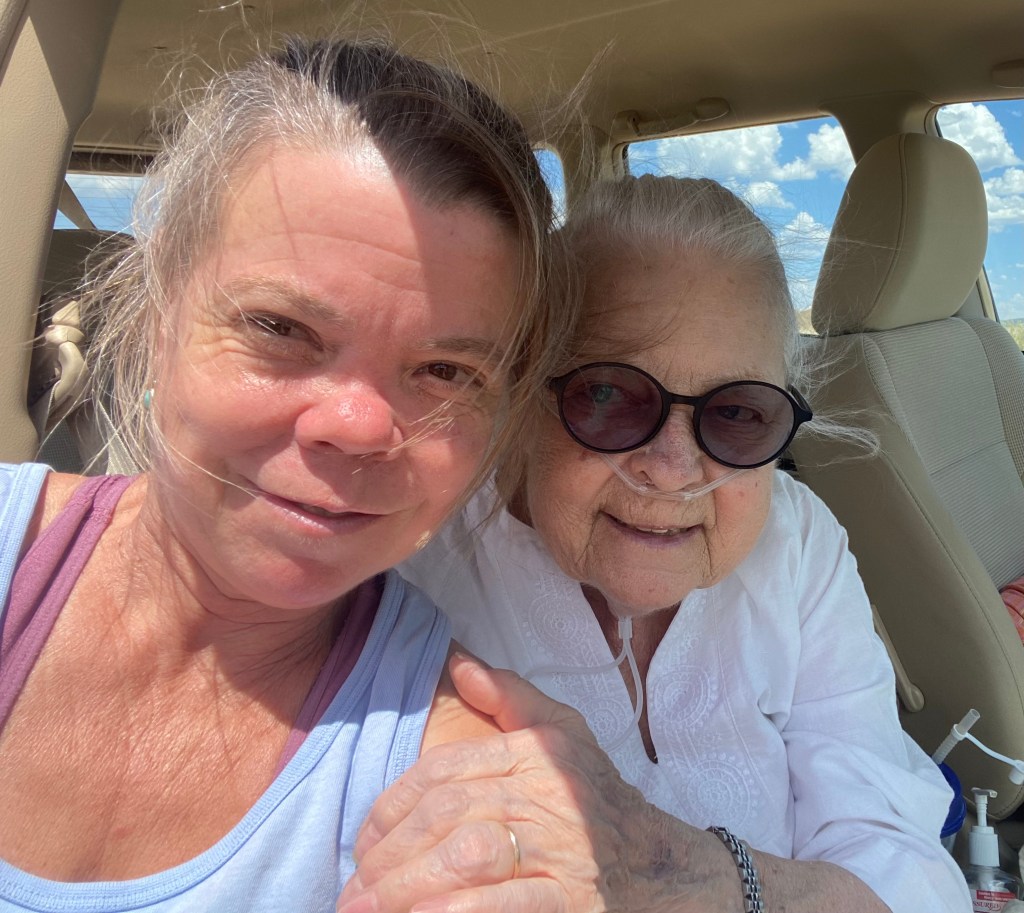
About a year before my mother died, I visited my parents in northern New Mexico. My mother was on 24/7 oxygen then, which she understandably chaffed against, and I took her on long drives so she could leave the house. One afternoon, I drove the rural roads to the Lamy train station. Take the Amtrak to Santa Fe, which I’ve done, and you don’t disembark in the quaint plaza town. 20 miles outside the adobe city, there’s the small Lamy station and an old saloon named the Legal Tender, and not much else. I parked at an old church that appeared to be abandoned and told my mother I’d be right back. I called over my shoulder that I wanted to see if the door was open, as church doors often are. When I looked back, my mother had her car door open, one foot on the earth, determined to follow me. She said cheerily, “I’ll come, too.” She was attached to a heavy oxygen tank on tiny wheels. The terrain was rocky, and there was no way I could navigate my mother to that door.

Somehow, I talked her into staying in the car. That was my mother, usually up for an adventure, willing to rattle a locked door, peer through a window, maniacally curious. It’s me, too.

In these brown-grass April days, as I begin to walk again, further and further each day, I think of my mother, how she would search for daffodil buds and admire the blooming snowdrops. Robert Frost is famous for his line, “In three words I can sum up everything I’ve learned about life: it goes on.” Bitter, perhaps, or maybe not so. Having faced my own (blessedly at this moment passed over) demise this winter, I’m beyond happy to immerse myself in the stream of life going on…. This life.

I woke this morning with a dream that I’d never had cancer. In the dream, I’d overslept and was late to work…. I was sweating, nightmarish. The dream haunted me all morning, trailing me, while my dear friend visited and brought me birthday presents that reminded me of my mother, and then fetched my library books so I could lie on the couch these afternoons and recover from this last cancer dose. When she’d left, I slept again. When I woke, the dream had broken and lay on the floor like broken glass: rubbish.

Such a labyrinthine world – mothers and daughters and granddaughters – disease, too. In these still days, waiting for spring’s rushing green, I embrace what I know, and that I never will.

… we are all

the dead, I am not apart from you,

for long, except for breath, except for 

everything.
~ Sharon Olds

Determined to do/the only thing you could do…

When I was six, I dropped a large wooden board on my toe, right where the nail emerges. My mother lifted me up and soaked my foot in the bathroom sink in Epsom salts. I cried fiercely, and my mother said she wished she could take the pain from me. Impossible, of course. Later, I lost the toenail.

The night before my last chemo infusion, I woke thinking of my mother who died nearly a year ago. She never knew I had cancer. Of all my family, only my mother endured chemotherapy, at age 80. Like so many mothers and daughters, we had a tangled and complicated relationship, sometimes fierce, sometimes outright silly and joyous. Not knowing about my cancer was one thing she was spared in her life, at least. No one seeks cancer, but in this long and snowy winter, I was spared the misfortune of being a parent of a sick child. Anything can change in this world, at any moment, but for now….

Recently finished with chemo treatments, how grateful I am to Dartmouth and its staff for their exquisite care. How humbled and thankful I am for the people who wrapped around me – some of whom I’d never met before. To write that cancer changed my life would sound trite. The deeper truth is that this disease will be with me for the remaining days of my life. But my life is in the present tense. I have not changed. I am changing. How blessed I am to be here.

… little by little…
the stars began to burn
through the sheets of clouds,
and there was a new voice
which you slowly
recognized as your own,
that kept you company
as you strode deeper and deeper
into the world,
determined to do
the only thing you could do —
determined to save
the only life you could save.

~ Mary Oliver

Beyond words.

A few days of streaming sunlight. I wander around outside, over the crusty remains of snow, the thawing grass. The garden yet lies covered. A junco picks at seed scattered beneath the feeder. This far along in the chemo, staring at the end, I’m hard used up, muscles withered, fat trimmed near to my bones. But here, here, alive.

My life – physically, mentally, economically, spiritually – has been crumpled up by disease. Now, ahead, lies the unfolding, the remapping. A friend visiting with her three-year-old, with daffodils and chocolate, points out what I’ve recently reckoned with: that my fierce independence, my raving insistence to live my life, on my own terms and never shaped to the pattern of any man (as Tillie Olsen wrote), has long been my lifeline, the way through lean times, betrayal, uncertainty. But cancer, that mighty devil, flipped that in my face and revealed it as my hollow weakness, too.

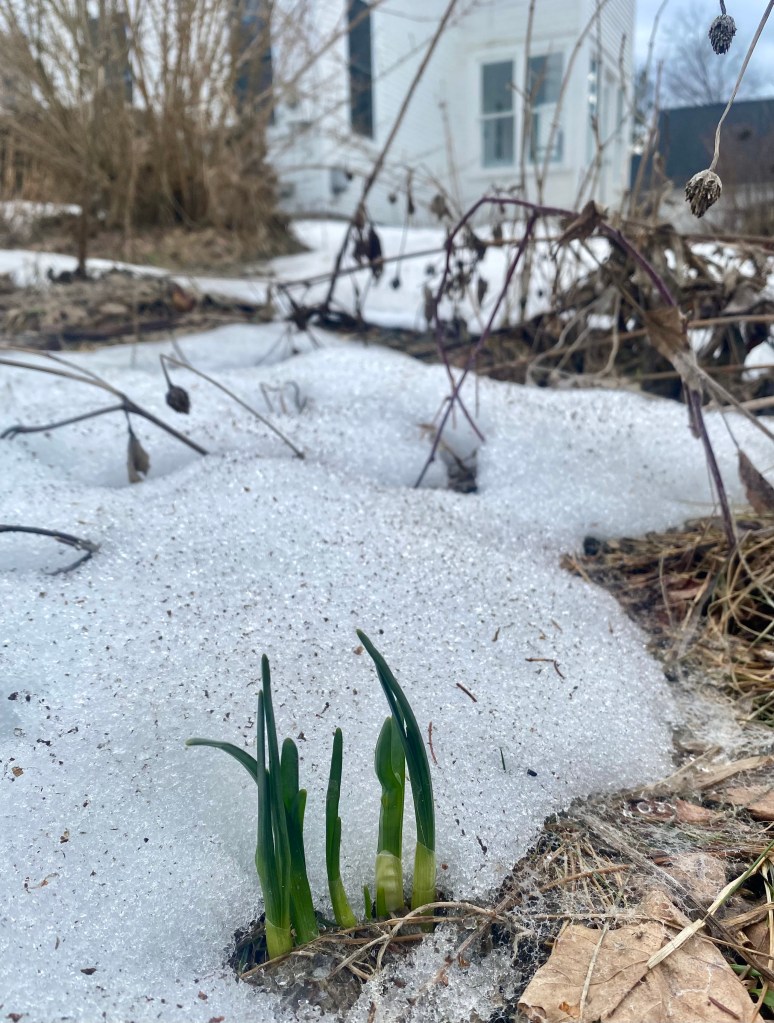
Day by day here, determined to remain free from the hospital, to finish to the final drop this course of so-called treatment, glean back what I can salvage. Four months ago, I didn’t think I would live to see this season’s Chionodoxa blue flowers. This afternoon, my daughter and I remarked that the walnut tree I planted seven years ago as a mere twig has plump buds on its lengthy branches. Buds, blossoms, leaves. Beyond words.

“Why do you want to shut out of your life any uneasiness, any misery, any depression, since after all you don’t know what work these conditions are doing inside you? Why do you want to persecute yourself with the question of where all this is coming from and where it is going? Since you know, after all, that you are in the midst of transitions and you wished for nothing so much as to change. If there is anything unhealthy in your reactions, just bear in mind that sickness is the means by which an organism frees itself from what is alien; so one must simply help it to be sick, to have its whole sickness and to break out with it, since that is the way it gets better.” ~ Rilke

A cup of tea, surrounded by ice, broken boards.

In the pale blue dawn, I wake with the taste of wild mushrooms in my mouth. In my dream, I’m eating tender stems from a soft paper bag. In the non-dreaming chemo world, I’m temporarily forbidden from dining on fresh anything from the produce world, but in this nubbly dream I munch on, relishing the residual taste of dirt, the forest itself.

I open my eyes. Day 4 – oh, I am counting these 21 days until the sixth of these six chemo sessions – Day 4, and through my window, geese wing across the sky. These past few days, spring blew in, fierce sun. On my back deck, broken by ice, a friend stopped by yesterday. I made tea, and we talked about this and that, kids and disease and politics, when we might plant spring peas. On my desk waits a cardboard box of wildflower seeds, a gift for this summer.

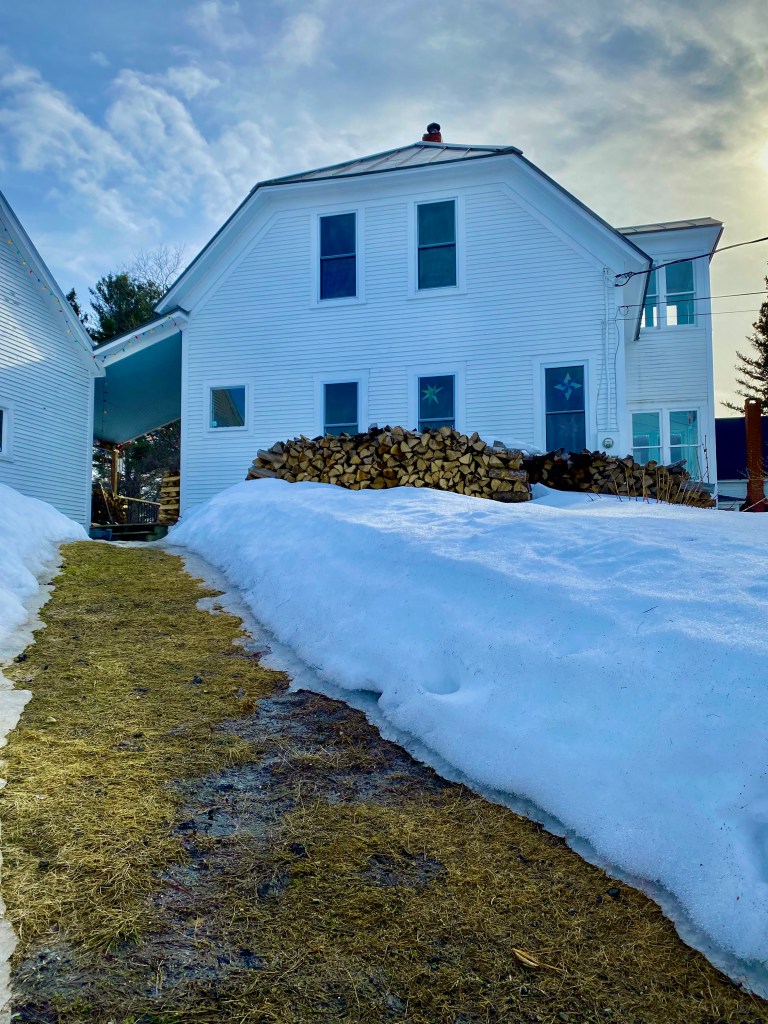
Spring is radiant light and also brokenness. The ash buckets trailing coals, the deck joists smashed by the roof’s ice, the barn still desperately in need of paint. Me, too, broken, with my few hours of clarity in the mornings, the stumbling way I’m heading towards this final treatment. Around me, too, the remains of this winter: people who have helped me more than I could have imagined, others who have distanced themselves, the disease itself, perhaps, too much, the leer of mortality a shivering thing. All that is neither here nor there. The cancer has stolen a share of my vitality, my economic steadiness, a winter of my life. And yet, all these pinwheeling days and nights as I’ve traversed this tunnel – what an infinitely rich journey, one I never would have booked a ticket to join.

My daughter sends word of singing redwing blackbirds. Spring, mightier than winter’s brawn. The season of planning, putting things back together, rearranging and cleaning, of tipping our eyes up to the sun, relishing the light.

…. Ariel Gore repeatedly quotes Audre Lorde’s The Cancer Journals in her Rehearsals for Dying. In these lines, I was reminded how we each respond to crisis in others’ lives, too, from the soil of our lives.

Each woman responds to the crisis that breast cancer brings to her life out of a whole pattern, which is the design of who she is and how her life has been lived.

Giving the slip….

Back again at Dartmouth, anyone entering my room dons a yellow gown, inadvertently hiding staff name tags. Two nurses enter yesterday and pause. My daughter and her boyfriend stand at my bed’s foot.

A nurse asks, Are you two the main medical team?

The three of us look at each other. In these days where not much has been funny at all, I’m tempted to roll with this, but my daughter jumps in and says, We’re family.

Oh, the nurse says, the Main Team. You looked so intent.

I add, Talking politics….

I’d been in the ER for two nights. The fact that I didn’t care is evidence of how lousy I felt. Due to my contagious infection, I’d been squirreled away. Wheeled through the hallways, I see how jammed this place is, people waiting in hallways, tucked into corners.

In these days, my daughters arrive with their cheery energy, with stories of their lives, their patience with me. I tell them my dream to start walking again…. A few warm days and I’m imagining the four feet of snow have vanished into mud. Not so.

My girls laugh. We’re going to have to Apple chip our mother so she doesn’t wander off….

No fear of my wandering in the (very near) future. But how I’m hungering for that. Just where, exactly, would I look for that chip? Under my boot sole? In the hem of my jacket? So I can give the slip when spring calls…..

We are every experience we’ve ever had…

A sunny morning, I’m at a place I’ve never been before, a sizable post-and-beam gallery at the end of a road. A fenced vegetable and flower garden shines orange and gold. A marble bust smiles mysteriously.

I love this about Vermont: these unexpected pockets of mighty talent. The woman’s house is built around the gallery — a beauty of wood and stone and glass. We talk for a while, and we discover that her artist parents were from the same midwest area as my father — Detroit — and then she opens the gallery and takes me in. Let me say here: I’ve been around the block a few times, seen my share of museums and art; I’m also feeling this sunny morning like the dirt road my Subaru tires pounded into, driving uphill.

The gallery ceiling soars in a peak. The wooden space holds the owner’s and her deceased parents’ work. She allows me walk through the metal sculptures wordlessly. Then I stand beside an oil portrait of a woman wearing a black and red dress that reminds me of a velvet blouse I bought for a friend, many years ago, when she graduated from college. The woman in the painting rests her chin on her fist.

The owner looks at me. “It’s always the females who are drawn to her.”

“She’s me.” Woman of a thousand and one sleepless nights, bread baker, hearth tender, the woman who swam under the luscious full harvest moon. Woman hard as these back roads, fragile as coreopsis.

We walk upstairs and finish the tour. Before I leave, though, I stand again before this portrait, a long soulful moment. “Gracious,” I say, “gracious.”

“…we are everything, every experience we’ve ever had, and in some of us, a lot of it translates and makes patterns, poems. But, my God, we don’t even began to touch upon it. There’s an enormous amount, but we can touch such a little.” – Ruth Stone