Heart Runneth Over…

The Gihon River runs through the Vermont Studio Center campus, turning as a river does just out my studio window. All day long, the mallards do their duck thing, swimming up and downstream. In the wild honeysuckle’s tiny bits of green leaves, cardinals perch.

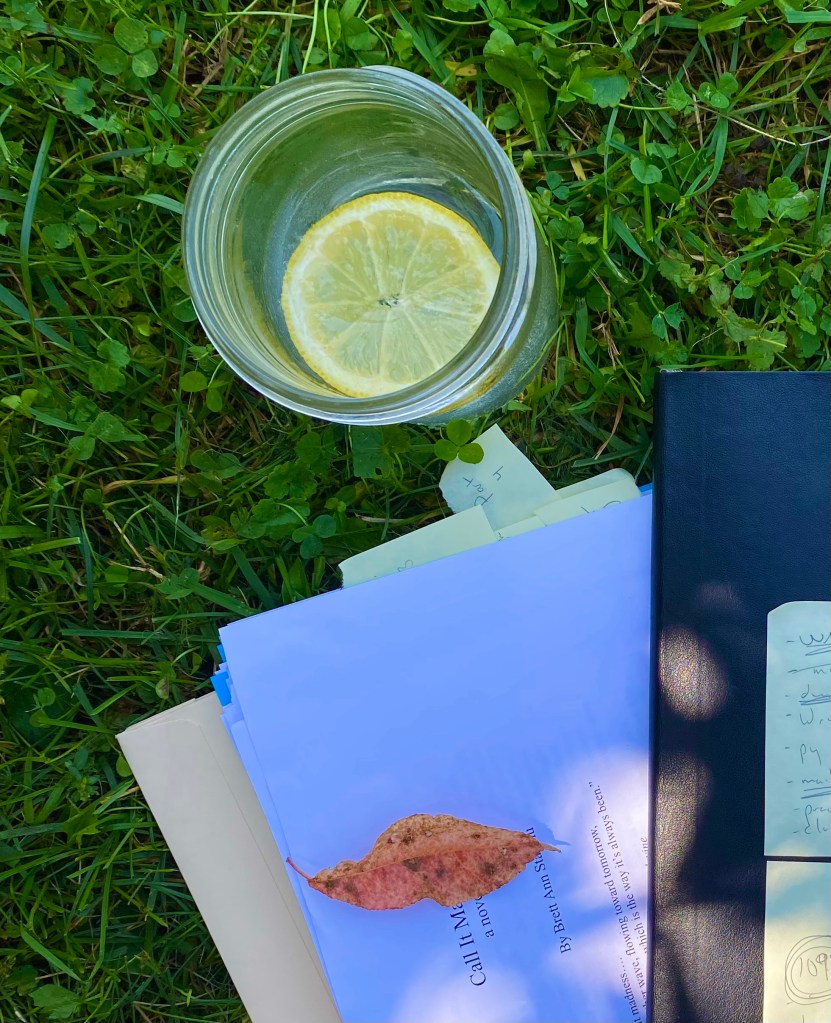
In this week I’ve spent at the Vermont Studio Center, I’ve leaned with a ferocity and joy into writing. A week to write, unfettered by the everydayness of commerce and cooking, of checking the car oil, adhering to those endless lists of can the house insurance get a lower premium, and am I ever going to paint the back side of my house? A thousand things comprise a life — some stupidly trivial like repairing a kitchen cabinet knob, some sacredly profound, like mourning a parent’s passing. 

Does writing, does sculpture, printmaking, poetry, make the world a finer place? The jury’s out perhaps, but art certainly unites the finer parts of who we are as humans, and makes this life more bearable.

Thank you again for reading.

A Thief Running Away…

Slacker, slacker, I’ve been about a few things in my life, the laundry folded and left in piles on tables, my blog idling, the emptied cans of cat food needing to be recycled.

These mornings, I’m up so early my glossy housecats are yet sleeping, curled in their cat balls, not yet grousing and purring for their breakfasts. A year ago, I believed I had finished a book; I had that draft in my hands. But a year later, here I am, drilling down, writing maniacally, to get all the way down to the end, in and out of chapters, between words, cutting and creating.

Walking to meet a friend after work, I suddenly see the whole shape — the beginning, the messy middle, the end — in the tangible image I’ve been searching for. That image is all through the book: now, some stitching together, a few crumbs for the reader’s delight.

Some of you have read clumsy drafts of this novel, and thank you, thank you. What a fool’s venture writing a book might seem. There’s never a guarantee of anything — of good work, of any money, of satisfaction. A year later, though, and I know this book inside out. I could recite sections, perhaps, if you and I spent time in a lock-up, although that, I hope, is unlikely.

Here’s what I learned this past year: worry about the few things that matter. Write as well and as hard as I can. Getting there, I think.

Here’s an article about human civilizations in Vermont that I’ve been thinking about all day, too.

A thief running away like mad from a ferocious watch-dog may be a splendid example of Zen.

— R. H. Blyth

August Gloaming.

The foxes that denned behind our house did not return this year. A neighbor who lives around our hillside shares that she saw a kit earlier this summer, and we speculate that the fox family set up summer quarters nearer her. It’s all speculation, neither here nor there.

Who has returned are the turkey vultures, roosting in the pines between our houses, reliable as the rain this summer.

Mid-August, and the kids are trickling back to school. A friend texts me that her son is headed into his senior college year. I remember when this kid was born. He used to come to our house and stand on a kitchen chair and bake cookies. In this soggiest of summers, still time unspools inexorably. In the evenings, we sit outside and watch the sunset sprawl crimson, the mosquitoes drawing drops of our blood.

The pollinators suck at my small garden’s calendula, gold and orange. A few years back, I sowed a few seeds. Gone wild, the calendula reseeded rampantly, nestling against tomatoes, among cucumber vines. I haven’t the heart or will to pluck a single flower.

It rained for three days straight, a relentless steady rain that kept up its monotonous rhythm day and night, there being no periods of waxing and waning or moments of imperceptible brightening…

— Mary Hays, Learning to Drive

Promising Sign.

Mist lies on the valley these mornings, indicative more of mid-August than this tail-end of July. 2023, the Vermont year with scant summer, thus far.

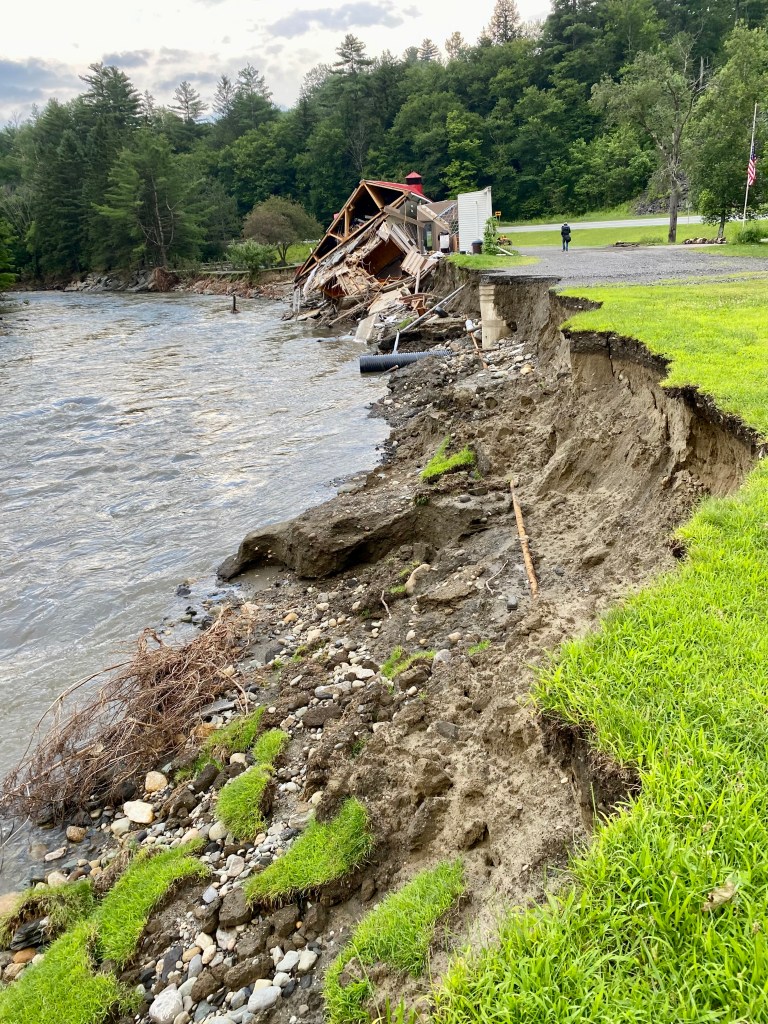
Nonetheless, on a ravishingly beautiful Sunday morning, we walk along the rail trail beside the Lamoille River. The trail is closed due to the flood’s multiple wash-outs, and there’s no bikers, but by foot and dog paw the walking is easy enough. The debris along the river is appalling. Two by fours with outlets lodge in treetops. We follow the silt and gravel, studying the way the river lifted, changed its course.

This morning, thrush chortle, and the cicadas hum their midsummer serenade. Distantly, across the river and hayfields, traffic grinds along Route 15. Where we stand, my daughter and I would have drowned, three weeks ago, as the river howled and smashed its way west, and then north to the sea.

Now, easy-going end of July.

I glean a washed-sparkling piece of white quartz, half the length of my thumb, in the shape of Vermont, and slip it into my pocket. I’d written exactly this rock and shape and size into the beginning and end of my novel. An auspicious sign — imagination incarnate — or hopeful dreaming at least.

…. Last, I’ve been generously invited to read at Meadow Meeting House, Corinth, Vermont, with the esteemed Alexander Chee, this Wednesday, August 2, 4:30 p.m. Please come if you can.

Four Feet of Mud.

Friday afternoon, when the Fed Ex man drops off a package, I ask what he’s seen on his route, his perception of flood damage and how folks are faring. In places, he says, nearly nothing. In others, houses perch over streams.

This stranger keeps going — and I keep asking questions — about his experience in the national guard, a tour in Iraq, and then a month in New Orleans after Katrina.

We’re back in blistering July, and I’m sweaty and dirty from weeding in the garden. On our sandy hillside, this summer the grass flourishes, a benefit of months of rain. I’ve finally mowed the grass (hardly a top priority these days in our house), and that ineffable and sweetly delicious summer scent of cut grass washes around us.

Our conversation bends back to Vermont and our washed-out valleys, how Hardwick’s Walgreens had four feet of mud. He looks at me and ask how tall I am. It’s true; I’m not that much taller than four feet. For a moment, we stand there, two strangers, contemplating four feet of mud. Then he heads to his truck.

Which pieces of our world will go back together, and which won’t? It’s a metaphor for many of us, perhaps.

All the way I have come

all the way I am going

here in the summer field

— Buson

Wreckage, Human & Otherwise.

There’s no one around the edges of town on Friday evening, save for a stranger in a brand-new leather jacket. He walks ahead of me.

Two weeks past the July flood, there’s stand-out heroes, and a lot of folks who stepped up in ways that are amazing, admirable, kind of jaw-dropping, honestly. But the flood unearthed all that pandemic misery, and so much more that we’d stuffed down, too. Similar — and yet, different, too. Piece by piece, my state is cleaning, hammering lives back together.

A young fox hurries along the jagged riverbank where lawn now meets abyss. The creature pauses, listens. I’m no threat, me with my hands sunk in my pockets, leaning back on my heels. The fox trots along.

The evening threatens more thunderstorms. I keep thinking of childbirth labor, how those waves of contractions bore me along mightily. Childbirth was the first time I’d understood so inherently that I’m as much a part of the universe as famed Helen of Troy, as that stranger walking ahead of me and disappearing around a broken-down scrapheap of a motel, as you reader, and my dear cats pawing a dropped ball of red yarn. Rain and more rain. Rising rivers. Even as the rain began pelting, I stood there, awestruck.