Postcards From the Past

Looking for baby pictures for her senior high school yearbook page, my teenager came across a postcard from long ago I’d stashed in a box. My father had mailed me the card when I was sophomore in college (about a 100 years ago), and it had been thumbtacked over my desk for years – once scribbled upon by the girl who’s now a teenager, when she was a toddler. On the back, my father had written that famous Hemingway quote, about the little new each of us has to give: fatherly advice, about the costliness of knowledge.

In my less confident mothering moments, I wonder if I’ve learned anything.

Last night, reading Mary Oliver, I found a line that reoccurs in her poetry, over and over, like a familiar stitch: take responsibility for your life. One of the very simplest things, and yet one of the hardest. The flip side is I force myself not to responsibility for all of my daughters’ lives, too. Put your hand through a window at 17? Odd and hard as it may seem, I believed it would be theft for me to take my daughter’s responsibility for that action.

I think of my toddler in her pink waffle-weave long underwear, going at this postcard with a gleam in her eye and my felt-tipped pen in her hand. At some point, I realized I had to let her grow up; at some point I realized I had to do the harder thing, and step back.

But there is, also, the summoning world, the admirable energies of the world, better than anger, better than bitterness… And there is the thing that one does, the needle one plies, the work, and within that work a chance to take thoughts that are hot and formless and to place them slowly and with meticulous effort into some shapely heat-retaining form, even as the gods, or nature, or the soundless wheels of time have made forms all across the soft, curved universe – that is to say, having chosen to claim my life, I have made for myself, out of work and love, a handsome life.

– Mary Oliver, Upstream

fullsizerender


Birds, Black and White

When you drive down our dirt road hill, the woods give way suddenly to open farm fields along the river valley bottom where, before the rivers were polluted, must have made for amazing swimming. We never swim in the river, but the immense fields and the arching sky are beautiful, and all my many journeys along the brambly edge have yielded treasures – wildflowers I’d never seen or small running streams from the steep hillsides.

This afternoon, crows pecked  at the corn stubble. Something like white cloths fluttered in the light snow, and I realized those graceful swoops of white were seagulls. I’d never seen seagulls there.

If you’d been looking for an omen – and I had, indeed – that mixture of the black birds, with their beaks working where the open ground lay barren and brown, coupled with the downy white of seagulls who tilted upward in the breeze and drifting snow would have sufficed. It was just me and the birds, and the birds would have gone on quite happily without me, serene in a mysterious drama all their own.

…. you can
drip with despair all afternoon and still,
on a green branch, its wings just lightly touched

by the passing foil of the water, the thrush,
puffing out its spotted breast, will sing
of the perfect, stone-hard beauty of everything.

– Mary Oliver

fullsizerender

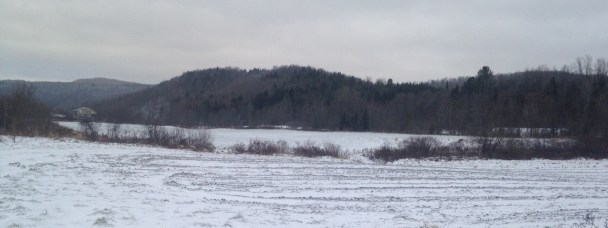
Hardwick, Vermont, snowing


And Then This…

Yesterday, the heavily overcast sky hung low, sullen with the threat of snow. The day lay cold and gray. In this dismal time of year, even the most valiant of Vermont admirers must wonder what holds us to this piece of earth.

In the night, emerging from the school’s basement library after a lengthy school board meeting, one of us marveled it did snow, after all. In the school’s sharp floodlights, the snow sparkled, and I remembered in a flash that the saving grace of winter is its beauty. Even in the darkness, I saw how the snow promised a brightening of the next day.

In Hardwick, I met my daughters, the town nearly closed up for the evening. The younger girl, giddy with staying out late, scooped up a handful of the wet white stuff and kept giggling, What is this? before she answered herself: Christmas coming. She pressed her face near the snow, dreaming.

It is January, and there are crows
like black flowers on the snow…

– Mary Oliver,”Crows”

fullsizerender

Photo by Molly S.


One Life Instruction, via Mary Oliver

Last summer, we were eating dinner with friends who have young children, and two couples compared notes about their toddlers drinking dirty bath water. I laughed and assured them, yes, someday their kids would brush their own teeth. The real challenge, I claimed, was when the teenagers take off in the Toyota.

As I often am, I was wrong. What about when a child decides to disappear into a remote mountain wilderness? Or head down her own path of parenthood?

In my forties, now, I’ve reached the point where life is no longer that amorphous, endlessly murky terrain, but indeed life stretches out, far more winding than I ever would have imagined when I was twenty. Perhaps it’s the decade of my life, but now separations, cancers, loss and loss again, is no longer uncommon – which perhaps is why good news is so much sweeter. Every one of these babies born well, a new house, a book published, a journey completed in good humor.

Or this: my girls with their long legs sprawled on the couch, laughing about silly things, nothing more, just silliness. Long life is made of little tiny moments: soak up the sweeter ones.

Instructions for living a life.
Pay attention.
Be astonished.
Tell about it.

– Mary Oliver

IMG_2047.JPG

The Footprint of Where You Live

I live in a Vermont town which has very little pavement. Route 14 heads north-south right through the village’s tiny center. In the village, a small amount of pavement fronts the post office, volunteer fire station, and the currently-closed general store. The elementary school has a square in the dooryard, none in the playground or dirt parking lot. Our town is wood, field, and a great deal of water in lakes, ponds, running streams.

The schoolkids took a field trip to Barre, and I met them in the morning, standing beside their one school bus, in a sunny but cold morning, eating apples on cracked asphalt. I laughed.

If you’re a kid, does it matter that your school garden’s footprint is larger than your pavement’s print? Does it matter as adult that you have both winter boots and mud boots? That your horizon is framed by trees and not rooftops?

I tend to think, whether we notice or not, where the soles of our feet walk matters.

Instructions for living a life.
Pay attention.
Be astonished.
Tell about it.

– Mary Oliver

FullSizeRender.jpg

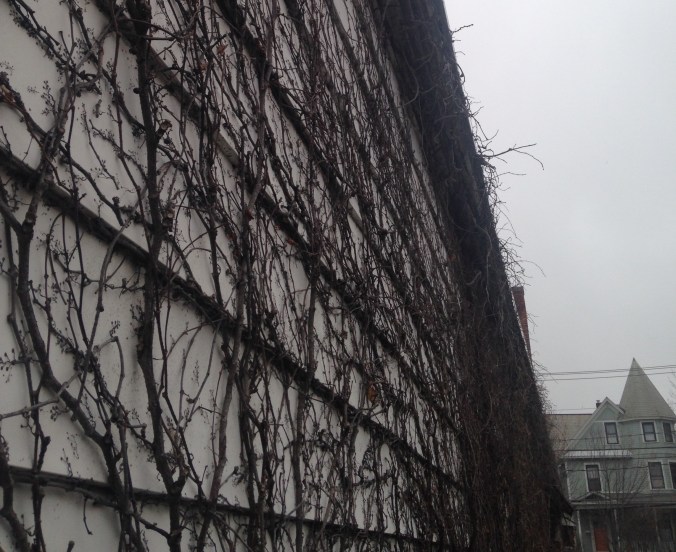
Burlington, Vermont

How To Write a Story….

Any writer knows a story can be told a myriad of ways. Today, visiting a school that once hovered near the brink of disintegration, I realized that school’s story could once have been told in numbers that reflected too much poverty, too little resources and not enough skills: too little – and too little again, and again, and maddeningly again – all the way around.

Instead, this is now a story of growing gardens and colorful classes – and thriving children. Who decides when a story needs to be rewritten? For a school? Or for yourself?

I remember Mary Oliver’s line posing the question about what to do with your one wild and precious life. Create at least one or two fine things, I thought. Leave one or two marks for better, and not for worse.

Sometimes I go about pitying myself, and all the while I am being carried across the sky by beautiful clouds.

– Ojibway proverb

FullSizeRender.jpg

Hardwick, Vermont