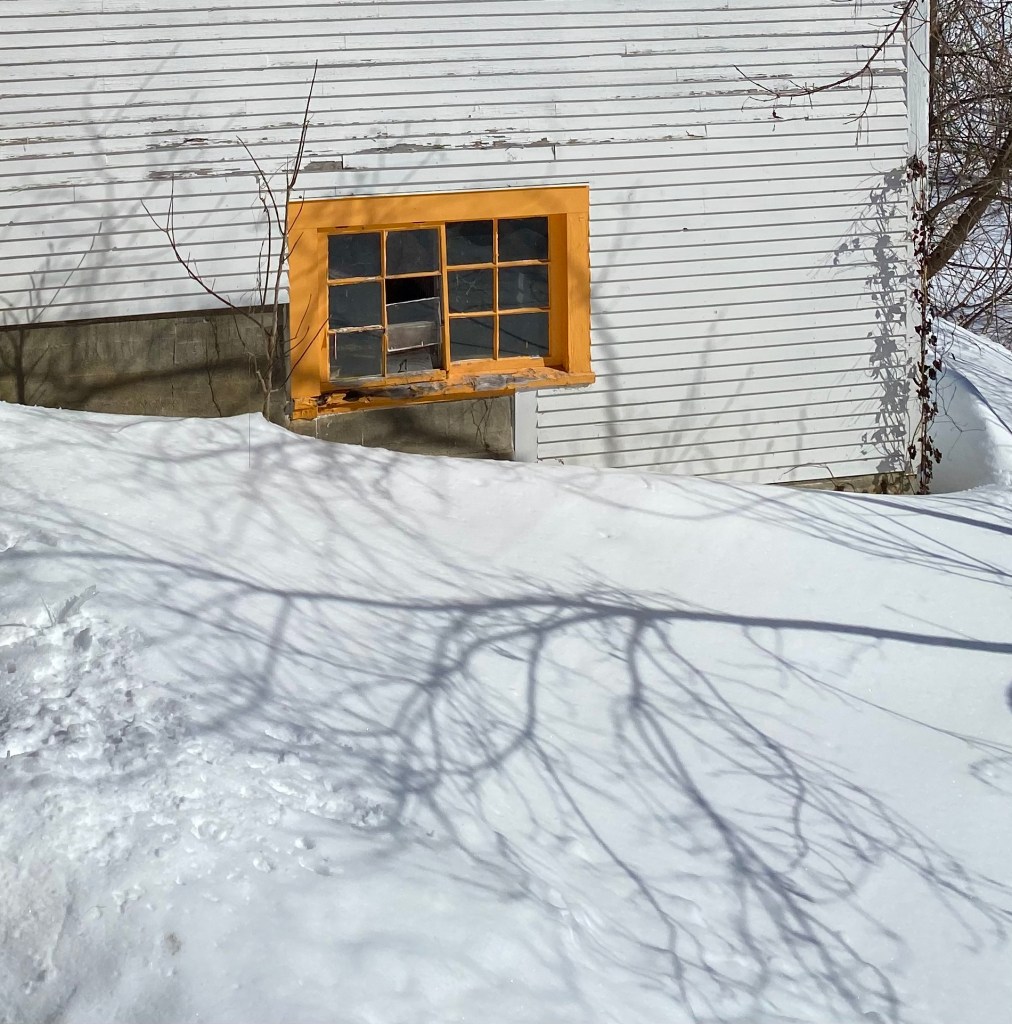
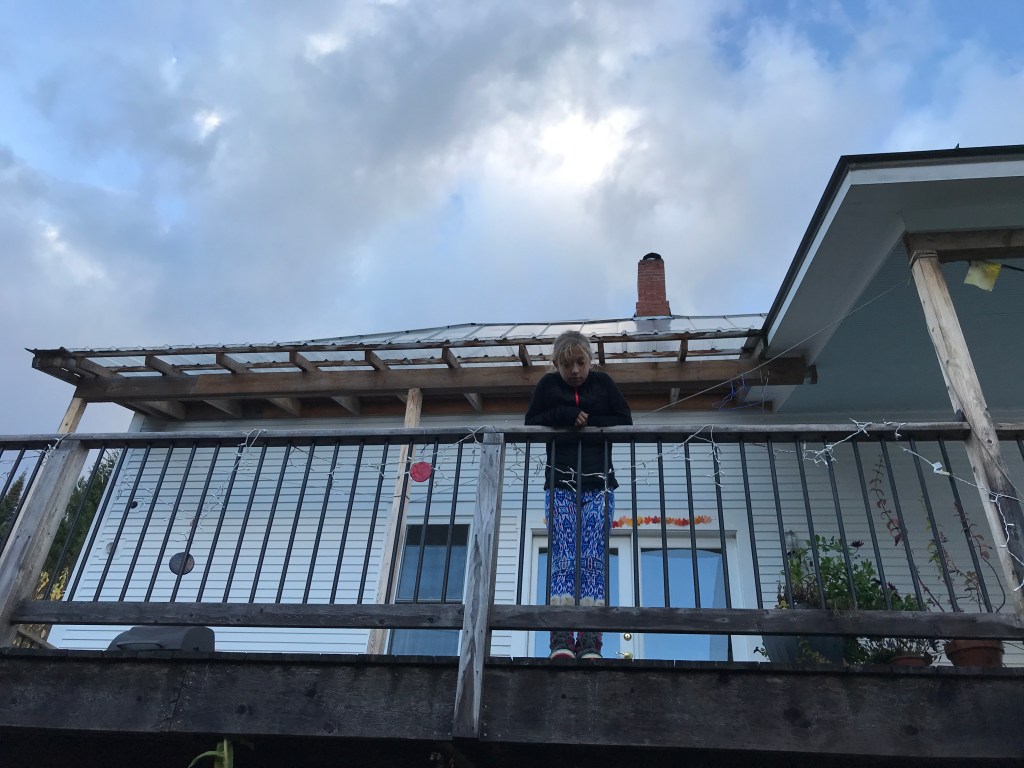
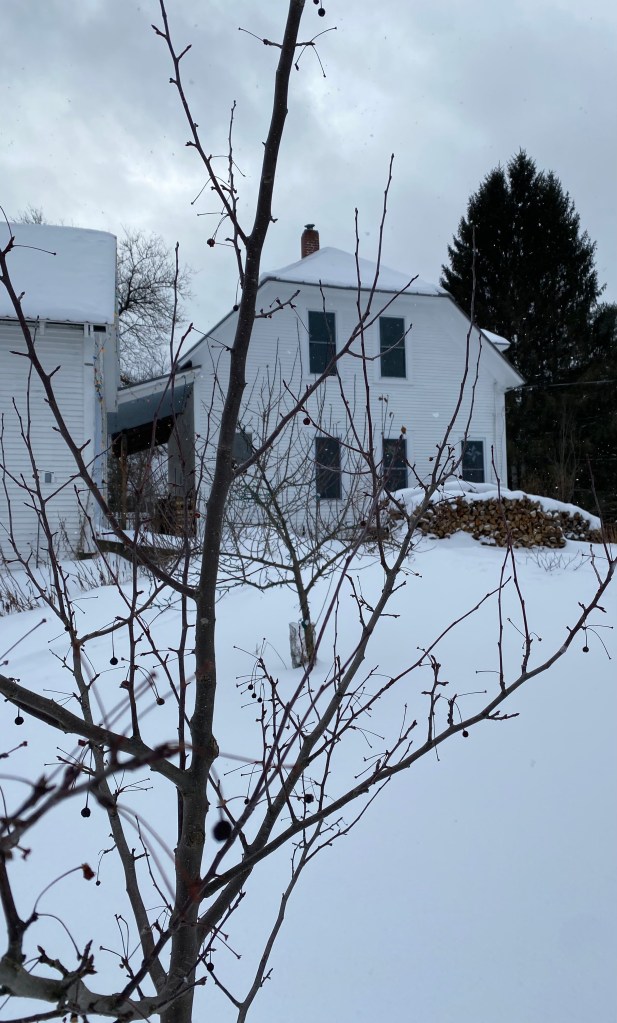
Pig farm, glass buildings, moss.

Photo by Molly S.

The man who swept and cleaned my room at Dartmouth-Hitchcock lives in a nearby farmhouse where he grew up. All this complex here, all these buildings, he says, unrolling trash bags, was once a pig farm. Marooned in bed, IV-ed with multiple lines, I ask questions. His family raised beef, milked, had sheep, their own pigs, a chicken-and-egg empire run by the family women.

We talk food – garden canning, slaughtering and freezing, how his mother’s cookstove had a can of grease they used for eggs, steaks, day-old biscuits. That stuff in a box we eat now, with too many ingredients, that’s not food.

We get to gravy recipes, boiling water and how much flour to paste in. Then we wish each other well. Done for the day, he trundles his cart down the hall.

Home, I’m less cloudy for a few morning hours. By afternoon, the cats and I retreat to lying down, reading, slipping in and out of sleep, where I dream of an enormous pig farm where those tall glass buildings now tower over the surrounding woods. I dream myself back to early girlhood, sick, sick, playing paper dolls in bed. I weld my paring knife, skinning a Chioggia beet. For one long piercing moment, I ache to pull on my jacket and boots, slip wordlessly out the door and along the brambly path – a solitary walk to clear my mind. How I’d relish stepping from frosty twilight into my warm house. Patience, patience: my lesson now.

Friends text photos of sunsets, lakes, moss, running streams. Cell phone photos once so common to me, I study these, proof of a winter day. Mail arrives. Half insurance bills, half gorgeous cards – flowers, a paper wreath, snowy mountains – and so many welcome words. Late afternoon, I cook a pot of rice, my first contribution to a meal in weeks, save setting out forks and spoons like a toddler.

I like the juicy stem of grass that grows

within the coarser leaf folded round,

and the butteryellow glow

in the narrow flute from which the morning-glory   

opens blue and cool on a hot morning.

– Denise Levertov

December, Holy/Unholy/Holy Season

Anyone who lives in a northern climate must inevitably come to some reckoning with the descent into this month’s darkness, the steady whittling away of daylight at either end, noontime oftentimes scrubbed to a soapy haze.

To my surprise, this month began on an ascent for me, an elevator rise at the end of November, crammed into a silver metal box on a gurney with my weeping daughters and brother, and an anesthesiologist who might have drawn the short straw to collect the patient in the otherwise sleeping hospital. He was actually assured me he was a much better anesthesiologist than a gurney driver. Bring me back safely to these people, I pleaded.

Here at Dartmouth, I’m in a major medical facility (of which I’ll someday write much more). There’s no illusion that this is giant Health Care. Within this, my tiny 4’8″ body and the fraughtness of grave disease and uncertainty, and so so many patients. Yet all these interwoven days and nights, I’m surrounded by an arch of kindness, by skilled and unskilled staff who labor so patiently. I’m humbled by this secular holiness. The respect is repeated among colleagues here, aiding each other (and all us needy patients) with their own thank you, thank you as they work together.

A friend, driving home to Vermont from family Thanksgiving, leaves me Time of the Child by Niall Williams. Late into the night I read, taking these hours to relearn the slow joy of novel immersion. Sleep, sleep, I urge myself, and yet Williams’ world entrances me. Here’s line from this novel that an elderly Irish country doctor remembers from his doctor father: “The sick are ourselves, was a thing his father had said. When you stop understanding that, take your name off the wall and throw your bag in the river.

…. Whatever way this month transpires — for rise or for misery — and it’s all holy, isn’t it, this sacred and profane mixture of spirit and blood and bowel. The journey itself we take together is the gem.

Although I will say, I was ineffably joyous to return from that dismal night and see my curved-to-exhaustion people. After all, I am in the only one in our household who devours the cold leftover French fries with gusto. Why would we waste cold potatoes?

Thank you again, all.

Hay strands for sheep, purring cat, Harry Potter chocolates for neighbors.

Now in my fifties, I’d lulled myself into believing my risk-taking days were sewed up: those early 20s of getting in the old Volkswagen for journeys of thousands of miles, buy a decrepit hunting shack and convert it into a home, severe a marriage soured terribly and fear he might take your life in retribution — all that time of selling the maple sugaring equipment (who to trust, how to cut a hard deal?). So jaywalking suited me just fine. Waking long before dawn to feed the cats and drink milky coffee, write and watch the sun rise, that streaming beet juice.

As if I held all the cards in the risk-taking plans, anyway. Now that thread of riskiness has spread to those beloved around me, too. More and more, I understand my learning to craft a honed a sentence or the deep pleasure of watching a cardinal pause on a branch, are my steadying rituals of rooting me meaningfully in this world. I have friends whose lives center around sheep and chores and woolly affection, in ways that transformed their lives. Chicken and horse lovers. My sister-in-law with her two goats.

As I write from Room 101, I haven’t forgotten that the world spins on. Last night, I listened to VTDigger’s Dave Goodman’s follow-up conversation with Elizabeth Price, mother of Hisahm Awartani, one of the three young Palestinian men who was shot in Burlington, Vermont, a year ago. The Gaza war reigns. The American presidency shifts.

In Room 101, so many stories of people come my way — the night nurse who studied for two years in England, near the beach, transcontinental; how transport folks and nurses made their to live in New Hamsphire and Vermont, often from places around the country. What do you like here? What have you found? I keep asking, curious to know what roots people in their lives.

The smaller world spins on, too, with its things both miserable, joyous, and pleasurably mundane. Your own rituals of offering hay to sheep, fingertips to a cat’s purring head.

Last day of November, the month of cancer in my world. A year ago I bought Harry Potter chocolates for the neighbors’ boys and waited in the dusk for the three laughing boys to appear around my woodpile. The Good Doctor tells me I will go down, down, soon, and then rise to where I once felt well. What would that mean? I’m hanging on to this unrealized promise.

I repeat. When I go down, I will re-emerge.

The awful, the reprieve, Maurice Sendak’s chicken soup with rice.

Snow falls early on this Thanksgiving morning. The nurse wakes me for meds and vitals. I am eighty-four miles from home. My window looks out into a courtyard with a fan of three white birches. In a wind, their papery bark ripples in the breeze. Nearby, an office window glows where someone is already working.

I am here for a haul. My daughter brought me the striped blue and green quilt from my bed, the worn hand-me-down that reminds of home.

Monday, the pain and awfulness returned. My daughters drove me not to the local ER this time, but down the interstate, the two of them in front, me in the back with a pillow staring out the window, to Dartmouth-Hitchcock. At the ER, they took blood, asked my story. Someone in the waiting room, who must have been a frequent flier, had been waiting for four hours was threatening to leave to get something to eat. The nurse said she couldn’t go. I was sent out, waited less than four minutes, and was taken in for antibiotics and saline and pain meds, another CT scan.

An MD, a second. An oncologist who explains slowly that the lymphoma I have often responds well to treatment, so reassuring. This raging infection. I am taken upstairs. My daughters, folding with exhaustion — it is now late again — head back up the interstate. Shortly afterwards, the oncologist returns and bends down to look directly at me, eye level. I know this position means bad news again. In the three-week span of CT to CT, the cancer has grown and possibly eaten into my bowel. Surgeons will be in shortly to speak with me about emergency surgery to remove a section of bowel. My thoughts immediately surge from Thank god, I may be alive in May with my family and see blue squill bloom to Are you fucking kidding me? It’s the middle of the night.

Middle of the night or no, the surgery team comes in and out, talking, talking. The lymphoma renders the CT scan unclear. Because my mind works this way, I size up the head surgeon: she’s long experienced in trauma and general surgery. Her fellow tells me he’s been working with her for six years. She tells me so much, all the terrible — and these are devastating — things that could go wrong me for in the next few hours. In the end, I trust my life to her. It is the only course.

I call my brother. We call my daughters, who have not yet slept. My brother gets in his black Subaru. My youngest drives our red Subaru and drinks a quart of cold coffee, a more experienced driver than her sister after a cross-country trip this summer. Is the moon guiding them? I don’t know.

In the OR, a woman whose name I don’t know holds my hand as I instantly go under. When I wake, so confused, in an enormous dark room — it’s the still the pitch of night — I immediately lift my jonny and look at my abdomen, asking what happened? My flat abdomen has no huge bandage. The surgeon had gone in with a camera and decided what remains is sufficient, for now perhaps, forever perhaps, to change perhaps. My oldest showed me a photo she snapped of my family curled in the empty ICU waiting room, sweatshirt hoods over their heads. Let me write this: what a hard awful night, and how much worse it might have gone.

….. Then, that morning, in and out with the surgery team, with phlebotomists, nurses. The lymphoma oncology team arrives in a pack. The lead pulls out a chair, tells us to record, and begins talking. He’s brilliant and confident without cockiness in his ability to cure me. He outlines that complications of infection and my bowel will keep me here for the first chemo run, deep into dark December. I decide to do exactly he tells me.

My family again leaves. My daughters refuel with fast-food chicken and sandwiches for their drive. I sleep and wake in a drenching fever, which creates a flurry among the nursing staff. They come in and out. Somewhere in the miasma, I really wake up and decide to pull myself together. I’m going to be here for month, and I need to quit feeling sorry for myself. A nurse tells me to eat some chicken soup with rice — remember Maurice Sendak? The soup is delicious. The fever breaks. I survive a ten p.m. MRI — a blind descent into a cave where dwarfs bang around me while Freddie Mercury sings.

This is a long way of writing a fragment of how I arrived here, medical center land, not a Thanksgiving morning where the kitchen is savory with sage dressing, and I’m out in my boots, admiring the first downy snowfall in my garden. Living is a nonstop risk, the whole she-bang, but we don’t always tread such a thin pinnacle. By chance, as I packed my laptop and socks for the ER trip, I stuffed in the Vermont Almanac that had arrived in that day’s mail. Later, when I had decided to embrace where I am now, I opened the envelope. This volume, as the others, is exquisitely beautiful. A phlebotomist arrived to take blood. She admired the cover — especially the view of the mountains through the window — and she told me a little of her story from rural Vermont to Lebanon, New Hampshire.

In editor Dave Mance’s opening, he writes, now post-election, how we might return to embracing the complexity, rugged and elegant, of the natural world and our very lives. (Gracious, when I’m able to untangle myself from cords, I’ll update with his poetic words from the book just out of reach on the windowsill.:)

Complexity is precisely where I am, enmeshing in this crazy mixed-up jumble of the medical system’s turbo drugs and powerful machinery, the stories of the people who labor here, a nurse training for her first half-marathon and another with three young sons, welcome news of a friend’s first grandchild, my own energetic and loving family.

All of you, too, on this Thanksgiving or perhaps just a plain old weekday morning — in our lives, how much we’ve chosen and so much we haven’t — gratitude for being alive in this world. For chicken soup with rice.