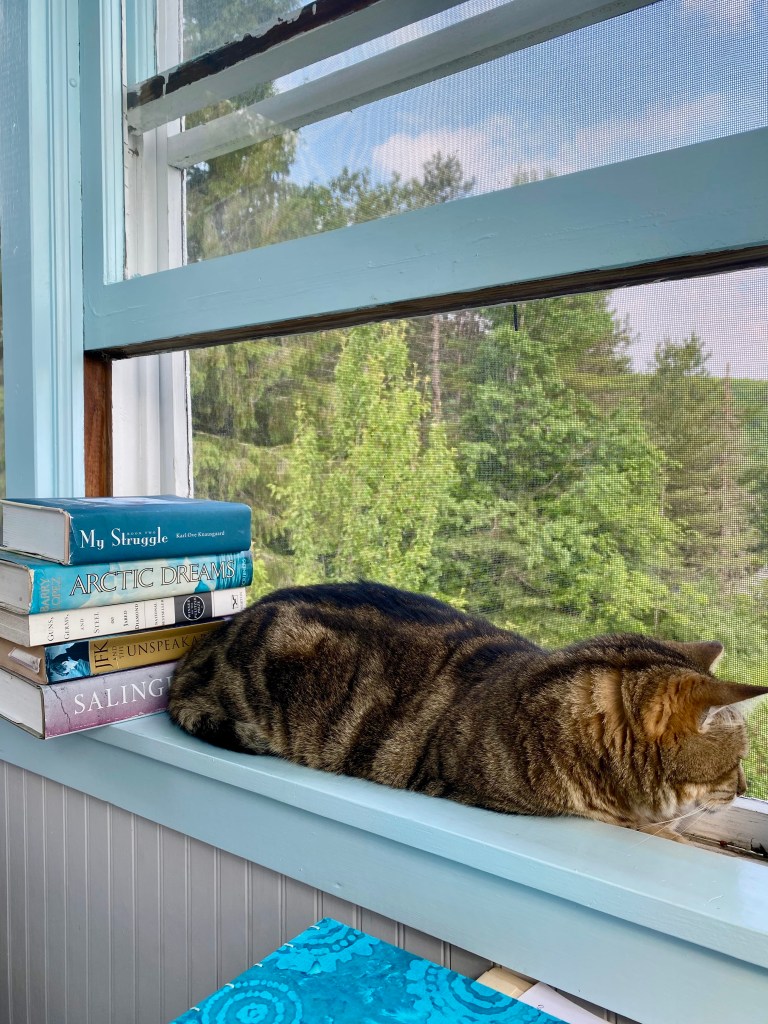
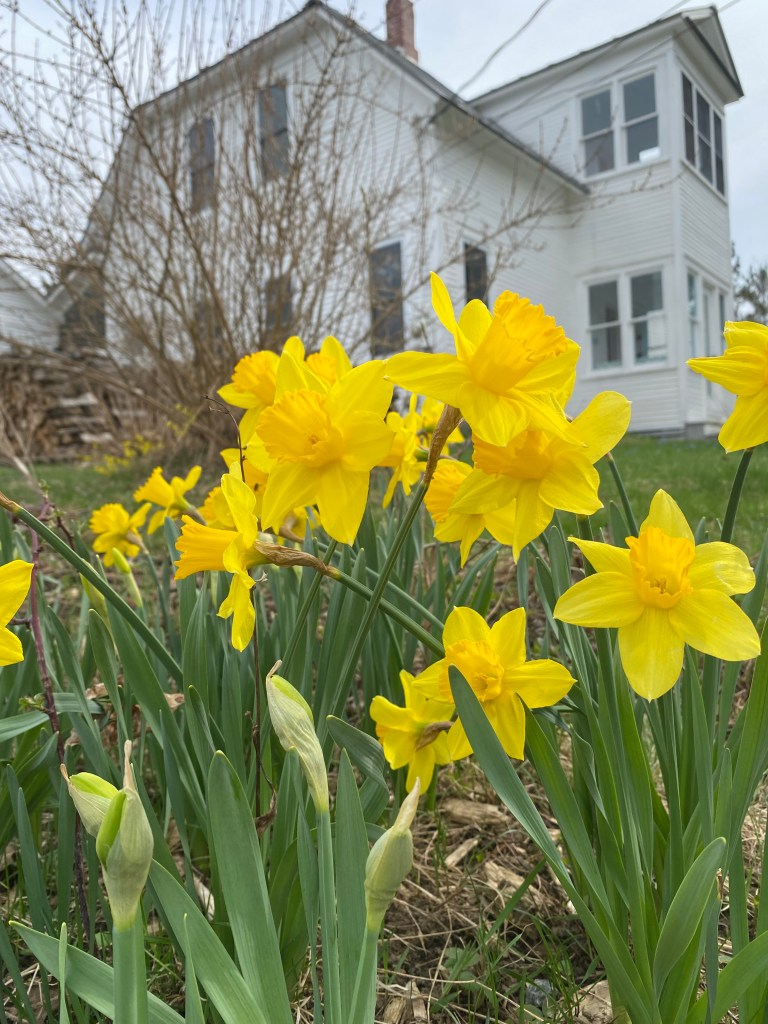
Seeking the Something New.

A friend arrives with a box of seedlings, including tithonia, AKA Mexican sunflowers, a tall, brilliantly orange, hopeful plant. A few mornings later, more friends appear with seedlings and a pitchfork. Lucky, lucky me.

I am a gardener who allows the Johnny-jump-ups and forget-me-nots to spread where they like, pulling back a few and nestling in basil, scallions, poppies. Why unroot a flower? Eventually, I weed diligently, ruthlessly. The garden mirrors my approach to novel writing. My friends leave with their boxes filled with forget-me-nots as a gentle rain falls on the tender seedlings.

Every day is a further day from surgery and chemo, the days and night accumulating like pages read in a book. I put away the narcotics, the Tylenol, the ibuprofen. Mornings, I drink a single cup of café au lait. I sauté mushrooms, bake a quiche. I ask for a ride to drop off my car at the garage, worrying about walking up my hill, but picking it up is mostly downhill. I walk.

For a little bit yet, I’m a person of interest in this small town. The postmistress asks me, no, really, how are you? For months, the PO staff has stuffed my box with cards and books and sheaves of medical bills from two hospitals. I’m there to pick up a book of essays (a gift which quickens my heartbeat). I tell her I’m in remission, that word still awkward as it emerges from my throat. I want to add that remission does not mean cured, does not mean that this strange and uninvited cancer beast has left my body – and certainly not my soul. I don’t know this woman at all well, but she looks steadily at me, as if she understands what I’m thinking.

Here’s the thing: how afraid I was of cancer eight months ago; honestly, I’m still fearful of it. Yet, cancer rooted in me, infested my family, my friends, a great wide circle of people around me, including my readers here. This is not unique. In its myriad forms, cancer spreads widely. I lived for years with the putrifying secrets of addiction. I refuse to repeat that with cancer.

Last November, I thought I wouldn’t live to see spring. I did. If jaywalking doesn’t do me in, cancer certainly might. Or I might die as a scrawny old woman from a stroke or heart attack. In this rainy late spring/early summer, I’m grateful for the possibly random dice throw, for plants and gardeners, for an infinitude of people. Among these are the people who’ve shared their stories with me, of decades-ago cancer diagnoses, almost always offered sotte voce, as if not to tempt the fates. Their stories ring clearly: I endured, I transformed, I thrived. This possibility can be mine (maybe yours, too).

From Suleika Jaoad’s The Book of Alchemy:

But there are also moments when our internal compasses tell us it’s time to change course–to leave something behind and build something new…. Rebuilding is not easy…. But to me, rebuilding unfolds alongside becoming. It is crucial, if we want to keep evolving and flourishing, to get rid of things that are no longer serving us and make space for something new to grow.

“…the strange idea of continuous living…”

A knock at my kitchen door wakes me. Midafternoon, home from a long morning at Dartmouth for routine things, nothing major, but a day that began in the dark after scant sleep. The week before, I’d left a message for a man who painted three sides of my house a few years ago to ask about an estimate for my barn and that fourth side that somehow I’d never painted. Last fall, sick and not knowing the (cancer) reason why, I’d managed to get out my sander, but that was about as far as that plan went.

The painter is a person my daughter and I know in our overlapping circles, so I’m not surprised when he says he’d heard of my illness. We talk for a bit in my kitchen. Then I grab my sweater, and we walk around the barn. A stunning sunlight makes me blink. Our conversation winds around primer and caulking and ladders. In the back, where the woodchucks claim domain, the painter turns the conversation towards politics and the word that’s so commonly used now — cutting. We talk about cancer research (which saved my life) and the bitch of enduring chemotherapy. A house finch perches in the honeysuckle in the wild tangles below my house. The honeysuckle’s bent branches are dotted with tiny fans of new leaves.

It’s been a day for me. I once had unbounded energy that I spent so easily with my garden shovel, my paintbrush, laptop, trowel, my two hands. I lean back against the barn’s peeling clapboards, beside last summer’s clematis vine that appears shriveled, used-up, no good. I have complete faith this beauty will bloom again this year. Listening to the painter, I wonder, why make any guesses about anyone or anything, really? What will happen will happen. Yet, I can’t help myself. I’m betting on the clematis and its purple flowers. The painter offers me his good will, and I take that, too.

Instructions on Not Giving Up

More than the fuchsia funnels breaking out
of the crabapple tree, more than the neighbor’s
almost obscene display of cherry limbs shoving
their cotton candy-colored blossoms to the slate
sky of Spring rains, it’s the greening of the trees
that really gets to me. When all the shock of white
and taffy, the world’s baubles and trinkets, leave
the pavement strewn with the confetti of aftermath,
the leaves come. Patient, plodding, a green skin
growing over whatever winter did to us, a return
to the strange idea of continuous living despite
the mess of us, the hurt, the empty. Fine then,
I’ll take it, the tree seems to say, a new slick leaf
unfurling like a fist to an open palm, I’ll take it all.

~ Ada Limón

After an absence, return.

Photo by Molly S.

A long while away from this space after a day last week that began easily enough in our kitchen with my daughter and transpired into another Dartmouth ER visit and a prolonged stay. Days and nights chopped into mosaic pieces. MDs and RNs, the revolving cast of the Dartmouth surgical team, my daughters, pain meds, ice chips, me sitting up and begging for a patch-up to get me to my next chemo appointment… Get me out of this chronic patient repeat.

Now, five of the six chemo treatments completed, I am in the final haul. While my in-box filled up (thank you for your patience), and I was moved from room to room by kind people, I kept thinking of this cancer in a narrative arc. I had hit the section of story where the impossible commences. Before, things looked grim. But now, as protagonist in my own story, the arc swerves sharply, the longed-for light-at-the-end of the tunnel snuffs out, the path is hidden.

I’m not a writer for naught, for make-believe or play. I’m a writer because I know our lives tread meaningful albeit sometimes horribly hard paths. Lean in, I counseled myself, my shoulders far skinnier now but just as fierce. Use math. Get to the fifth infusion. Get to the sixth. Count down the finite days to the end of this treatment, which is, thankfully, eradicating the cancer. In the mosaic: my two daughters, the plastic IV tubing, the doctors in their masks, the ER nurse who stayed long past his shift in the middle of the night, holding my hand and assuring me that, yes, indeed, I would endure.

This is my story, but also the human story, in all our infinite variations of human desire, choice, the immutability of fate.

Sunny morning in our kitchen, birdsong, the fierce thrust towards spring.

Small town, rural hospital, snapshot, tinge of the seventies.

Driving into the Dartmouth Hitchcock Medical Center, the soaring buildings with their blue-green windows inspire confidence. They’re just so darn topnotch, cream of the crest, but (in the cancer journey) I also use the nearby hospital, too.

At the local hospital, not far from our house, we arrive again in the dark, the crimson EMERGENCY sign glowing. My daughter leaves me at the door and disappears around the corner to park. Inside, it’s the same receptionist, who nods a little sadly to see me again. In the waiting room, there’s no one but me and the Mountain Dew machine, my reflection in the windows.

Months into this cancer, I’m familiar with the process (don’t ever put your feet on the ER floor without shoes!) of questions and fluids and meds, a room far away from the day’s flu and Covid patients. Here’s what has changed: the ER doctor and I know each other now. My brilliant oncologist calls me and thinks aloud, what’s going on now? and orders an unusual set of tests. The ER doctor listens, nods, yes, let’s try that. My daughter’s boyfriend appears. The three of us talk about xc skiing and DOGE.

I’ve crammed my backpack with my laptop and notebook, two books, and a few clothes. In the middle of the night, I’m admitted. The woman who takes me upstairs knows a longtime friend of mine. She tells me about growing up in eastern Montana. Wherever you go, she tells me, the sky is infinite. Vermont’s so small, I feel like I could put it in my pocket.

Having lived in the West, too, I sometimes chafe against the pocket-sidedness of Vermont but mostly I love it. I keep thinking of this woman’s description for these few days again, in this rural hospital that’s about the size of double pocket in the front of hoodie sweatshirt. The census is so low here the rooms are all singles. Each of the rooms where I’ve stayed seems to be finished with unique salvaged materials. Beadboard cabinets in my last room, painted glossy cobalt, line one entire wall. In this room, the window is trimmed with wooden rosette corners, the sill plastic faux marble.

The medical world is hurry up and wait, but this hospital leans back towards the 1970s. I drink Shasta ginger ale and chat with the LNA about the cold and maple sugaring. Here’s what changed in me: I see these people throwing everything they have at me. The hospitalist who advised me, just a day after the cancer was discovered, do not stay in bed; be part of the world. The social worker stops in and asks my daughter about her job. The chaplain and I talk Dostoyevsky and cats. The nurses who have survived their own savage cancers share their stories and let me ask my questions. I have so many questions. The questions narrow down to one: how will I survive?

Then I ask to leave. My daughter stops at the pharmacy for another prescription and texts that it will be a few minutes. I open the door and lean against her winter-salted car. I’ve been at this crossroads in this unremarkable section of town so many times. Across the road was the department store Ames where I bought this daughter her first pink ball so we could roll it between us, the baby version of Catch. In the Price Chopper parking lot, I used to meet people to exchange boxes of wedding favors in leaf or heart-shaped bottles, tied up with ribbons, for checks. Afterwards, I’d take my girls into Price Chopper and buy ice cream. Behind the pharmacy is a home center, where I’ll never go again, after my ex-husband absconded with his customers’ money and stiffed the home center… how many tens of thousands of dollars I never knew. I’d severed that cord by then. On the other side of the crossroads stands the hardware store where the girls and I used our pandemic stimulus money to buy a glass table and red umbrella for our back porch. We use those things every summer, nearly everyday.

Behind Price Chopper, craggy Elmore Mountain looms, where I and the girls and their friends have camped and hiked and swam for years. The gentlest of snowfalls sifts down, swirling. My long-legged daughter crosses the lot, shades on despite the overcast sky, grinning.

The contours of your heart…

Not February, a long time ago, at our house…

Prying an aluminum safety-seal off a bottle, I remember drinking a tiny plastic bottle of cherry-red juice as a girl when a soft piece of aluminum was the top: once you peeled it back, you were committed to drinking the whole thing. In our sugar-free house, we rarely drank sweet things. This was somewhere in that vast expanse of the Midwest, land of a long-ago sea. In our parents’ green Jeep, we hurtled along I-80, two kids in the back and another up front in the middle between my parents. The Jeep had no radio. In a fit of enthusiasm, my mother had bought a transistor radio that she insisted would work. My dad insisted it would not, despite my mother unrollling the window and jamming the antenna into the wind. (The radio did not, although she did play music at a campground picnic table. We insisted she turn it off: too suburban, mom…)

In the floor of the Jeep’s backseat compartment was a hole where a screw must have fallen out and disappeared. In these pre-seatbelt years, we sometimes lay on the hot floor and stared down through the hole at the interstate whizzing beneath the wheels. A steady blow of hot air blew upwards.

Midwinter now in Vermont, that eternal season of accumulating snow and intermittent dazzling sunlight. My parents, bickering or laughing in their front seat domain where the three of us kids were clearly only intermittent visitors, were enmeshed in their crazy lives, scooping us along in their journey. As for us kids, the void of that quarter-sized hole in our family car and the pleasure of those unexpected sweet drinks, the promise, perhaps, of a swim in a campground pool later that evening, defined those summer days.

Now, decades beyond that cherry drink, I see my own rugged journey spanning decades, my daughters always along and still along, as we’ve come together and parted and reunited with so many people over these years…. In the end, perhaps, what remains with a child might simply be that special drink, not the mighty panorama of ancient geology or the American landscape of truck stops and diesel fumes and KOAs, not even my parents’ own struggles to figure out their lives — where are we going? what are we doing? — that, in my parenting turn, I’m hammering out, too.

From the inimitable essayist Leslie Jamison: “Don’t assume the contours of another person’s heart. Don’t assume its desires.”

Born in 1933…

William Maxwell writes in his riveting short novel So Long, See you Tomorrow: “The reason life is so strange is that so often people have no choice.”

This strange world, indeed. My daughter drives us up Vermont’s long loneliness of I-91, the interstate running above the river. Villages are tucked into the blue and snow-sprinkled mountains, these tiny clusters dominated by spires of white clapboard churches. This has been a week of in-and-out of ERs and hospital rooms, of resurgence in energy and a low so low I’m unable to bother to speak. Now, the ride home, the passing through of this winter country, where the new snow (so pure white) piles high on tree branches. This northern land in midwinter is territory I know with a familiarity akin to the veins on the backs of my hands. A haven of cold, often slow-going, a muted palette of pale blue, sooty gray, evergreen nearly black.

We talk until we’re spun out from chatter. I lean my head against the cold Subaru window. In the last room where I stayed, my companion was a woman born in 1933. 1933 marked the end of Prohibition, the year stenciled on the green-glass-bottled Rolling Rock beer we drank in college. 1933, the year of Roosevelt’s New Deal. The woman’s voice was clear as a spring stream, often studded with small wry jokes. When she saw me, her face glowed in a smile. Of all the things I’ve learned from this week and scribbled into my notebook, this woman’s radiant smile and easy language sticks with me. A few times, I wandered her way, hoping to have some of her joy rub my way.