Keep Reaching.

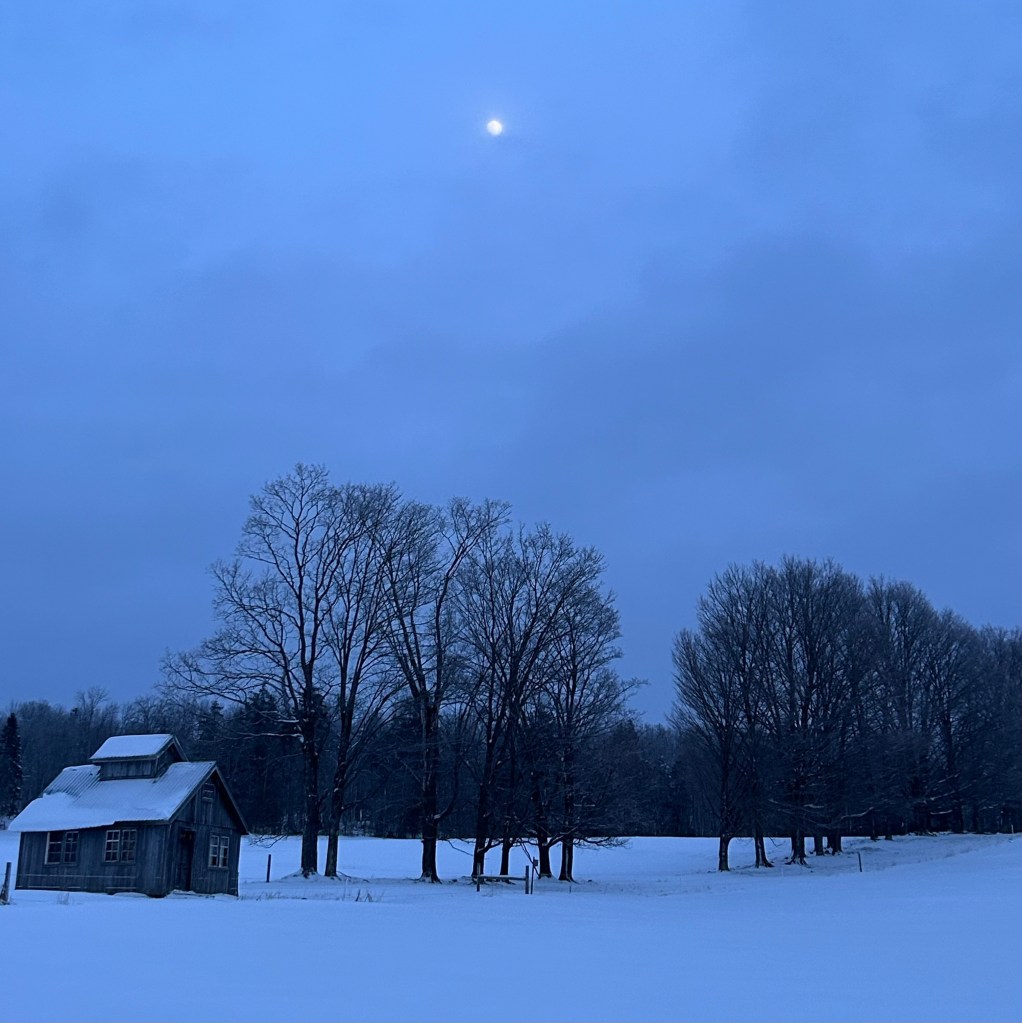
Dark as a pocket or the inner chambers of my heart — so goes these December nights. The nights descend earlier, more afternoon than evening. I randomly meet friends on Main Street with the darkness kicking around my ankles. We step into a community center, pulling off our coats and hats and talking about random things — the price of gas, the upcoming holidays. For those who don’t live in a northern climate, a public building in Vermont sometimes has a curtain just the inside the door to stave off winter’s wind and snow. I push aside the curtain, and we step into a well-lit room.

It’s a simple/not simple thing. We eat bowls of hot soup and chunks of fresh bread at a long narrow table. A couple I’ve never met sits beside me with a brand-new infant, gustily sucking. I refrain from bending my head and breathing in the child’s milky scent.

Darkness presses against the windows as we talk and keep talking, and eventually the three of us are all leaning our elbows on the table, our heads propped on hands, spent. People appear, say hello, offer a hug, disappear, and still we’re talking about what might happen with the schools and our old parents and the persistence of memory from early childhood. How do we reconcile our stories? Escape or rewrite our stories?

Eventually, sodden with sleepiness, I pull on my boots and step out. The weather has turned, and the sidewalk is slick. I head out of the village. The wet air is not so much clean but fresh, a mystery of fomenting things both lovely and fearsome. But for now at least, I carry these gems of companionship in my heart. A pleasure, a warm joy.

…. and a poem from a friend….

Keep Reaching

The trick is to keep reaching

for the light you will never touch,

and to be nourished by the stretch

toward impossible things.

The trick is to bloom where you are,

not calling it a failure because

you wanted a different outcome.

Live each day devoted to awe, 

so that when a monarch lands 

on the tip of a coneflower, seeming 

to swell with that sudden infusion 

of sweetness, you don’t miss it. 

So that, while you watch, a pair 

of hard-won wings seems to open 

and close, and open again in you.~ James Crews

Small Celebrations.

Each morning presents a new skein of yarn, knotted and jumbled as if carelessly carried in the bottom of my backpack, beneath leaking and softening apples, a sandwich wrapped in wax paper whose crumbs have escaped, the shuffling of notebooks, pricks of pens.

A friend asks me to xc ski this weekend. I pause and then warn her of possible abject failure. Can I balance? Can I even snap boots into bindings? Talking, I think of my ski boots in the upstairs closet. A year ago, a knitting companion asked to borrow needles: an inconceivability. A year ago, I couldn’t walk up my house’s wooden staircase, let alone swing open the closet door and shuffle through needles. I might as well have considered mining for gold with a plastic spoon. Pulling together boots, skis, poles: that alone would mark a kind of success. I am a lousy skier, but the glide of ski over fresh snow has given me so much pleasure. I imagine again stopping at the trails on my way home from work, how the cold winter twilight gleams on snow.

A theme that emerges in my writing over and over is order versus chaos. How laboriously I endeavor to keep the chaos from my life, from vacuuming the ashes and bark shreds around my woodstove to ordering my work life. Be productive. Get my work done…

When I first emerged from surgery and chemo this summer, I flung myself into living with buoyancy and joy. Now, I am in the longer stretch — grateful to be here, but mindful of sinkholes. A longstanding quarrel in town rises up again and grabs at me. I remind myself, this was not my doing and not my requirement to undo. What I do, instead: I force myself up from the couch, lace up my boots, and walk. In town, I fill my backpack with library books, zip my coat against my throat as the gloaming sprinkles down. I take the longer walk home through the neighborhood built near the coal-dark Buffalo Mountain, these houses built for Hardwick’s granite workers, a hundred years and more ago, once filled with hardscrabble people from other places, seeking not a fortune but a livelihood. The kind of work where a slip or accident had horrible consequences. I pass a house with a family of small children, strung with glowing lights, sleds jammed in snowbanks. The empty house where the old woman with the two barking dogs disappeared in my illness, and another empty, for sale. On my road, I’ve strung red globes in an apple tree, bits of brightness, small celebrations, better than order.

The oncologist… “knows not to describe everything all at once.” — Marion Coutts, The Iceberg

Among Lilacs-Gone-to-Sticks…

Late afternoon in Vermont December is twilight; I’m hustling along my road, a glass container of hot soup wrapped in a pink cloth in my hands, and I stop for a moment and talk to the neighbor boys who are sledding. The light is dim enough that I squint to count the three children, shadowy figures in snowsuits. The cold is fierce on my face. This day has been sprint from one thing to another, more yet to come, but I pause, that glass steaming in my mittens, the sunset sprawling over the great sky, the stars already emerging in the east’s darkness. A small moment, a tiny exchange of hellos. Such luck to be in this ordinary afternoon.

I walk through the parting in the lilacs-gone-to-sticks for the winter, study the bird feeder hung in the mock orange, the seeds sprinkled in the new snow. Behind me, the boys call to each other. In their lit kitchen window, I see the boys’ parents. Dinnertime nears. The cold is so mighty a body without shelter could and would perish. In the snow that gleams with the last of the day’s light, my boot prints lead to me, my lit window and cat, the upstairs bedroom dark where I stood a year ago and wondered if I would die. Wrong question. Not if but when. For this moment, however (a great big however), I remain in this simple-not-simple equation of laughing children, hot soup, the night swooping in. I study my bootprints with satisfaction and then head towards my own kitchen door.

“The Way It Is”

There’s a thread you follow. It goes among
things that change. But it doesn’t change.
People wonder about what you are pursuing.
You have to explain about the thread.
But it is hard for others to see.
While you hold it you can’t get lost.
Tragedies happen; people get hurt
or die; and you suffer and get old.
Nothing you do can stop time’s unfolding.
You don’t ever let go of the thread. ~ William Stafford

The Scythe, the Past.

Twilight, 25 degrees yesterday, the temperature dropping, I’m walking back and forth by the town garage, a tumbling-down quonset hut beside the town’s towering sand pile. Such much winter yet to come. On the snowy road, I pace back and forth, watching the sky turn from blue towards black, the stars hidden behind the clouds, talking with my friend about family and politics. Listening, I remember the Christmas manicotti she brought me last year. My daughter and I ate that delicious meal at the kitchen table; through our glass doors, I watched the snow fall, wondering if I would live another year.

Another year is not a guarantee for a single one of us. Another lymphoma lesson. I’d woken that morning with that now-familiar fatigue, as though sandbags were tied to every bone in my bone, pulling me earthward. I fed the wood stove, drank coffee, rallied and did my writing, rallied again and pulled on my coat and boots and left the house.

Later, by chance, at an outdoor fair I see a woman I’ve known for many years, who was part of a trying time in my life when my daughters were young. She offers me a particular kindness, and I thank her, wondering what I’m supposed to say. She does not seem to expect the standard answer of all’s well, that’s over and done because of course any fool knows, once cancer has rooted profoundly in a body, the reaper’s scythe does not hide. By now, it’s not so much the scythe that frightens me, it’s the suffering to get there.

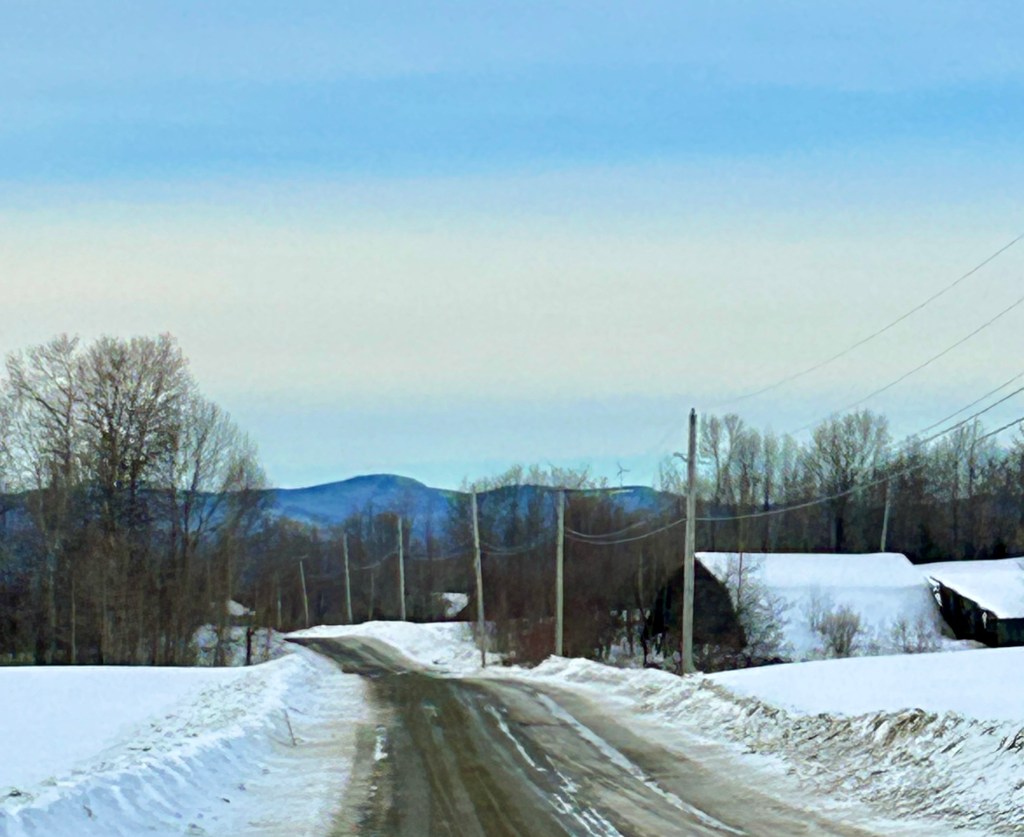
On my way home from the fair, I pull over and get out of my car. The sun shines brightly, but it’s freezing, and I’m shivering. I walk back down the dirt road that’s empty of everyone, not even a crow perched in a bare-branch maple. Far up the valley I see enormous white wind towers, the Lowell Mountain Project. To my left is a house where one of the leaders of a group that protested the towers now lives. When the tower project began, my then-husband joined that protest group. The experience broke my naive love affair with Vermont and my blind faith in that too-hard-used word community. Not so long after, the husband and I divorced. My life went on, and I became intimately familiar with my own fallibility, my own deep pockets of untrustworthiness. I devoted two years of my life to writing and publishing a book in atonement for my own callous actions. Which never changed the consequences but widened the story. Then, cancer — the plot turn.

Robert Frost, no stranger to suffering, famously wrote that everything he knew about life could be summed up in three words: it goes on. Standing alone on that roadside, I imagine myself as the mangiest cur, footsore, half-starved, near mad. Disease may yet be rising within me. If not now, perhaps soon, perhaps never. This hillside above the Black River valley will endure long beyond my bones and flesh, long beyond yours, too. The sun and wind cut into my eyes. Why do I refuse to remember my mittens? Rather than letting all this go, I stuff these stories back into my heart and trek back to the village. I’m not finished with any of this. I’m still following the strands of all these stories.

…. and last, Rick Agran of Bon Mot has kindly invited me to his radio show at 5 p.m. EST tonight…

How We Spend Our Time…

Sunday, I ask a friend to take a walk. It’s been a morning of housekeeping and writing chores, vacuuming and laundry, and the easiest thing would be to lie on my couch all afternoon and read. A light snow falls — pretty flakes and scant accumulation. As we walk, I pull off my hat and take off my mittens. It’s not the swimming season, not an afternoon where we meet at #10 Pond and talk about kids and work, about old parents and gardening, the loons calling and the sunlight thick with pollen. November is the honed-down season, stick and bone season, where your eye admires the landscape’s starkness. On these back roads, we pass farms, fields scattered with equipment, the shorn-down remains of last summer’s crops.

For so much of my life, I seemingly always had somewhere to be — and, raising kids, I probably did. I hurried to work and home to make dinner, or to pick up a daughter at school or a soccer game. Now, my girls are grown, with their own places to be; how hungrily I’m anticipating the abundance of our small family and apple pie this holiday. But this Sunday, I leave my post-it list on the kitchen table, check the woodstove dampers, and lace up my boots.

A year ago, I was for the first time in the Dartmouth-Hitchcock ER, in the trauma room with my daughters and the first oncologist I met. I was so new to the cancer patient world that I did not yet understand IVs and fluids and pain meds. That night, a surgeon told me I had to have surgery right now, immediately or I may not live, and I might not live through the surgery, either. It was the first time I had gone under in an operating room and woke in a dim recovery room and wondered, what now?

What now is the privilege of the living, and my god, I embrace that.

A year later, a few hours in the afternoon on a slippery dirt road. Later, I arrive home as twilight falls, the darkness so impenetrable in late autumn, back to my clean house and the cats who insist upon their dinner immediately, my solitary and sometimes un-solitary life, and what I’m making of my mortal time: fiercely writing, keeping the cats and myself fed, the hearth glowing, a holiday meal imminent. These earthly joys.

“… how we seek to spend our time may depend on how much time we perceive ourselves to have.” — Atul Gawande

Disease as Teacher.

About a year ago, a friend asked to borrow knitting needles, a request I almost certainly ignored as I could hardly walk up the stairs in my house, and forget the effort of opening the closet door and searching through my needles. A year ago, my family moved my bed downstairs, and I wondered, Well, is that? Am I now confined to one floor like an old woman? I was not, thankfully.

Half a year out from chemo and surgery, my family moved my bed back upstairs. The first morning I wake, I stand at the window looking down at the mock orange planted decades ago. In June, this giant bush is covered with small white blossoms, but in November, the bush is mostly sticks, save for a few withered leaves.

Standing there staring down, I felt suffused with profound grief. Almost immediately, I chastised myself. Why grieve when I survived a terrible illness? When this might have easily gone otherwise? And yet, grief.

Nearing the holidays, I think often of my mother who died not so long ago. She and I had years ago separated our lives for reasons both silly and profound. Only at the end of her life did I begin to have empathy for her and see her not merely as my mother but a woman in her own right. So that morning, thinking of her, my grief is for her absence, for what might have been between her and my daughters and myself. So many years I invited her to holiday meals, and all those years, she refused to join us. How I would love to invite her this year. Surviving cancer (thus far) broke me in so many ways, shoved me right up against the fragility of the world, revealed my own meager strength, but it also allowed me to grieve the loss upon loss that is not endemic to me but woven integrally through our mortal lives. Cancer empowered me to hold that grief without rage, to acknowledge simply what is.

But sadness, of course, is one variation of the complex symphony of our lives. Yesterday, walking along a hillside dirt road in the November sunlight, hat pulled off my head and in my hand, eyes on the spine of the Green Mountains in the distance freshly covered with snow, pure joy suffused me at simply being in the world. Six months ago, my companion had walked with me from my house to Main Street. It wasn’t at all certain to me that I could manage that short walk there and back. Now, the two of us moved quickly through the world, talking poetry and plans. How remarkable is that?

What if we embraced the messy, evolving, surprising, out-of-control happening that is life and reckoned with its proximity and relationship to death? What if, instead of being afraid of even talking about death, we saw our lives in some ways as preparation for it? What if we were taught to ponder it and reflect on it and talk about it and enter it and rehearse it and try it on? What if our lives were precious only up to a point? What if we held them loosely and understood that there were no guarantees? So that when you got sick you weren’t a stage but in a process? And cancer, just like having your heart broken, or getting a new job, or going to school, were a teacher? — Eve Ensler