Seeking the Something New.

A friend arrives with a box of seedlings, including tithonia, AKA Mexican sunflowers, a tall, brilliantly orange, hopeful plant. A few mornings later, more friends appear with seedlings and a pitchfork. Lucky, lucky me.

I am a gardener who allows the Johnny-jump-ups and forget-me-nots to spread where they like, pulling back a few and nestling in basil, scallions, poppies. Why unroot a flower? Eventually, I weed diligently, ruthlessly. The garden mirrors my approach to novel writing. My friends leave with their boxes filled with forget-me-nots as a gentle rain falls on the tender seedlings.

Every day is a further day from surgery and chemo, the days and night accumulating like pages read in a book. I put away the narcotics, the Tylenol, the ibuprofen. Mornings, I drink a single cup of café au lait. I sauté mushrooms, bake a quiche. I ask for a ride to drop off my car at the garage, worrying about walking up my hill, but picking it up is mostly downhill. I walk.

For a little bit yet, I’m a person of interest in this small town. The postmistress asks me, no, really, how are you? For months, the PO staff has stuffed my box with cards and books and sheaves of medical bills from two hospitals. I’m there to pick up a book of essays (a gift which quickens my heartbeat). I tell her I’m in remission, that word still awkward as it emerges from my throat. I want to add that remission does not mean cured, does not mean that this strange and uninvited cancer beast has left my body – and certainly not my soul. I don’t know this woman at all well, but she looks steadily at me, as if she understands what I’m thinking.

Here’s the thing: how afraid I was of cancer eight months ago; honestly, I’m still fearful of it. Yet, cancer rooted in me, infested my family, my friends, a great wide circle of people around me, including my readers here. This is not unique. In its myriad forms, cancer spreads widely. I lived for years with the putrifying secrets of addiction. I refuse to repeat that with cancer.

Last November, I thought I wouldn’t live to see spring. I did. If jaywalking doesn’t do me in, cancer certainly might. Or I might die as a scrawny old woman from a stroke or heart attack. In this rainy late spring/early summer, I’m grateful for the possibly random dice throw, for plants and gardeners, for an infinitude of people. Among these are the people who’ve shared their stories with me, of decades-ago cancer diagnoses, almost always offered sotte voce, as if not to tempt the fates. Their stories ring clearly: I endured, I transformed, I thrived. This possibility can be mine (maybe yours, too).

From Suleika Jaoad’s The Book of Alchemy:

But there are also moments when our internal compasses tell us it’s time to change course–to leave something behind and build something new…. Rebuilding is not easy…. But to me, rebuilding unfolds alongside becoming. It is crucial, if we want to keep evolving and flourishing, to get rid of things that are no longer serving us and make space for something new to grow.

Under a Thousand Stars.

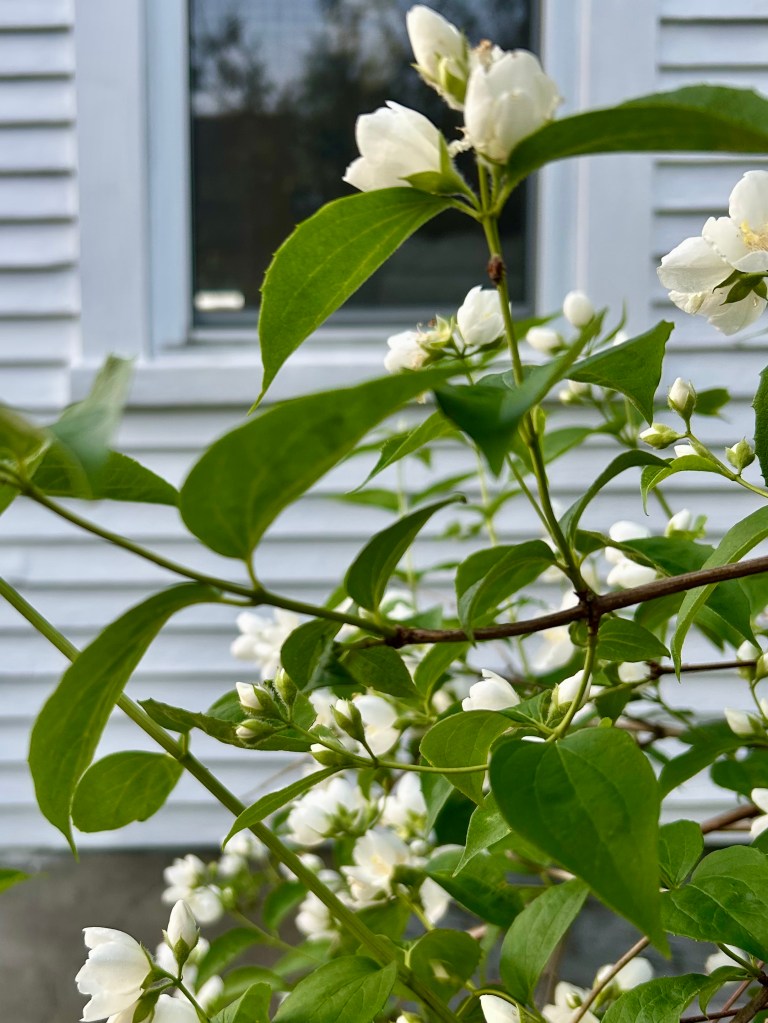
Walking home, I spy a smattering of white blossoms among a stand of pines, off the path. That short stretch is a strange area, more sand than soil, unusual on my Vermont hillside. Running theory is that someone stripped the top soil, years ago. Although I haven’t energy in excess, I’ve enough that I wander from the path. The blossoms are wild strawberries. Sweet mark of June.

For those not in New England, the common gripe is the weather. Every weekend, rain. Figures are tossed that there’s not been a fully sunny weekend since December; then I hear November. As for me, recovering, the days and weeks merge. Now, three weeks out from surgery, I’m easing back into work. The cats wake me at early light. In recovery, my old worries rekindle, but so does my drive and curiosity. I get up, eat cereal and maple syrup, brew coffee. I spread the manuscript of my fourth book over the kitchen table, cut, rearrange, stitch.

What’s changed, though, is a new slowness, a willingness to let the course of things unfold, to crouch beside those strawberry blossoms, wondering which birds will snag the tiny crimson berries. In a few weeks, I may wander here and sample this sweet delicacy. Half of this May, I lived in a hospital. Finally, I limped out the door with my brother. While he drove me home, I kept saying, “I’m out, I’m out,” and “The trees are leafing, the forsythia is blooming, the lilacs are opening.”

That surgery and that stay might likely have saved my life, again; and again, how immeasurably capable and kind was the hospital staff. Nonetheless, it’s June. The sky this morning is scrimmed over with smoke from wildfires. Under that dome, I have work to do. A friend will visit. I’ll move through this day, this Wednesday, happy.

I want to lie out

on my back under the thousand stars and think   

my way up among them, through them,   

and a little distance past them, and attain   

a moment of absolute ignorance,

if I can, if human mentality lets us.

I have always intended to live forever;

but not until now, to live now.

~ Galway Kinnell, “The Sekonk Woods”

Start again…

Twenty years ago, I wandered on an early morning walk. Mightily pregnant, I didn’t go far, merely down to our sugarhouse and through the white pines. I looped back through the garden. I was about to have a second baby — that very day — and, second time around, I knew those solitary walks would — for an undetermined time — be a distant memory.

In a break in the rainy weather, a friend walks me through the cemetery, past the little league field, and down the hill into town. At Front Seat Coffee, she buys cookies, and we sit in the courtyard, eating and talking, the courtyard where I’ve passed so many hours with my laptop. Slowly, we walk back up the hill. Three robins perch on the elementary school’s fence.

Six weeks ago, another friend walked me to the Galaxy Bookshop, the first walk I’d taken to town since last November. I picked up a copy of Dostoyevsky at the Galaxy, and finished the novel in Dartmouth, waiting for surgery. The surgeons teased me, Why such light reading?

One more lesson from cancer: how intensified the world becomes. Slip back, start again. Repeat, repeat. But isn’t that one way of the world? There’s plenty more ways — a crash, a sudden halt, a perilous nonstop descent — but often our lives are fits and starts.

I remind myself, Try to learn something.

This day dawns overcast, broody with the promise of rain, the world lush with spring green and birdsong. To keep myself and my cats happy, I light a fire in my stove, brew coffee, consider the day. As I recover, my old demons of uncertainty have woken, too. My walking companion counseled me to narrow my energy to the actual day. Help was recently sent fortuitously to me; this morning, as I mixed powdered sugar and butter for cake frosting, I reminded myself, Be grateful; use your luck wisely. Savor this day.

At Twenty-Eight

By Amy Fleury

It seems I get by on more luck than sense,

not the kind brought on by knuckle to wood,

breath on dice, or pennies found in the mud.

I shimmy and slip by on pure fool chance.

At turns charmed and cursed, a girl knows romance

as coffee, red wine, and books; solitude

she counts as daylight virtue and muted

evenings, the inventory of absence.

But this is no sorry spinster story,

just the way days string together a life.

Sometimes I eat soup right out of the pan.

Sometimes I don’t care if I will marry.

I dance in my kitchen on Friday nights,

singing like only a lucky girl can.

And another turn in the plot…

My body falls apart again, and my daughter drives me to Dartmouth. “My car only goes to this ER,” she tells me when I hint at negotiating a closer ER. She asks her blunt and even-toned questions, “What are you afraid of?”

Among other things, I’m afraid of waiting, in pain, which is what happens, and I survive that, of course. The hours in the ER waiting room introduce us to an intimate slice of others’ lives. The man who drove a screwdriver into his hand and didn’t seek antibiotics (not a good choice), another who crammed his hand between his two fighting dogs (the hand lost), a woman with a damaged foot who phones her mother on speakerphone. Across the large room, listening, I wince at the painful distance in that relationship.

Eventually, I’m given a bed in what’s labeled Hall 3. Shift change, a kind nurse hustles to give me meds. In the hallway, we are yet in the swirling mix of others’ lives. A hall mate (not a roommate) who I never see but who’s recently widowed; his companion struggles to figure out his meds. Later, my daughter steps outside and sees a prisoner who’s a patient run through the parking lot, high drama. She leaves after midnight. “Drive safely,” I say, “text me when you’re home.”

In the night, the surgeons stop in, and again the next morning, when the surgeons and the Good Doctor my oncologist meet in my room. Like a rushing train, surgery is coming rapidly and unavoidably towards me. Much as I’d rather not, really rather not, I begin to accept this. I think: get my tools together to survive this. Print out my manuscript, collect books and a knitting project. In all these countless hours in varying hospital rooms and hallways, I’ve never been bored. Frustrated and weeping, laughing and curious, but never dull. Another thing to be grateful for.

I’d rather not, but here’s another bend in my story, as with my hall mate and waiting room companions…

At the edge of damage…

A few days of radiant sunlight and steady breeze, a burnish on my cheeks: solid medicine. It’s spring.

In rapid succession now, the coltsfoot, the lungwort, Siberian squill, my mini daffodils bloom. Each day I remain out of the hospital feels like a victory, a day worth savoring. Afternoons, evenings, I lie in bed reading Dostoyevsky.

There’s this line from a Louise Glück poem I mull over as I walk around my budding forsythia, the Daphne I planted last summer that survived the winter. The line is: “Nothing can be forced to live.” In these lengthening days, I wonder if perhaps my attitude has been skewed for years, gritty-mouthed and wry, one foot behind me ready to flee, the other toes nestling into the garden. Mid-April, and green shoots and velvety petals thrust from the earth. The honeybees swarm. The groundhogs feast and dig. The children ride bikes.

We’re early enough in the season that I can yet pick out this patch of Chionodoxa, the lilac buds. My sandy Vermont hillside thrusts towards life. A poem my friend Jo sent my way, and I’ll send yours is below. Swan’s words about the crack in our world — how much these resonant with me. Now, in my days and nights after chemo, as I begin putting my life and soul back together, I remind myself (as my siblings remind me) to lean into my cracks, to embrace the holes and the whole of my life.

BOWL

BY HEATHER SWAN

for my mother

From the mud in her hands,
the bowl was born.
Opening like a flower
in an arch of petals,
then becoming a vessel
both empty and full.

Later, in the kiln
it was ravaged by fire,
its surface etched and vitrified,
searing the glaze into glass
as its body turned
to stone.

It is at the edge of damage
that beauty is honed.
And in Japan,
the potter tells me,
when a tea bowl
cracks in the fire,
that crack is filled
with gold.

The crying moments…

I’ve written frequently in this space about living with cancer and cancer treatment since I was diagnosed with lymphoma last November. From the beginning, I was determined to hold myself together. Some of this was simply shock; I could not believe I had been walking around, working, going to birthday parties, hanging with family and my friends while cancer was devouring my body. By the time I ended up in the ER, telling the triage nurse I was circling the drain, the cancer had metastasized to stage four. I needed a moment. I was not about to get a moment.

In the long hours of yet another ER visit, my daughter told me that a longtime friend had asked her last November if I actually intended to undergo chemotherapy. I hadn’t heard about this inquiry, and the question stunned me. I’ve been my daughters’ sole parent for a decade now; even in the worst of these cancer nights and days, I remain foremost a mother, unable to relinquish my watchful eye. After diagnosis, it was immediately clear that the cancer was rapidly growing; without some kind of treatment I would die that winter. The lymphoma I have responds well to chemo. My other option, perhaps, was to seek an alternative treatment — where, for how much, and with what likelihood of success — was dubious at best. In my fifties, I was determined to live. My oncologist was clear that the chemo would shove me to the edge of demise. He told me, You are curable. So, in a rare action of trust, I stretched out my arms and said, Infuse me.

As the cancer was so advanced, I suffered numerous complications from the chemo, which resulted in all the hospital stays I’ve referred to in this blog — nearly a dozen — weeks and and weeks and weeks this winter.

Now, April, Easter rising tomorrow, I’m drinking a friend’s homegrown chamomile tea this morning at my kitchen table, watching the small rain feed spring’s green, alive, in remission.

From the get-go, too, I determined not to burrow into the rathole of despair that I’ve seen disease wreck upon individuals and spread to families. This recent ER visit, however, forced me to the crying day. I wept before the kind nurses, the warm hematologist with her sparkly hair, the PA who insisted I not leave even as I connived deals and plans for discharge. I did not cry before the elder hematologist, who had certainly been practicing medicine for most of my life. I said, yes, yes, I understand. And then I wiped my tears with my thumb when he left.

By the late hour when my daughter had left, and I was alone again in the darkened ER room, I’d taken stock of what I’d crammed in my backpack: two books, my laptop and charger, a handful of underwear, my notebook. I’d forgotten my knitting, which was unfortunate. The nightshift nurse brought me water and those eternal saltines. She was a traveler and had last worked in Iowa.

Much later the next night, two nurses wheeled me through the dim and empty hospital halls to another room. Of all the experiences I’ve had at Dartmouth-Hitchcock, I’ve oddly enjoyed these late night journeys through this huge building. So many stories here, so much living and dying, so much richness. By then, I’d finished with my weeping, joined the world again, all of us, doing what we’re doing.

A driving spring rain
gliding, wending through the trees
speaks in little drops

~ Bashō