A Condensed Parenting Manual

There’s an odd line from Lee in Steinbeck’s East of Eden that’s always stuck with me, since I first read the book when I was sixteen or so: I will not put my finger in any human pie. What a strange metaphor (as if we’re baked goods?).

Tomorrow is Woodbury Pie Breakfast, the community-wide sit down to pie and coffee, live music and cabin fever conversation. This afternoon is pie baking in my house, as I suspect it will be in many Woodbury kitchens. The question around town is, What kind of pie are you baking? Or, wishfully muttered, I hope I get some of Skip’s chocolate with raspberry swirl this year.

Pie is easy – crust and filling – but human pie? Human creation? A family member this winter drove to North Dakota and joined the Standing Rock Protests, then disappeared underground, in a variation of Five Easy Pieces, with not a word to family he had left behind. He must have profoundly believed he was called to that Jihadist path, leaving behind a grief like earth crudely harrowed up but untended, uncultivated.

Steinbeck is likely at the heart of my own raw parenting philosophy. As one daughter steps into adulthood, and the other teeters on adolescence, my mantra repeats Socratic self-examination: What the heck are you doing – and why? What an annoyance it must be to have a mother more concerned with keeping the darkness of Nihilism at bay, rather than building a really stellar college application.

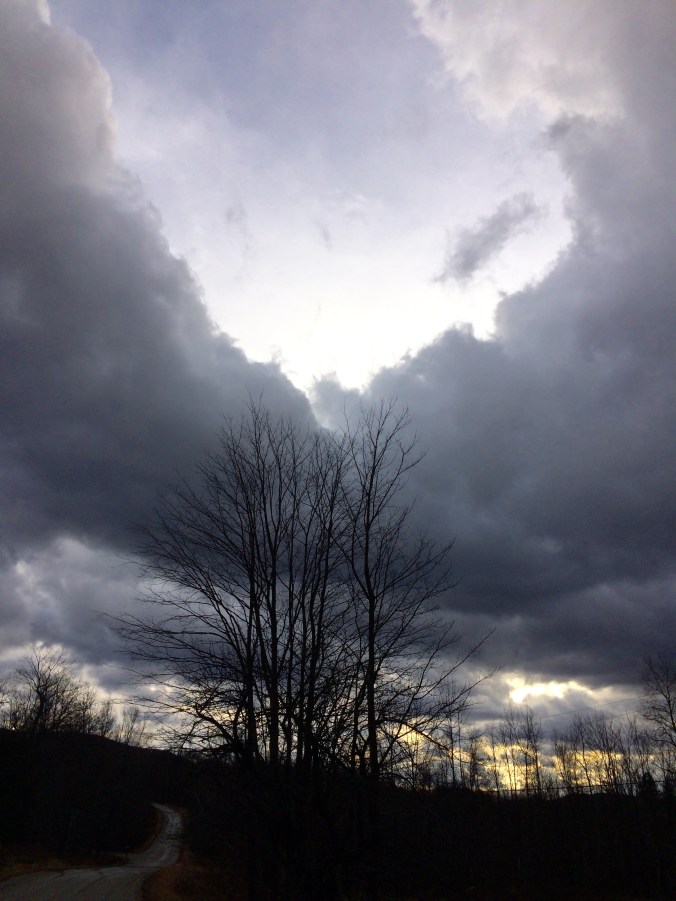
March is always the season of entropy, cabin fever, quarreling. We’re surrounded by depths of snow: Currier and Ives picturesque, and a real complication, too. And that’s another metaphor.

I believe that there is one story in the world, and only one. . . . Humans are caught—in their lives, in their thoughts, in their hungers and ambitions, in their avarice and cruelty, and in their kindness and generosity too—in a net of good and evil. . . . There is no other story. A man, after he has brushed off the dust and chips of his life, will have left only the hard, clean questions: Was it good or was it evil? Have I done well—or ill?

– John Steinbeck, East of Eden

FullSizeRender

Traveling

These past few days I’ve been reading Steinbeck’s The Wayward Bus, traveling through the rain in California, on an old bus named Sweetheart, with the desperate-hearted, the lovely and the profane, the young and the dying. The novel is classic Steinbeck, with an eye for the landscape, and characters so real you could pull up a chair and have a conversation. Near the end, when I began to think this wasn’t my favorite Steinbeck novel, I read a half page of dialogue that made the whole book rise and spin. Then I went with those two characters back to the bus, dug it out of a mud hole, and drove to San Juan.


We have only one story. All novels, all poetry, are built on the neverending contest in ourselves of good and evil.

– Steinbeck, East of Eden

FullSizeRender

Photo by Molly S.

Stormy Seas, Human Choice

Years ago–not that many but still a number–I worked at a business owned by a decent man who was in forties then, and his life was falling apart, in just about every way. He and I spent a great deal of time working and talking together, and at one point, he remarked that the lives of everyone he knew then were falling apart.

I rather blithely replied that my life was not falling apart.

When I think back on myself in those years, I imagine myself as a clipper ship, strongly-built, straight-masted, confidently sailing through sunny blue waters, a fine wind in my sails. I had no idea in those years that boards would spring loose, the ocean harbored darkness and flesh-eating creatures, that sails would rend in a deadly storm. How could I have known that if I sailed far enough, careless without a map or compass, the seas would freeze solid and shatter my wooden hull?

While the footprint of my life is yet on West Woodbury Road in Vermont, the geography of my life now has unfolded and unfolded yet again, into a landscape that extends beyond the garden’s button zinnias and life with small children to the territory of disease and betrayal, of human cruelty and despair:  the realms that as a youth I naively believed I could witness but not sully myself by partaking in. Perhaps the real folly of youth is to believe you can refuse the chalice of human suffering.

As a young woman, one of my beloved books was John Steinbeck’s East of Eden, an enormous novel about the human ability to choose between good and evil. I still have that paperback copy my father gave me one Christmas, marked up in pencil in my girlhood handwriting. Like Walden, that book has arced through my life.

Walking with my daughters and the neighbors this evening, the rural air was rich with the scent of freshly-cut grass and hydrangeas in bloom. The air was warm without cloying, and all around us was the summer’s growth, wild and intertwined and beginning to brown up at the edges and curl with the end of summer. Overhead, the stars came out in the deepening blue sky, a single glimmer at a time.  How sweet it was, with the children happy, but the dark was falling in, and I took my children home.

I believe that there is one story in the world, and only one. . . . Humans are caught—in their lives, in their thoughts, in their hungers and ambitions, in their avarice and cruelty, and in their kindness and generosity too—in a net of good and evil. . . . There is no other story. A man, after he has brushed off the dust and chips of his life, will have left only the hard, clean questions: Was it good or was it evil? Have I done well—or ill?

― John Steinbeck, East of Eden
IMG_8763