My canoeing experience, while somewhat lengthy, has always been confined to summery, pleasurable afternoons, on Vermont’s still lakes and ponds, often with swimming and almost always with kids. Only once, on my honeymoon, did I worry our canoe might flip.
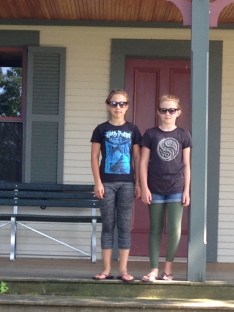
Oddly, I found myself on nearly those same waters in Lake Champlain this weekend, worrying again if I might roll the canoe. While the two cheerful and sunglasses-wearing 12-year-old girls waited for the ferry, I headed out to an island with a canoe loaded low with camping gear, not looking closely at the lake – a very large lake – rough with wind, torn up with the furled wakes of motorboats.
After I spun around, I gave myself a rapid crash course in reading the water washing near the low sides of my canoe, keeping my prow headed into the waves – those long curls might have delighted me swimming near the shore but frightened me with all this water around. The silver ferry passed by with my smiling girls, waving merrily in the sunlight.
On the return leg of the journey, after a few days of bicycling and card playing on an island magical with fiery sumac and twining vines, the water lay invitingly still, just me and the ducks and few gulls cavorting overhead.
It was then, on that crossing, that I remembered the children’s father and I had paddled in a rainstorm to this same stretch of beach, from an island further out, in a canoe we had borrowed from his parents that had no lifejackets. In a different version of my life story, I would have taken the ferry with the girls and he would have rowed the canoe – much stronger than myself and far savvier at reading wind. He would not have gotten stuck on the far side of the island as I did, and struggled against the current to round the rocky edge.
As I rowed, the lake lifted against my old red fiberglass boat, all that deep blue water, stretching far further than I could imagine, filled with darting fish and frond-waving plants, the shale-splintery islands, boats with white sparkling sails, sunlight profuse, with sunken ships and ancient fossils. I had been reading David Hinton’s The Wilds of Poetry, filled with narrative and a collection of stunning poems, from Rexroth to Robinson Jeffers, a stonemason apprentice who built his house at Carmel-by-the-Sea, all about motion and change. Kismet reading for sleeping on an island. I imagined how the gulls might see me, a small woman with a braid and a wooden oar with a broken handle, rowing home with a basket of dirty clothes, crumbles of crackers, softening cheese, a coffee pot and an unfinished sweater on knitting needles. I could not have wished to be anywhere else than there.
On the mainland again, I unloaded the canoe and walked along the high bluffs, waiting for the ferry. The wind was picking up then, and the day, the first of August, was bright with promise. The grass could not have been greener. I read the heartbreaking memorial marked for the boys who had died in the Second World War and then leaned against a bent cedar tree, one small woman in a landscape beyond time, myself just one living piece of its infinity.
When I met the ferry, its captain asked if the two girls alone were mine. Yes, indeed, I said and walked onto the rattling gangplank to greet them.
I have tried to write Paradise
Do not move
Let the wind speak
that is paradise.
Ezra Pound, from Cantos in Hinton’s The Wilds of Poetry: Adventures in Mind and Landscapes

 Stony Soil Vermont