Ordinariness.

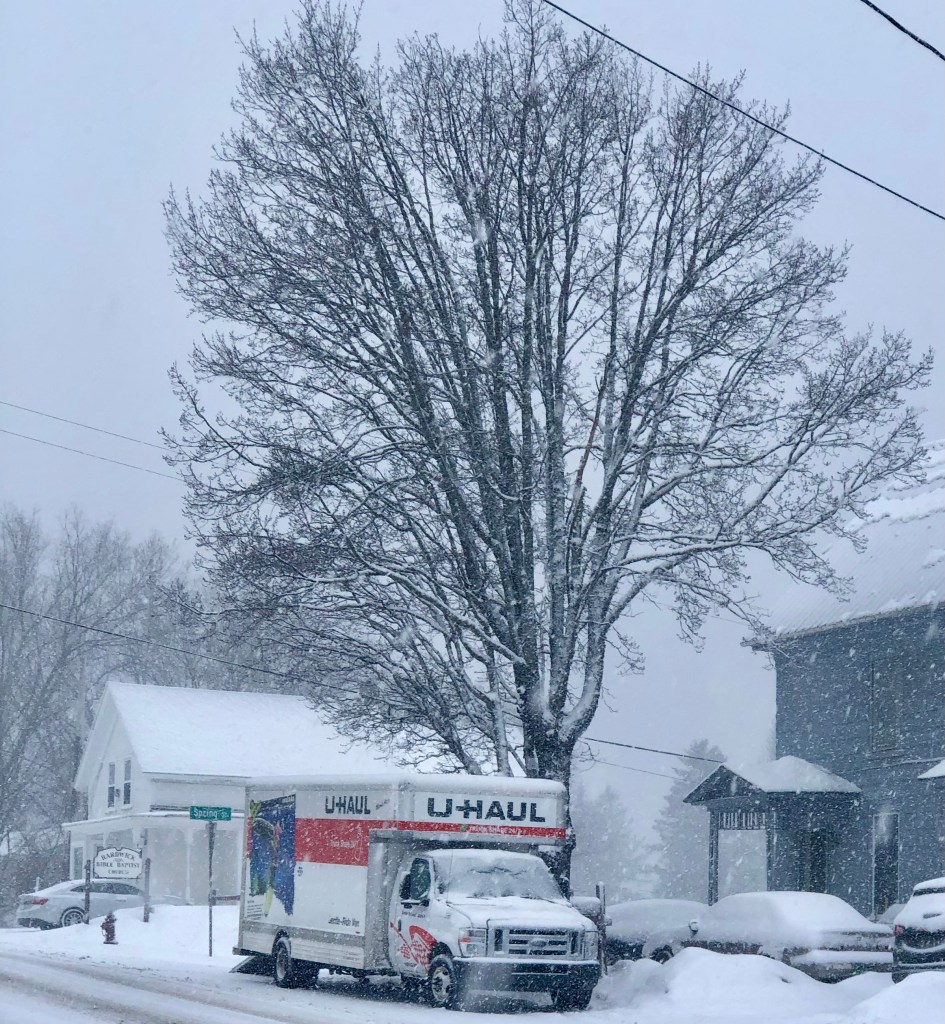
On a day of yet more snow, of wind and cold, I’m reminded that people still keep on with their lives. Living doesn’t wait for convenience.

At the post office, I mail off a copy of my book. The woman who weighs my small package insists this is “sugar snow,” an early spring snowfall that will lengthen the maple syrup season. We sugared for years, and this kind of snow always meant a break in boiling and a chance to wash filthy snowsuits. The upcoming forecast is for as near-perfect sugaring weather as possible. Sugaring is the epitome of day-to-dayness — be smart, keep your eyes open, do the best you can — with no guarantees of a good or even decent season.

We talk for a few more minutes about shoveling snow, and then I head back out into the town’s Saturday morning. On my walk home, I stop in at the coffee shop and stand in the window drinking an espresso and staring out at the traffic struggling on snowy Main Street. There’s the usual confusion of the three-way intersection so many don’t understand — two stop signs and a blinking yellow light — as if the calculus of two stops and one yield doesn’t make sense. Standing there, I wonder if it makes sense mostly to those who use these streets day after day.

A year ago, the coffee shop’s tables and chairs were closed for seating, and I wondered if I would ever bring my laptop back here, to my favorite table where I once wrote a book. A year later, here I am, drinking coffee, surrounded by maskless people laughing and talking, writing notecards, going on about their lives. On this inclement Saturday morning, that seems nothing shy of a miracle.

“The answer must be, I think, that beauty and grace are performed whether or not we will or sense them. The least we can do is try to be there.” 

~ Annie Dillard

Blackbird.

I’m late to a meeting at the library I’ll participate in when I stop in the parking lot. In the wetlands behind the library, a red-wing blackbird sings. I can’t see the bird. This isn’t a flock; a bird calls and chirrups, that old familiar, unmistakable sound of spring. I’ve driven, in years past, on the hunt, just to hear this bird.

A few years ago, by chance I met a friend outside the Woodbury, VT, post office. We stood talking about something we found mutually so enjoyable, while in a winter-bare maple tree, a flock of these beauties sang. Spring! we marveled.

This year, I remember how long and hard mud season is, most rightfully a season worthy of its own true name. Hence, love of little things like tiny birds.

The river is moving.   

The blackbird must be flying.   

~ Wallace Stevens, “Thirteen Ways of Looking at a Blackbird”

Little Walk.

Our basement door art.

When my daughter and I return from a walk tonight, we stand for a moment outside our house in the dark. The moon is a bit of a creamy curl over our roof. Mighty Orion stands at his guard in the constellations. Whoever dug this house’s foundation in the sandy soil, carefully set the fieldstones, and built this home has long since passed out of this world. People have lived and fought and loved and died in this house. It’s March and Mud Season hovers over us, freezing, thawing, freezing, and eventually the thaw will win out for the summer. Upstairs, my youngest daughter puts her face to a window. We go in, leaving the stars and the night to their own particular magic.

“It may be important to great thinkers to examine the world, to explain and despise it. But I think it is only important to love the world, not to despise it, not for us to hate each other, but to be able to regard the world and ourselves and all beings with love, admiration and respect.” 

― Hermann Hesse, Siddhartha

Q&A.

My teen and I are in an office filling out paperwork and the last question asks her how apprehensive she is about dental work.

She stares at me. “Why on earth,” she asks me in her reasonable way, “would I reveal anything like that?”

I note it’s a standard question. Her answer: that’s a ridiculous question.

It’s another cold afternoon — a mostly sunny day in Northern Vermont — in a winter where cold has now dragged on well beyond its welcome. We’ve driven a little distance and taken a detour along a river whose middle has thawed. Only its shores are frozen.

A couple of decades now into parenting, I’ve observed children are formed by their parents’ lives — and not, too. She’s driving, and I seem to have taken up residence permanently in her passenger seat — a place I inhabit uneasily and definitely gracelessly. We drive and talk. Youth, I think, repeating the word soundlessly, like a mantra; I’m drawn to its utter ebullience and brashness, like the sunlight we all desperately need.

We remark on the price of gas. Our sheer luck at the happenstance of living in the Shire of Vermont right now. Of the war in cities and villages and homes on the other side of the globe.

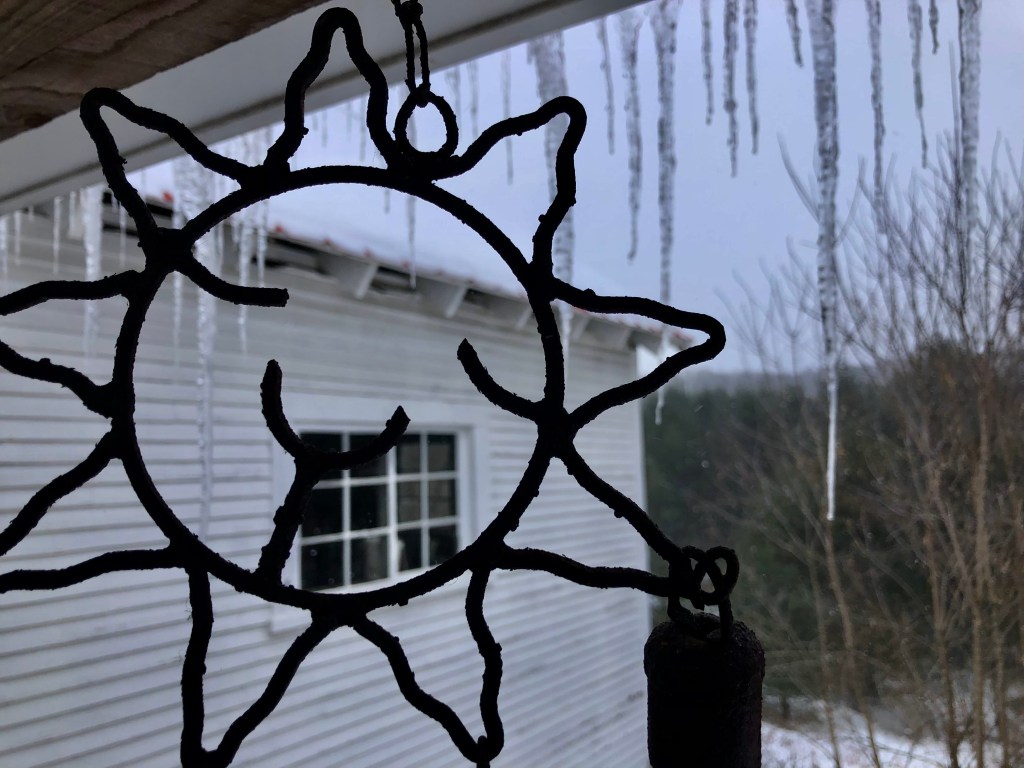
At our house, the icicles on our covered porch are exceptionally skinny and long this year. In the early morning, the ice begins falling in spires that break on the wooden porch. So many questions, and my answers are so poor. Keep asking.

Psalm for the Ordinary.

Ordinary Life, by Barbara Crooker

This was a day when nothing happened, 
the children went off to school
without a murmur, remembering
their books, lunches, gloves. 
All morning, the baby and I built block stacks
in the squares of light on the floor. 
And lunch blended into naptime, 
I cleaned out kitchen cupboards, 
one of those jobs that never gets done, 
then sat in a circle of sunlight
and drank ginger tea, 
watched the birds at the feeder
jostle over lunch’s little scraps. 
A pheasant strutted from the hedgerow, 
preened and flashed his jeweled head. 
Now a chicken roasts in the pan, 
and the children return, 
the murmur of their stories dappling the air. 
I peel carrots and potatoes without paring my thumb. 
We listen together for your wheels on the drive. 
Grace before bread. 
And at the table, actual conversation, 
no bickering or pokes. 
And then, the drift into homework. 
The baby goes to his cars, drives them
along the sofa’s ridges and hills. 
Leaning by the counter, we steal a long slow kiss, 
tasting of coffee and cream. 
The chicken’s diminished to skin & skeleton, 
the moon to a comma, a sliver of white, 
but this has been a day of grace
in the dead of winter, 
the hard cold knuckle of the year, 
a day that unwrapped itself
like an unexpected gift, 
and the stars turn on, 
order themselves
into the winter night.

Breezy Walk. A Stranger.

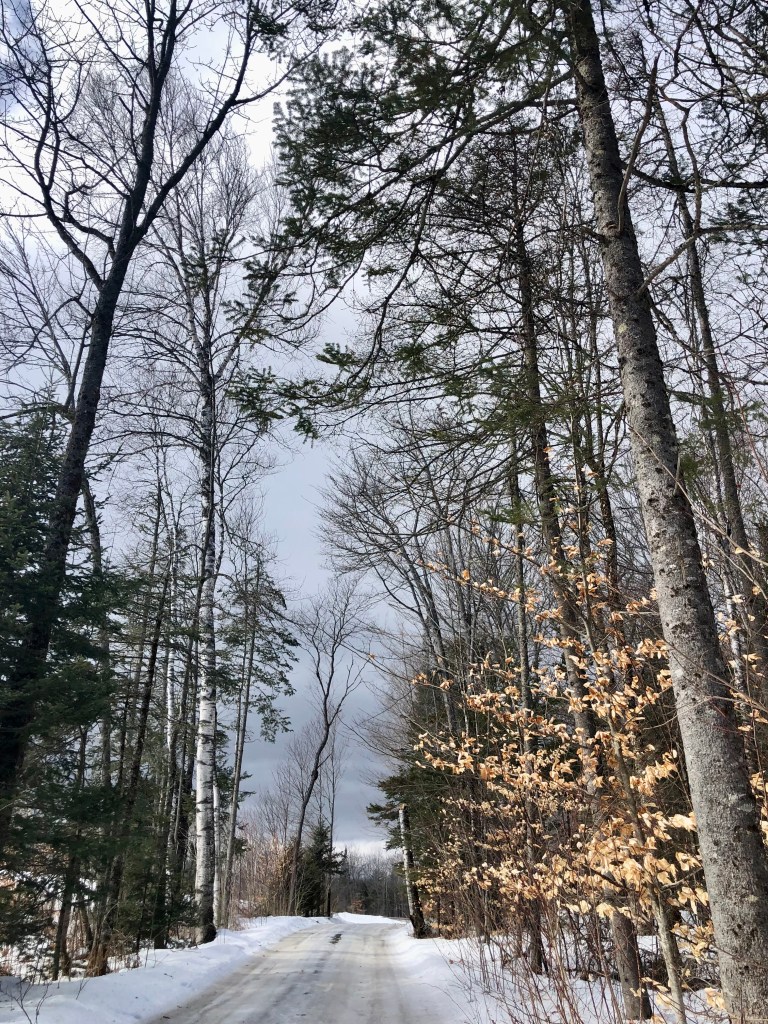
March in February — the fields are beginning to open, at least for this afternoon, for this particular moment. I park by the side of the road and take the long way where I’m going, by foot, my hat off, jacket unzipped, letting the wind pull at my hair.

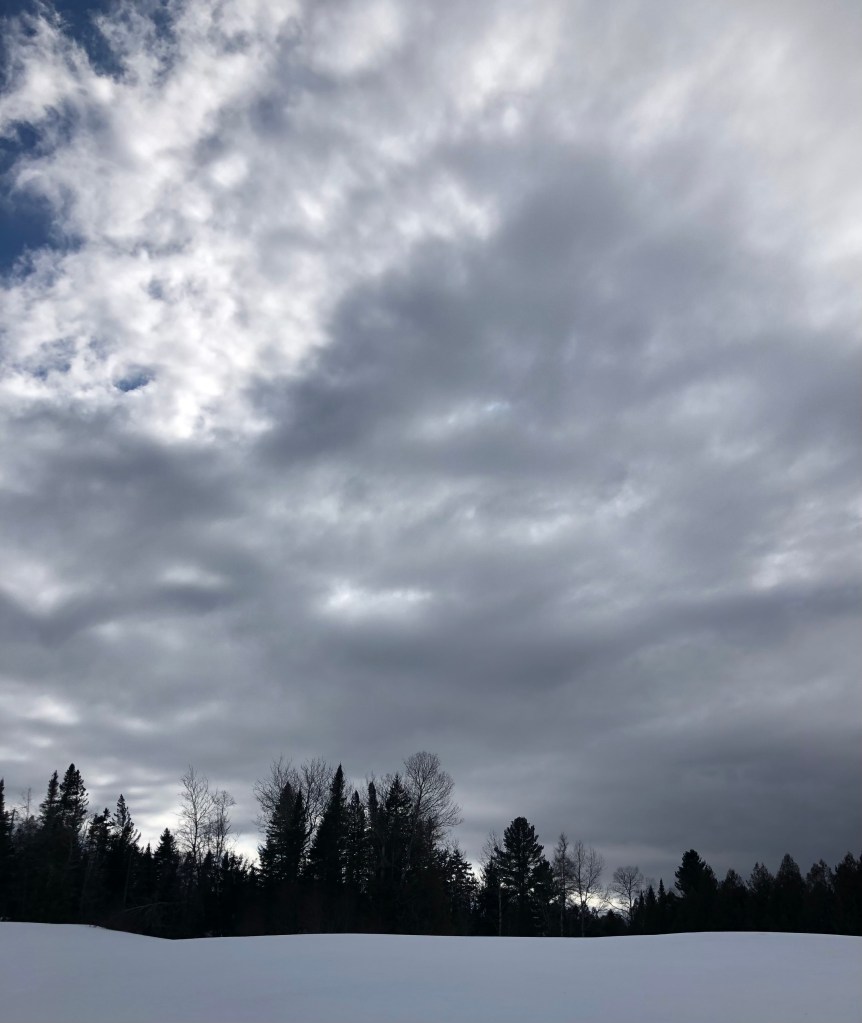
I’m snapping a photo of a field and the sky when a car pulls over at the side of the road. There’s no one else around, and for a moment I wonder if he’s a landowner, angry or just curious what I’m doing. Wednesday afternoon, and no one is around.

He gets out of his mud-splattered white car, laughing, and asks for directions back to a paved road. He was visiting someone and took “the other way.” I laugh back, and we joke about where the other way in Vermont leads someone.

We stand there, joking, the dirt road both melting and already beginning to freeze again as we speak.

When he gets in his car and disappears down the road, I stand for a moment longer. I’d wanted nothing more than wind in my eyes, sunlight on my face. Fait accompli. Then it’s back to civilization for me, too.

“I feel my life start up again, 

like a cutting when it grows

the first pale and tentative

root hair in a glass of water.” 

— Jane Kenyon