Sacred Spot

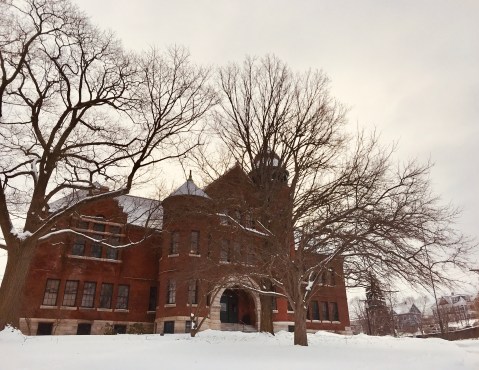
At library class yesterday, I’m in one of my places — like canoeing on Calais’s Number 10 Pond or Bandelier National Park in New Mexico — I’m (at least temporarily) where I’m supposed to be. Housed in the original Barre, Vermont, Spaulding High School, the building was constructed as schools once were — as places of community pride and beauty — with tin ceilings, ornate woodwork, and a view of the city below.

I love Vermont’s Department of Libraries because the staff is articulate and funny and clever — because they champion intellectual freedom in a time of increasing censorship and groupthink, because they’re adamant about the rights of children to have their own thoughts, and because they’re committed to librarians working together.

When they say We have your back, I trust that — and I’m not someone who easily trusts. No hard sell, no payment plan, no exchange of cash. Simply: this is the good mission we’re committed to, and we’re doing it.

Libraries were a solace in the Depression. They were warm and dry and useful and free; they provided a place for people to be together in a desolate time. You could feel prosperous at the library. There was so much there, such an abundance, when everything else felt scant and ravaged, and you could take any of it home for free. Or you could just sit at a reading table and take it all in.

— Susan Orlean, The Library Book
IMG_4469.jpg

Barre, Vermont

Vermont Democracy

Outside the town clerk’s office, a little after 8 last night, I’m talking with an another adult while the kids jump around in what feels like balminess at 14 above zero when I suddenly shout out, Look at the moon!

Ringed by a rainbow, the luminous half-moon hangs over the town clerk’s building — a former one-room schoolhouse.

Our friends head home one way, my daughter and I the other.

Woodbury, Vermont, with its population less than a 1,000 souls, has a 3-person selectboard. I’m there as the town librarian. Most of the school board is there. Members of the public. The worry is to how to retain the tiny elementary school the state seems intent to close.

The kids are not in the meeting. They’re hanging out at the clerk’s main desk, reading graphic novels, and raiding the clerk’s candy jar. They’re giggling about kid stuff that’s important to kids.

I want the kids know this version of democracy — a group of people wearing fleece and hand-knit sweaters, jammed into a tiny room, our knees bumping, some of us liking each other and some maybe not at all, but all of talking, thinking things through — what’s the wisest course of action? how do we tend the common good?

It’s the first snowfall —
When it melts again we’ll see
Dewdrops on the grass.

— Buson

img_4443

Reprieve

At the hardware store in town, the woman ringing up my chicken feed asks if I’m going out partying for New Year’s Eve.

Are you kidding me? I blurt out. Then I apologize and ask about her plans. I like these hardware store folks, with their humor, their can-do willingness to solve my piddling problems — a clogged bathtub drain, a stuck lamp switch.

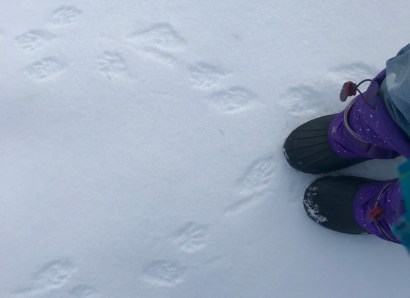
The cold’s broken for December’s last day. Before dusk, I follow the raccoon tracks from my compost down the snow-crusty hillside, wondering where this creature lives.

Another of my daughter’s homemade calendars folded up and put away, the day-to-day record of our lives — work schedules and friends and dentist appointments — the stuff of our lives.

For this year? Stay solvent. Paint the kitchen gold, my bedroom turquoise. Swim in the Atlantic with my kids. Follow wild tracks and fill the creative well.

Why speak of the use
of poetry? Poetry
is what uses us.

— Hayden Carruth


IMG_4331

This.

Midnight, my 19-year-old pulled free the extension cord on the Christmas lights around our barn door and came in the house, banging snow from her boots.

On my bed, the cats pricked up their ears and hurried downstairs. I followed.

Cheeks flushed with full moon sledding down Mt. Mansfield, my daughter and I talked about the history of birth control — the political is personal — ate cold clementines, and fed the cats shreds of turkey from our fingers. Over our metal-roofed house, the moon made her silent, luminescently gorgeous way through the heavens. We turned off the lights and headed upstairs to bed. I parted the curtains and touched a single fingertip to the cold glass.

In this season of a new and vulnerable family on the move, of the ineffable mysteries of angels and holy gifts, a prayer for domestic peace, in odd and unexpected moments.

IMG_4253

Christmas Eve, Hubbard Park, Montpelier, Vermont, 2018


Kindling in December

Frost twists upward this morning on the sticks of our lilac bushes. Come early June, we’ll live outdoors, surrounded by the fragrance of multiple blossoms. Not so, these New England winter days.

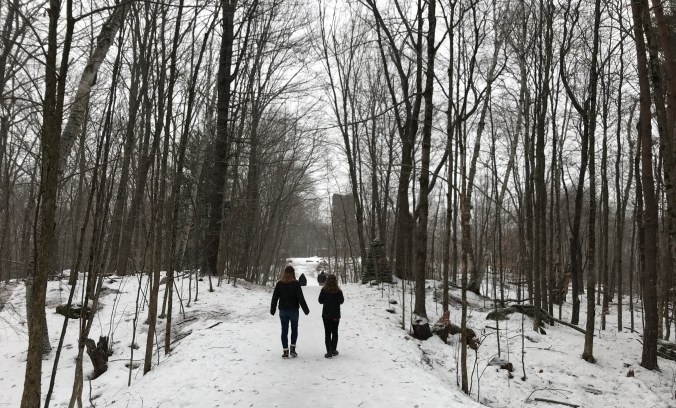
In a brief pass of sunlight, we hurry outside, take a walk through the woods, observe the ice curling over a running brook. Later, in my Sunday housecleaning, shaking rugs over the deck railings, I hear the girls in the cemetery laughing. From the barn, they’ve taken the sled in search of a snowy hillside.

Mid-December — the hard and holy time.

Upstairs, my daughter plays the clarinet, the melody languorously easing into the afternoon’s already fading sunlight.

Mid-December, holy perhaps precisely for its hardness. Draw the darkness fast around us; see what we hold, what we cherish.

I peeled my orange
That was so bright against
The gray of December
That, from some distance,
Someone might have thought
I was making a fire in my hands.

— Gary Soto, Oranges

cropped-fullsizerender12


Reprieve

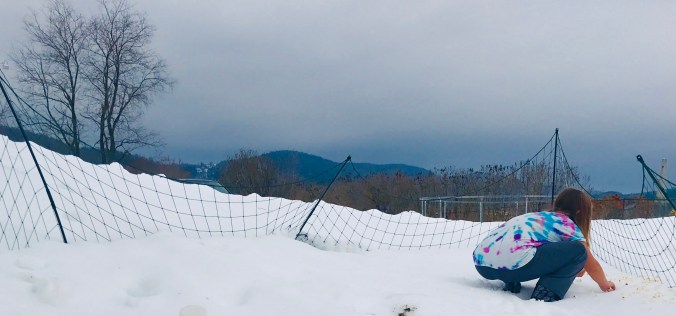
This morning, I’m in the snowy garden assessing the remaining kale. As I lift the limp leaves, crusty snow crumbles fall into my boots and around my sockless feet.

Walking back to the house, my daughter’s outside in a t-shirt, feeding her chickens leftover popcorn.

Kale, garlic, onion, fennel-sweet sausage for a savory soup. Mid-December. Take heart.

We look at the world once, in childhood.
The rest is memory.

— Louise Glück

IMG_4187 2.jpg