The Momentary State of Where We Are

A mother and her little girl stop in my library to stock up on picture books. She reminds me that I have lived in a state of emergency in Vermont before — in the aftermath of Hurricane Irene when the state slowly began putting itself back together. In those days, shovelful by shovelful, we could set our hands to work.

Now, with illness invisibly stealing in, the dynamics are completely different. To keep communities safe, libraries are closing — in utter antithesis of how librarians have always operated. Goodness, keep the library open at all costs! Be a social center. Not so, now.

As the social center becomes our homes, I lean hard into my query about the meaning of writing. Of creation and art? In these trying times — and in the days, months, quite possibly years ahead that will confound and challenge us — I know more than ever that writing and art illuminate the threads that stitch us together. As we inevitably grope through uncertainty, through fear, through a fragmenting of the everyday world we know and expect, art tugs us back to that inevitable story that, this, too, will pass. Writing reminds me that the human story spreads vast as the sea, with each one of us living our own particular story.

Here’s word from my sunny corner of Vermont. I’m so darn glad to be outside, the melting snow running in streams down to the rivers and winding its watery way north to the Atlantic Ocean. I hope your patch of earth is well.

Hope locates itself in the premises that we don’t know what will happen and that in the spaciousness of uncertainty is room to act. When you recognize uncertainty, you recognize that you may be able to influence the outcomes — you alone or you in concert with a few dozen or several million others. Hope is an embrace of the unknown and knowable…

— Rebecca Solnit
IMG_7320

Put a Fork in Winter

On a sunny and breezy Friday afternoon, the Transfer Station Guys assure me the back of winter is broke. Their weatherman — who’s never wrong — told snowmobilers and skiers to put a fork in winter. It’s about done in.

I’m on my way from here to there, later changing out of the mud boots I’d worn to the dump, switching to shoes on a sidewalk. A log truck driver, seeing me in sock feet, raises one hand in a thumbs up.

Later, picking up my daughter around five at the high school, the grownups stand around chatting while the kids scale the enormous, dirt-blackened snowbanks flanking the parking lot.

Redwing blackbirds are singing: oh, sweet harbingers of spring.

IMG_7275

Closing February

We wake to rain, the sound more reminiscent of March than April in Vermont, but not unheard of. So it begins: this back and forth marching to spring, freeze, thaw: put that on repeat.

My little cat sits at the glass door in the kitchen, staring out at the rain, dreaming of chickadees and grackles.

Likewise, my daughter gets a little better from her illness each day, the fever emptying from her. So it goes in this winter: this season when I’ve felt surrounded by so much unhappy news. Sad deaths, lost jobs, injuries. Against this, a fever looms almost welcome, as if a lesser, harmless inoculation.

Spring’s a distance away: there’s no arguing with that. But the season change looms inevitably now. Outside my library door, deep in the pebbles against the southern wall, the first green shoots press upward, tentative, persistent, resilient.


IMG_7250

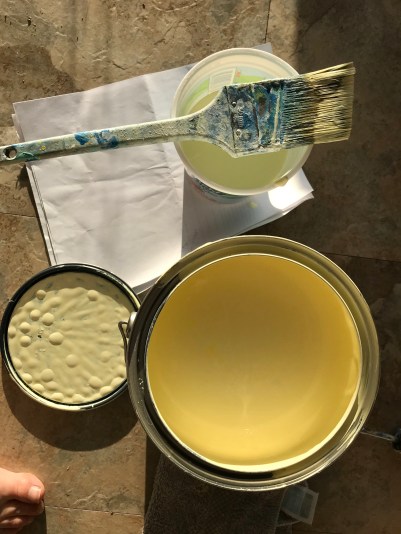
Painting the Kitchen the Color of Cake Batter

In the sub-zero cold, my daughter’s car cranks over after a long hesitation. Start, or not? Oh, February. So much effort.

The girls are gone skiing while I’m painting the kitchen. The cats move around from stepladder to drop cloth. Meanwhile, I listen to Dolly Parton’s America podcast. I had no idea Nelson Mandela was a fan of Parton.

The girls return with their cheeks bright red, cold and hungry.

Here’s a poem from Ensouling Language.

It is good knowing that glasses
are to drink from;
the bad thing
is not to know what thirst is for.

— Antonio Machado

IMG_7180IMG_7188

Little Kid Yellow

Two summers back, I bought a gallon of paint for $10. At the local hardware store, the clerk had inadvertently mixed the wrong color and offered it to me. What a score, I thought. The color approximated the hue I once used to paint windows in a cupola — a color I christened Little Kid Yellow.

Not everyone in my household has been an enormous fan of painting our front steps bright yellow. Afterwards, even I wondered, Why do I do these things?

Likely, because of January. Because of November, too, and December, and February. Heck, March and April. By the end of May, tiny blue squill will sprinkle the greening-up grass.

But right now, color in northern Vermont is hard to come up. And the little bits of brightness — that’s gold.

The winter wind
flings pebbles
at the temple bell

— Buson

IMG_7057.jpg

Potato Pie Antidote

My oldest daughter texts me early this morning — she’s driven through slush to get to work. And so it begins, the snowy season. The days already burn low, dim by late afternoon. It’s Not the Swimming Season.

To counteract, I contemplate potatoes. Sausage and potato pie? I ask my youngest. Cook together?

Having lived in New England for most of my life, this side of the stick season is familiar to me, intimately so. During Saturday’s sunny afternoon, I coil up the garden hose, pull weeds from the garden, play soccer with my girl, then lie on the grass while she samples bitter apples.

My father sends good news — it’s Arkhipov Day — a celebration of a man who served humanity and not the nation-state. Read details here.

IMG_6702