Brutal and Brilliant Lights.

My brother drives us out of the Dartmouth-Hitchcock conglomeration of soaring windows. Somewhere in the afternoon, the gloaming sifts down through the interstate traffic. The stream of trucks bends south. We head north. Evergreen and gray, a pale blue of mountains ahead. Midwinter, I mutter, but it’s yet late fall, the solstice ahead.

All the way back home, up and down the ribboned swell of interstate, coal night tapping down, I’m jumbled in an unbroken stream of searing hospital lights, the sparklingness of The Good Doctor who sits beside me and then phones me with good news, that the lymphoma and I are parting ways, disease shedding from my unseen flesh.

Now home again, drifting in and out of this perpetual river — of appointments and results, in an unfamiliar body swollen with water that, trickle by trickle, the chemo poisons are doing their fierce work to keep me alive, thrust me towards full health — the strangeness of not being able to lift a piece of birch to feed my stove, kindle my own hearth.

Grave illness is the void. The void is always with us. I know this even as I write with my tabby purring at my knee, epitome of domestic bliss. Maybe that’s why I was compelled to write so savagely in this place about terror. Late summer, as I’d descended into this cancer, without knowing that I was sickening, I could feel myself gyrating in a sucking whirlpool of negativity — from my own particular life and in this unusual time we inhabit. On the eve of the election, the cancer word smashed into my life. A levee burst in me. For me, a woman with cancer (this is no flip joke), these are fraught days, months, more months. But even in illness I’m part of the whirling flux of this time. As we drove out of that glass complex for the first of what will certainly be many times, I was imbued with a sense of magnitude, the mightiness of the tension between life and death and the mightiness of our collective lives, each dear, each interwoven.

I left Dartmouth with a bright red card in my hand from a kind stranger. At home, the sky was overcast. The stars were shrouded. Our dear white clapboard house twinkled with colored and white lights. I stumbled on the top step and fell. My daughter lifted me up and helped me in.

“You have come to the shore. There are no instructions.”
― Denise Levertov

Chemo ride…

… took a bitch turn. Dreaded day 5 passed (thank goodness for the amazing anti-nausea meds), but with the last bag of this poison/healing fluid, a fist immediately grabbed my chest and squeezed my breath. My cheeks coursed with blood.Terror, say the word, terror. So much back and forth, oxygen and treatments and more liquids through this purple spaghetti plastic that drip, drip, drips near my heart. I shook fiercely – rigors – the nurses said. I was stuck on the word as my molars hammered, rigors!, where is this hard ride taking me? The fluid was stopped with a promise not to start again until I knew.

In and out of a fog, a dream of a herringbone jacket with a pleated flair my youngest wore as a two-year-old. In the evening, a nurse sits with me. As the drip-drops begin again, she talks, right beside me, watching me, close eye, about this disease, about infection and rest, about what I will need to do and avoid – do not knick your fingers with a knife, no dirt, no cat litter, no flowers, no illness. I ease from tension and realize, yes, yes, I am still breathing, I am still taking in this toxin that quite possibly will save my life. I glance up at the round analog clock on the wall that reminds me and my brother of school days. These are the moments Burlington’s Phoenix Books is hosting the Almanac intro in an online event. In my haze, I imagine the Almanac editors and reading and answering questions, this book filled with farm dirt and blooming flowers, hay chaff and sneezing, insects and sheep, and stories – so many stories – of people working on this northern place on the globe. In my half-dream, exchanging novels to read with this steady stranger, I feel my place in the world opening up, both descending into the long trek of illness and healing and, miraculously, an upward course, too, as this illness strips me down. Your bone marrow, the stranger says, marrow, a word I love and have been content to let lie, bone marrow doing its bone marrow thing. All this is changing, too, from nature, from medicine, from my fierce intent to reclaim my body.

All of you who have traveled or will travel this journey, bone marrow and rigors and fear, how simultaneously far and yet close this feels, all of us.

….. Everyday, a dear friend texts me a poem read in her clear strong voice. Here’s Rilke’s “Let Darkness Be a Bell Tower”

Quiet friend who has come so far,

feel how your breathing makes more space around you.
Let this darkness be a bell tower
and you the bell. As you ring,

what batters you becomes your strength.
Move back and forth into the change.
What is it like, such intensity of pain?
If the drink is bitter, turn yourself to wine.

In this uncontainable night,
be the mystery at the crossroads of your senses,
the meaning discovered there.

And if the world has ceased to hear you,
say to the silent earth: I flow.
To the rushing water, speak: I am.

Sonnets to Orpheus II, 29

Lantern Light.

My immense thanks for so much kindness and light sent my way this week…. It’s meant the world to me.

When my daughters were in a sweet little Waldorf nursery school, around this time every year the children made lanterns from canning jars covered with colored tissue paper. The whole school gathered for a vegetable stone soup and then set out for a walk with the lanterns. This is rural Vermont, remember; the nursery school was surrounded by forest and the deep night, and parents carried lighters and matches to relight anyone’s lantern that was snuffed out. In the dark, stumbling a bit, we walked, singing.

Martinmas. I was tugged right into the Waldorf world with its heady folklore and mummers plays, the stories within stories, my natural bent of mind.

A week into the cancer world, veritable novice, walking on November 11, I was thinking of all these powerful layers — Martinmas and Armistice Day and Veterans Day (after WWII and the Korean War) — and the hidden interconnectedness of so many things, String Theory, the magical enchantment of books with stories that seem disconnected and then — whoosh! — are magically revealed at the end.

Maybe this is only my own way of thinking of things, but this uninvited and unwanted cancer that has now joined my body and story could hardly be random. Here I am, on the edge of a journey of indeterminate length, still looking to put these hard pieces together.

And for November, with her lovely gloaming light, a few lines from Adrienne Rich:

… You’re what the autumn knew would happen
after the last collapse
of primary color
once the last absolutes were torn to pieces
you could begin

How you broke open, what sheathed you
until this moment…

What twenty bucks brings.

My father asked me to include the whole W.H. Auden poem I quoted in the previous post. The poem reads:

Stop all the clocks, cut off the telephone, 
Prevent the dog from barking with a juicy bone,
Silence the pianos and with muffled drum
Bring out the coffin, let the mourners come.

Let aeroplanes circle moaning overhead
Scribbling on the sky the message He Is Dead,
Put crepe bows round the white necks of the public doves,
Let the traffic policemen wear black cotton gloves.

He was my North, my South, my East and West,
My working week and my Sunday rest,
My noon, my midnight, my talk, my song;
I thought that love would last for ever: I was wrong.

The stars are not wanted now: put out every one;
Pack up the moon and dismantle the sun;
Pour away the ocean and sweep up the wood;
For nothing now can ever come to any good.

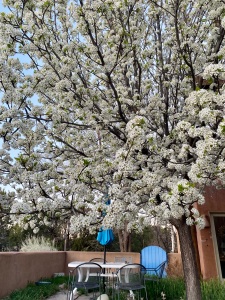
I’ll add this, too: a stunning blossom year for the plum tree my parents planted years ago. They bought the tree for twenty bucks. Would a fruit tree take in the desert, my mother wondered. My father reasoned, Heck, it’s twenty bucks. The tree will grow, or not. The tree thrived.

Your own darkness.

An old friend from years ago sends me a message. She’s persistent, wearing down through my imposed or self-imposed hermitage, whatever this thing is I’m doing, and I drive myself out on muddy roads. She has such a lovely little girl, I’m smitten immediately. I sit down on the floor and chat up the child, and eventually remember my good friend and how much I enjoy her world. She’s funny, with boundless good will and cleverness, in a life that’s had her share of lemons.

End of March, nearly Easter, my perennials spike up further every day. How the earth desires green. I’m far enough along now in my own life that I know the cupboard of my mortal life will always hold certain grooves and scars, its beaten shape, the way the material in my life has shaped me. Aren’t we all that way, though? Maybe this is why spring is the dearest of seasons, that from mud and ice emerge tender shoots, the improbable made manifest every year.

Beginning

The moon drops one or two feathers into the field.   
The dark wheat listens.
Be still.
Now.
There they are, the moon’s young, trying
Their wings.
Between trees, a slender woman lifts up the lovely shadow
Of her face, and now she steps into the air, now she is gone
Wholly, into the air.
I stand alone by an elder tree, I do not dare breathe
Or move.
I listen.
The wheat leans back toward its own darkness,
And I lean toward mine.

— James Wright

Putting the World Back Together, Again.

By Thursday, I’ve lost track of days. A kind man stops by the town office with plates of cookies, still warm from the oven. I’ve been up for hours and hours by then, some working, some staring out the window at the dawn pushing up over the mountain, a spill of pink that widens into gold.

I haven’t been flooded. I know no one who’s injured. Yet, all around, the torn-up world, the folks who are seeking dry shelter, clean clothing, the next meal. The roads are our arteries, and slowly, gravel load by excavator sweep, the world is being put back together.

Thunderstorms and flash floods are in the forecast. Through all this, there’s the subtle underlying sense of how quickly the world turns.

Stores warn of early closings. We’re in this place I recognize immediately, almost giddy, slightly horrified, where people let down their guard, laugh at things that maybe aren’t that funny. Slowly, wrapping order around chaos.

“Water symbolizes the whole of potentiality – the source of all possible existence.”

— Mircea Eliade