The Obvious

In a terrible mood on Friday afternoon, I’m driving too fast through town when I round a corner and see a rainbow spread over Hardwick.

The arc shines so brilliantly and near I imagine I can reach out and touch its particularly vibrant green. I pull into the Village Market, and a woman I know gets out of her car, wearing a mask, too. For a moment we stand there, marveling, then walk towards the market door.

Another woman — vaguely familiar to me, in the way of small town Vermont — is loading her car with groceries. My companion and I urge her to go see the rainbow; it’s just a few steps around the building.

She shakes her head, saying she can’t see it.

But we insist and walk those few steps with her. The rainbow by then has morphed into a double arc. Then, as we watch, the rainbow fades.

Over her mask, the woman looks at us and says, “Well, that’s a nice thing after all today. Something good.”

October 5. So much more winter to come. Watch for rainbows.

It was the Rainbow gave thee birth,

And left thee all her lovely hues;

“The Kingfisher” by William Henry Davies
Mid-September?

Three years ago, I sold our house on a back road and moved into the village, for a few reasons, for mostly so my daughter could walk to school. By then, I was a single parent, hustling a livelihood, and I needed my youngest to be able to get herself around. Rural Vermont, for those not in our world, depends on the car or pickup to get yourself around.

In the pandemic world, where I often find myself ticking off what I’m grateful for, as an antidote to the long list of what I’m decidedly not grateful for, that 15-minute walk ranks pretty high up my list.

These days, I’m wondering how this pandemic will shape my daughter’s generation.

A year ago, she was a freshman in high school, with a regular slate of classes and fall soccer games. As a sophomore, she’s more like a college student, grabbing in-person classes instead of online classes, insisting I’m not to interfere; she’s worked out her own schedule.

Study hall on Monday afternoon? I’ve given her permission to walk home with her friends.

So, while she’s hoping her year will be filled with chemistry, anatomy and physiology, trigonometry, Spanish, and French, I see a different kind of education this year. When her father and I divorced, her childhood had a hard line — a Before and an After. Now, across her whole generation, I see a Before and an After.

I’m incredibly curious to see how that unfolds.

The Uses of Sorrow | Mary Oliver

(In my sleep I dreamed this poem)

Someone I loved once gave me
a box full of darkness.

It took me years to understand
that this, too, was a gift.

Hardwick, Vermont

Butterscotch Lifesavers

In the evening, as dusk settles in, my daughter and I walk downtown to the corner store.

I’m looking for Lifesavers, a rare treat in our house. She asked if I would mind buying her Lifesavers on my way home from work. I’d forgotten her request in my hurry home.

At the corner store, we realize she’s forgotten her mask, so I go in alone and stand there, pondering the three Lifesaver options that store offers. What the heck, I think, aren’t there like a thousand flavors of Lifesavers?

Outside, I find her leaning against the store’s cement block wall, talking on her phone to her uncle, who’s called to find out how school’s going and what’s up in the realm of pandemic adolescence. She’s talking and smiling, glad to hear from him, spilling her happiness with her math class and driver’s ed, the two bright spots in what otherwise appears to a whole lot of chaos.

These days, my head feels jammed with a snarly chaos, with a stream of work and winter prep, a marathon-length school board meeting, and our first frost. As my daughter talks, I wander along the river, its bank piled with old tires. Oak trees spread over the water, their leaves still summer green. What a story, I think, this will be one day, for these kids who grew up in the pandemic’s shadow.

I slide the packs of Lifesavers into her jacket pocket, my small offering.

Homework

In the evening, with the windows open to the crickets’ songs, my daughters sit on the couch, doing homework together, while I read about the 1918 pandemic and knit.

Half-listening, I hear my daughters figure out the answer to a chemistry question, googling definitions. Decades beyond my own high school science classes, I’m no good here. Inevitably, these discussions always remind me of my adolescent years — well before google — when my father was the in-house reference for anything from trigonometry to weird geography questions.

Not so, in this house. I advise the girls to call my brother.

But as I listen, I realize they’re piecing through an interesting problem about change on the molecular level, and my youngest notes that change is the one constant.

It’s a particularly poignant observation for a 15-year-old, and I lay down my knitting and take a walk in the darkness around our house.

This week — heck, these months — seem filled with stories of people around me whose lives are in upheaval. These are all people I know and care about, in varying degrees. I keep thinking how, on a political level, so much misery is caused by exploiting the weakness of others. So, too, in our own personal levels, where so much of our energy often jockeys for a position of strength, betraying a marriage, a confidence, a professional relationship.

Meanwhile, change is the one constant. Surely, if nothing else, that could be a theme for 2020.

And yet, perhaps, it’s not.

In the darkness, I stand near the woodpile, breathing in the scent of sap and fresh wood, of damp soil turned up. Our cat sits on the windowsill, peering out at me. Overhead, the Milky Way spreads across the sky. My daughters’ voices drift through the screen, figuring out their answers, laughing a little — for the moment — happy.

In the Journey

In these warm September days, the little boys who live across the street dig in their dirt driveway, holding up their tractors for me to admire, their faces covered with dirt. The older boy, who’s heading into whatever might be kindergarten this year, wears his Spiderman suit everyday.

Our two houses are at the end of the one-way road. The two brothers, this summer, have begun dismantling the road’s pavement, picking up the broken asphalt pieces and building a tower in their driveway. I look at the tower with immense pleasure. Sure, the world may be falling down around us, but here’s two little boys, recreating the world.

I can’t help but wonder if someday these boys will remember the Covid time as the summer of digging, like I remember the summer of my brother’s fourth year as the time he dug a bear trap — and then fell into it.

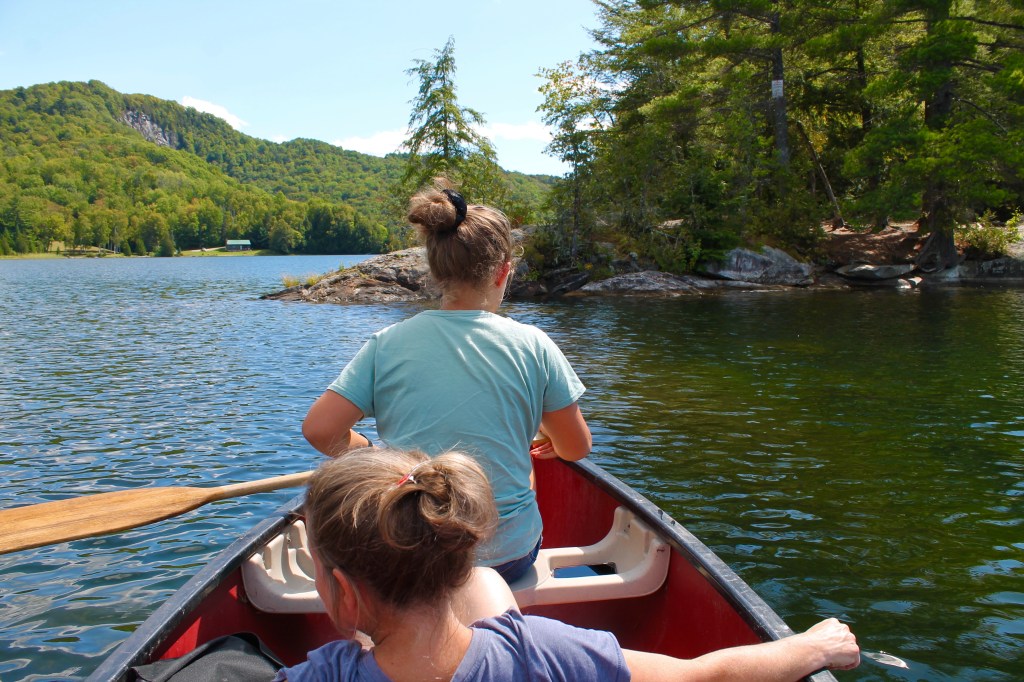
On our end, with my daughters, we canoed out to an island of hemlock trees, a beautiful place, silent but for the water lapping the shores and a loon calling across the pond. The girls packed sandwiches and apples and a bag of potato chips. We ate everything and then rowed across the pond. Why not? This is where we are. What’s the rush to go anywhere?

On the eve of school (possibly) reopening, I keep thinking of Maria Montessori’s wisdom….

Preventing war is the work of politicians, establishing peace is the work of educationists.
― Maria Montessori

Nichols Pond, Woodbury, Vermont
Photo by Molly S.

Little Gifts

Much of my library work these days is talking and listening. Hey, how’s it going? What’s happening? When I listen a little longer, I hear stories of ordinary lives in upheaval — families separated, folks trying to figure out some kind of future.

I hand out books — mostly fiction and mysteries. And I often step outside the library where we keep talking and talking. From the school’s vegetable garden beds, I pick cucumbers and send patrons home with pickle fixings.

That’s about all I have to offer; that little will have to suffice.

In my own garden, the zinnias have gone brushy and wild, brilliant pink. Radishes have flowered and gone to seed. Late afternoons, I wander, barefoot on the cold soil, taking in the colors, breathing the spicy scent of arugula.

Before long, frost will be nipping at my garden, but for now, the pollinators are hungry, the crickets are singing, and these ragged-petaled flowers are nothing short of miraculous.

Photo by Molly S.