Put on a dress of flowers…

I spy a young fox on my front yard sniffing the trunk of the pear tree. Someone planted these two fruit trees long before I lived here. The smaller bends into the lilac hedge as if it’d prefer to be a lilac. This one, the taller, shoots high, its branches like an enormous hand raised in greeting.

The fox checks out the cohosh I planted this fall. Dawn is coloring up towards whatever day might emerge. I’m walking around my downstairs rooms, a dress in my hand, headed into work today, to sort out questions I both can and cannot answer, to talk with my office partner about town roads and FEMA, the drying up streams and lakes, about the merits of apple cider vinegar, and grownup kids. We’ll open the screen-less windows wide open in this 100-year-old former school, letting in the sunlight over the dusty sills. Hungry wasps fly in and out. An ordinary day of the things of this world, some humdrum, some irritating, some lovely as this balmy October weather. As for me, broken by cancer, limping back to whatever rude red health I can summon, I think, Put on a dress with flowers.

The fox crosses my neighbor’s pine-cone-strewn grass and disappears down our thin road. A fortuitous sign, I think, for this day.

Ode” by Zoe Higgins

Here’s to everything undone today:
laundry left damp in the machine,
the relatives unrung, the kitchen
drawer not sorted; here’s to jeans
unpatched and buttons missing,
the dirty dishes, the novel
not yet started. To Christmas
cards unsent in March, to emails
marked unread. To friends unmet
and deadlines unaddressed;
to every item not crossed off the list;
to everything still left, ignored, put off:
it is enough.

“Where are you going?”

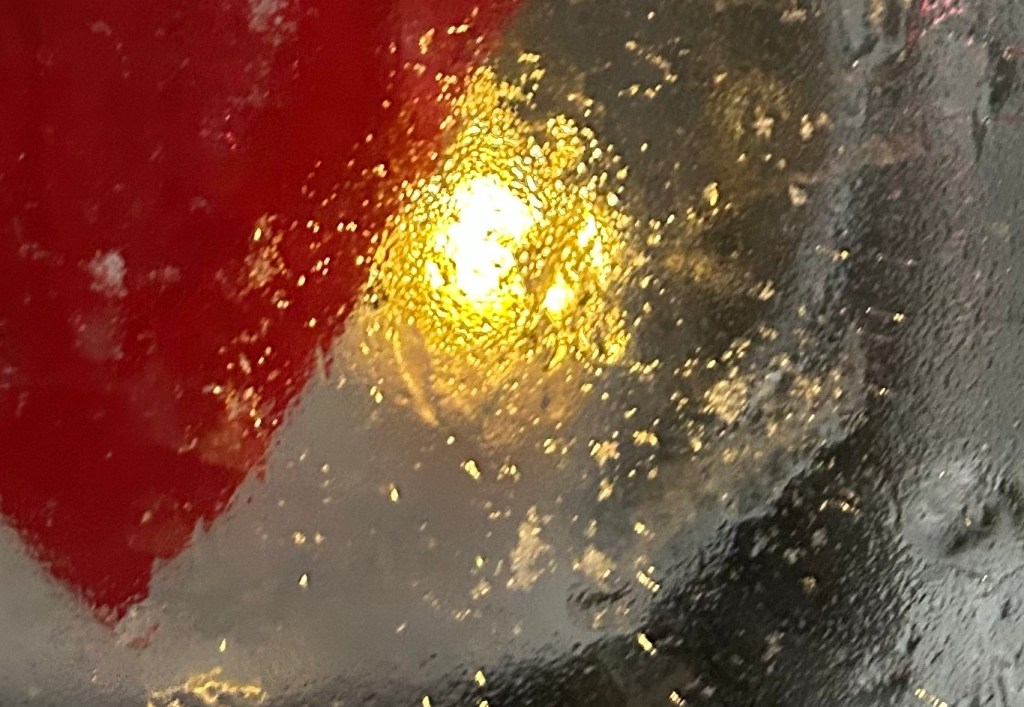
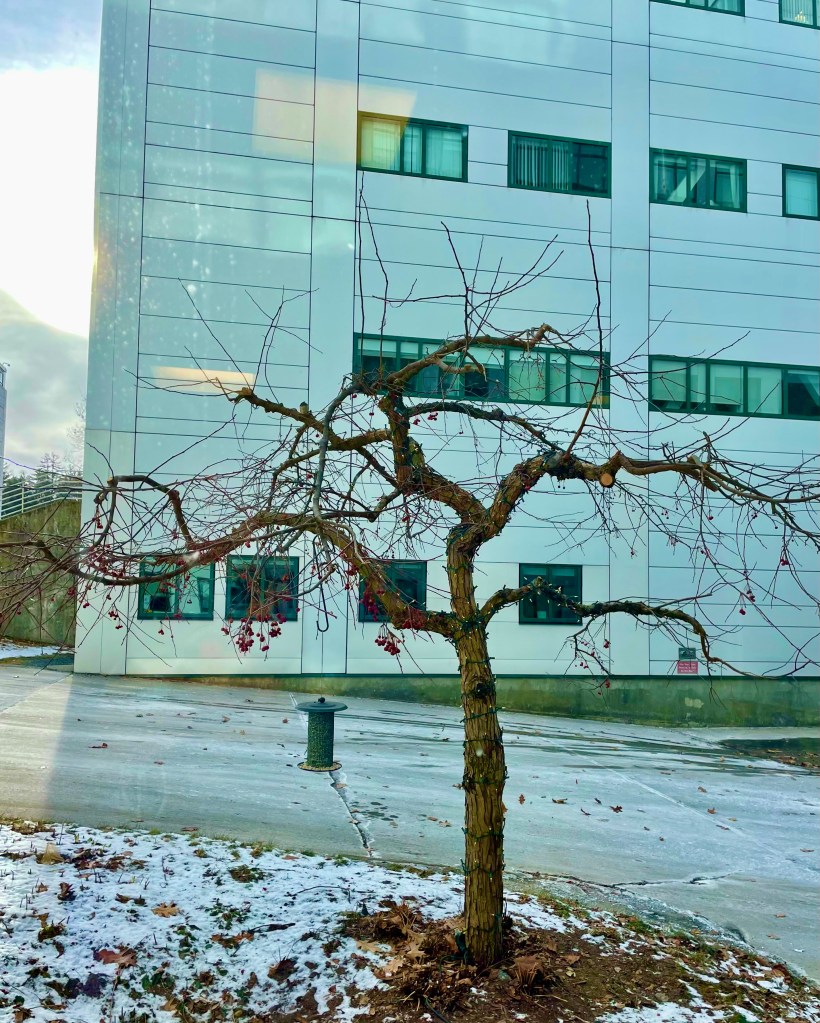
Photo above taken in a courtyard garden at Dartmouth-Hitchcock. Inside the building, there’s a short flight of stairs to a sunroom. Glass doors lead to the garden. Much of this winter, I couldn’t walk those half-dozen steps. When I finally could, I proofread my daughter’s college essays in the sunroom. We stared out at the blowing snow and wondered what grew in the spring garden.

Today, mid-June, an appointment of good news. The Good Doctor reminds me that I’ve finished treatments, that I’m in remission. Go on and live your life. Gain weight and muscle.

I’ve been so far out of the everyday world that, after this appointment, waiting in a gas line, seems like a small event. For some reason, I remembered the gas station a few miles from my father’s house in Santa Fe, New Mexico. On a random summer morning, I pumped gas and then stood for a moment, breathing in the spiciness from the station’s kitchen vent and staring up at the flawlessly blue sky. The desert’s hot breath touched my cheeks, my hands, my bare knees – at once so familiar to me (my birthplace the New Mexican desert) and enchantingly unknown. The day lay before us like a pie that could be cut any which way, and the result would be enjoyable.

That’s how I felt, leaving the cancer center, walking up the stairs in the parking garage – light – as if I had shed that caul of cancer and pain. I mean nothing easy or innocent about this lightness. One afternoon when I could barely walk around the high school, I sat in a friend’s car and imagined myself as gray – my face ashen, my bones crumpling to cinders. I wondered how I would survive. In December, wandering the halls of yet another hospital, I turned around and couldn’t recognize the only other person in the hallway, my friend Jo who was even calling my name. “Brett, where are you going?”

Living with cancer taught me that we are not creatures of the mind; we live in our bodies. Cancer may return in my flesh this summer, two years from now, or never. I may perish falling down stairs, or expire as an old woman in my bed beneath a quilt my mother sewed. Any hubris I once had about eating organic brown rice and my garden’s bounty vanished this winter; mortality’s blade is ubiquitous, final.

Nonetheless, this day…

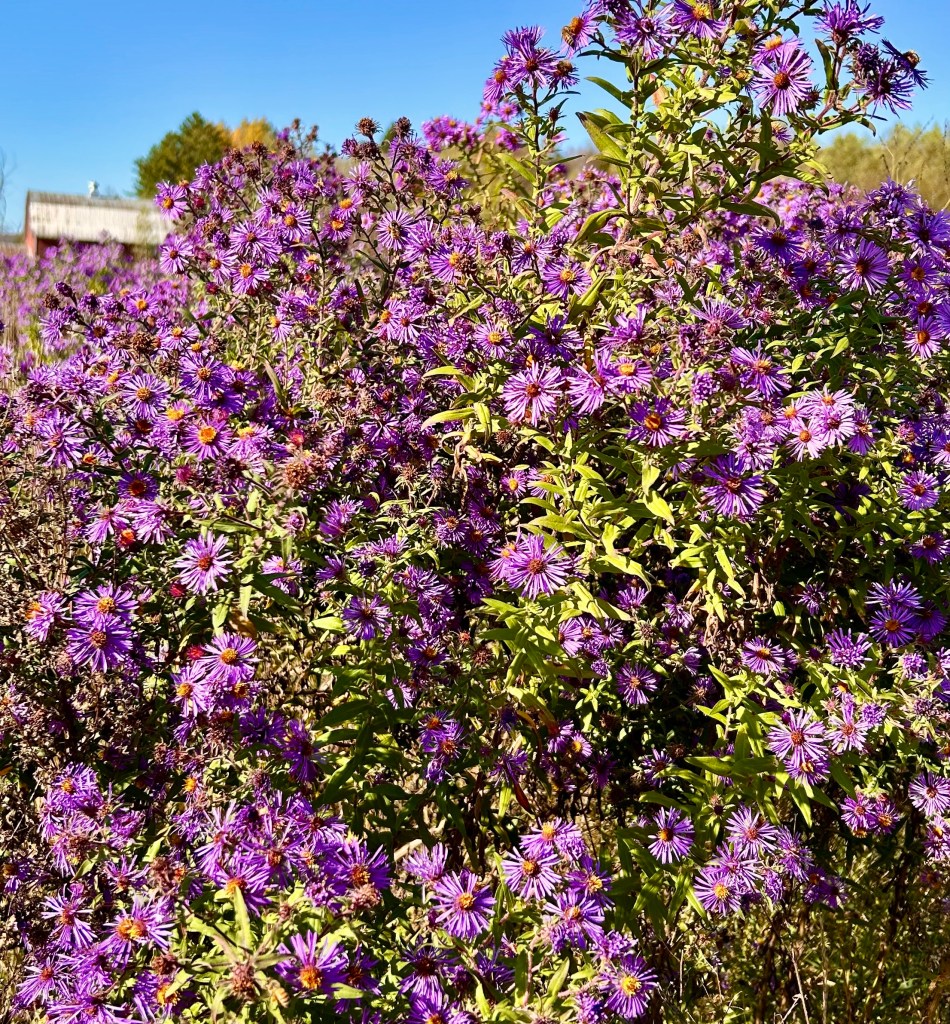
Driving home on the interstate, my daughter and I mused about hurried drives through snow to the ER, the repeated treks, northward, home, where we scrutinized roadside trees for the faintest blush of spring green. This time, my daughter pointed out patches of lupines, purple and pink and white, sure sign of summer.

You must do something to make the world more beautiful.

~ Barbara Cooney, Miss Rumphius

A fluttering stir like a fledgling first stretching its wings…

On my way home (again) from Dartmouth-Hitchcock Medical Center, I’m at a pharmacy, picking up prescriptions. The one I really want – the pain meds – is apparently not available, simply not stocked, which surprises the heck out of me. It’s a common opioid. In my brother’s car, I phone Dartmouth, miraculously reach a nurse who sorts out my problem swiftly. My brother drives down the road, where another pharmacy tells me I’ll need to wait.

In a dusty midafternoon sunlight, I take him on a downtown tour of Barre, around the courthouse where I spent so many hours. I point out the window where I stared at the chickadees in the crabapple trees. We keep going and walk around the Civic Center where my daughter and I went to basketball games. The lot is empty, dirty with winter sand. We talk for a bit about these neighborhoods and where we grew up, our mutual interest and speculation in local history, how towns rise and diminish.

In the Walgreens parking lot again, I pull up my sleeve. Where a nurse recently pulled out an IV, the band-aid is soaked. I show it to my brother. “Don’t touch,” he tells me, as I wince, creeped out. “We’ll clean it when I get you home.”

That blood-soaked band-aid, in a filthy parking lot, feeling beat down to hell and just wanting to head home, wash off the hospital reek and nuzzle a cat, but waiting for pain meds… is a sliver of cancer. In Walgreens, they’ve received my prescription. The pharmacist asks me if this is going to be an ongoing thing or what.

Hello, I think. I am clearly a cancer patient, with my scalp wrapped in a sparkly scarf and my eyes underscored by lines. The backs of my hands are red-dotted with red needle sticks from blood draws. My fingernails are broken by chemo. But there’s enough of me, yet, to lay into the pharmacist and both get my prescription and make him apologize. I know the deal about opioids. I’ve published a book that included Walgreens’ role in the devastating opioid crisis. Nonetheless, I’m determined to get my 21 pills, and I’ll send family back for the remaining allotted 21 pills, and I’m darn grateful for that. This, I tell him, is getting me to the finish line. And I’m going to get there.

I ante up my $4 copay, and then my brother drives north, over the Winooski River, where I happily point out the first spill I’ve seen of coltsfoot this year.

Later, at home again and opening my email, I’m gratified to read that my essay “Red Devil, Survivor Herself,” has been accepted for publication this April, my way of rowing against disease. A line from the essay reads: “Here’s a lesser known side effect of my chemo mixture, cisplatin: lying in bed, a whooshing revolved in my left ear, a fluttering stir like a fledgling first stretching its wings.”

Last, if anyone is so inclined, my youngest has signed up to walk in Dartmouth’s Cancer Center‘s annual fundraiser. Many thanks again, all, for reading my words. Happy April, wherever you may be.

From Donna Tartt’s The Goldfinch, my hospital read:

And I add my own love to the history of people who have loved beautiful things, and looked out for them, and pulled them from the fire, and sought them when they were lost, and tried to preserve them and save them while passing them along literally from hand to hand, singing out brilliantly from the wreck of time to the next generation of lovers, and the next.

Picking at the salty remains of roast beef…

Shortly before the November election, I’d heard word of a friend’s illness, and I determined to fly West and see this couple. At that time, I thought I was poisoned by mold and struggling myself, but I really wanted to visit. I decided to hold off buying the ticket for a few days until just after the election, because, well, what if? What if the grid crashed or something? I’ve lost money on airline tickets before.

What happened, instead, is I ended up in the ER the night before the election and discovered the mold was a red herring. I had cancer — although I hold, yet, that the mold was an element of a complicated equation that may, or may not, have added to turning on that cancer gene. By then, flying was impossible for me. Now, news comes to me of her final passage from this life. My friend has lived a long, loving — a good, very good — life, and yet…

All afternoon, another friend and I text back and forth. Remember the nights we ate in their dining room where the walls were painted light blue above a cream headboard? On the wall thermometer, we watched the January temps dip to 20, 21, 25 below zero, laughing at what would be a cold drive home. We never wanted to leave early. Instead, we kept drinking wine, eating chocolate cake, picking at the salty remains of roast beef.

Sorrowful, indeed. We are all now far enough along in life to know that no one dodges the Reaper, that the cut of illness or injury might fall swiftly at any moment. That, in the end, we leave as we entered. While my daughter drove me home the other twilight, I watched the stars ignite in the burnished blue along the horizon, one by one, these ancient untouchable illuminations. She followed the highway home; my eyes fastened on those seed pearls, the slender thread that thickened just the merest width as the night flushed in.

Here’s a line from Niall Williams that, by stroke of coincidence, I read today.

“… you could stop at, not all, but most of the moments of your life, stop for one heartbeat and, no matter what the state of your head or heart, say This is happiness, because of the simple truth that you were alive to say it.”

Three things of varying importance…

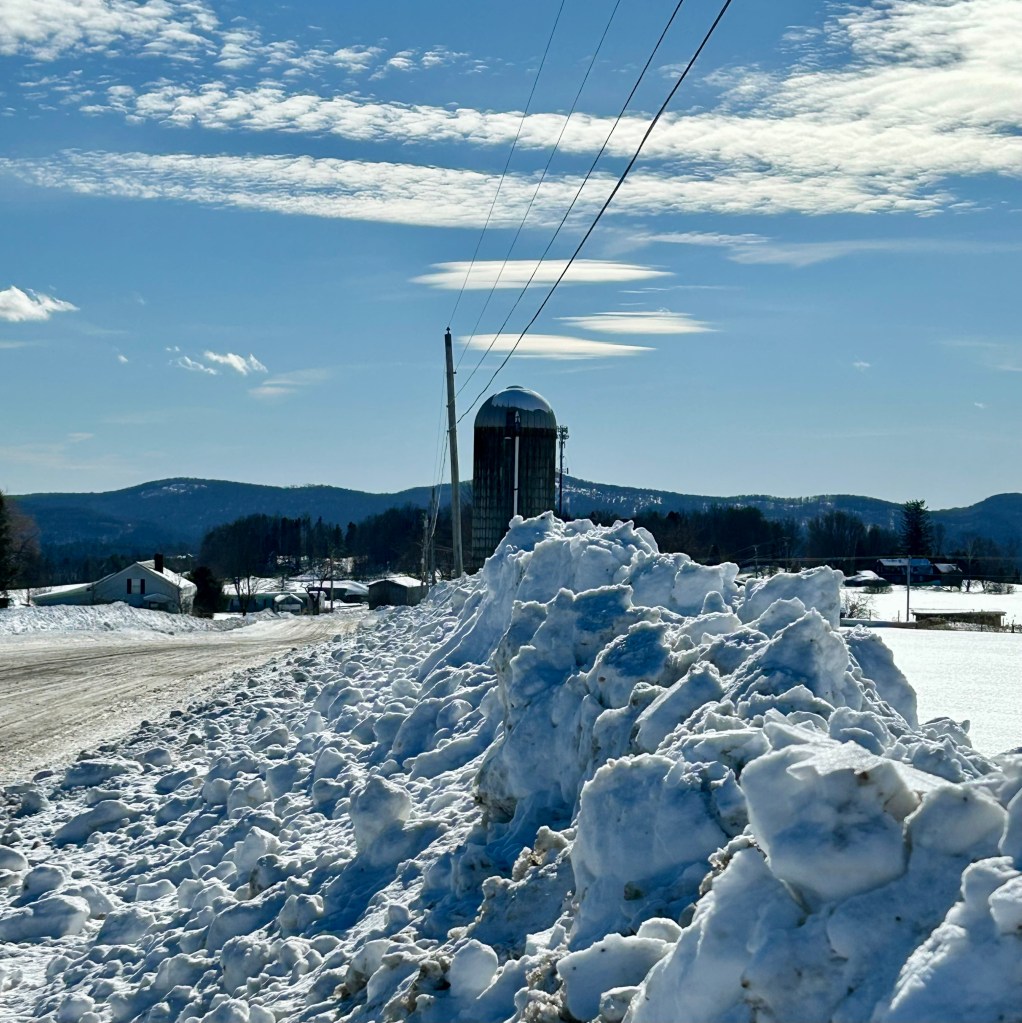
Because I’m writing from Vermont, first, the weather: cheek-slashing cold, furious wind.

Second, back at Dartmouth these past few days for a consult and an infusion. Checking in, my insurance card was denied. Denied because it’s January and the new year wasn’t set correctly, or denied because some system is broken? I imagine these numerous co-pays, from ninety-cents to $750, piling up in my electronic portal. I’ll kick that to Monday, begin to straighten that out then…

Halfway through my treatments, the Good Doctor gives me the heads up about what’s to come, including the shift from what I’m calling Cancer Land back to the Everyday World. Although I’m sure he hears this repeatedly, I say how otherworldly is this cancer journey. Rarefied isn’t precisely the word I’m looking for, as so much of disease isn’t lofty or grandiose but mundane and sometimes miserable. But the journey is like nothing else I’ve undertaken, laced through at times with impending death, elevating the stakes to the utter center point of what matters. There’s nothing trivial here.

Third (and certainly not last), I’m so grateful for the lovely mail in my P.O. Box – cards and books, seeds and poems, such as this one by Danusha Laméris.

Insha’Allah

I don’t know when it slipped into my speech

that soft word meaning, “if God wills it.”

… How lightly we learn to hold hope,

as if it were an animal that could turn around

and bite your hand. And still we carry it

the way a mother would, carefully,

from one day to the next.

Lantern, Starlight.

In a half-sleep, I hear my daughter talking in the kitchen. Another odd parallel to pregnancy – sudden sleep, confused awakenings. Where am I?

She brings me a slender book, Pax by Annie Lighthart, gift from a friend. I rally up, read the book that afternoon as the wind lifts the Christmas lights around our house and barn and gently tap, taps, the clapboards. Solstice, winter’s toothy cold burrows in. My daughter’s whole life I’ve been the hearth keeper, the ash sweeper. The rotator of ash buckets, kindling boxes, the wakeful night-keeper layering the firebox with wood. Now, suddenly, her duty. She’s fed the fire for years, of course, but the ash shovel has been handed over. Fact, fact.

The solstice crossed, we enter winter’s long terrain. The neighbors’ dogs howl. Somewhere in the night, I lie awake, a single star a distant light in my window, pure as a teardrop.

LANTERN

Some evening, almost accidentally, you might yet understand
that you belong, are meant to be, are sheltered—

still foolish, but looking out the door with a contented heart.
This is what the king wants and the old man and woman

and even the busy young if you knew, and you have it
by no grace of your own, standing in the doorway

with loose empty hands. Now your heart lights your mind,
a little lantern bobbing within you,

giving out not thought or feeling but confluence,
something else. On what do you pour out this light?

The wet street is empty, one wren in the yard. Let us
redefine love and wreckage, time and weeds.

Pour out your lantern light on the grass, on the bird,
great and small worlds. Don’t go inside for a long, long time.

– Annie Lighthart –