Friday Run

Just before dusk, I’m running along the rail trail, where train tracks once lay, when a woman steps out of the brushy woods, puts her hand over her chest, and gasps.

I’ve frightened her. She’s dressed in hunter’s orange and holds a rifle pressed against her body.

I stop. There’s no one else around, and I have the sudden terrible feeling that I’m in the wrong place at the wrong time. I’m wearing the ripped blue sweatshirt and knitted cap I always wear.

It’s hunting season, and I should be wearing orange. She looks angrily at me. I nod, edge away, and then keep on with my run. On this run, I’m mostly worried about a skinny dog at the one house I pass — a creature who doubtlessly is harmless. I run through the thick woods between the highway and the Lamoille River, snaking through its bends. It hasn’t escaped me how the wilderness presses right up against the village where I live, in acres upon acres of woods where I hardly ever see anyone.

On my way back, I again meet this woman with a florescent pink mask over her lower face. I’ve seen no one else, save the dog, and I slow to a walk again and apologize for not wearing brighter colors.

Jesus, she says and keeps walking.

Not long after, back in the village, the twilight drifts down like a gray snowstorm. My daughter’s school is closing again, perhaps opening in December, but maybe not. All around us, the pandemic continues to upend lives, through loss of in-person schooling, jobs and childcare, and the widening gulfs of isolation.

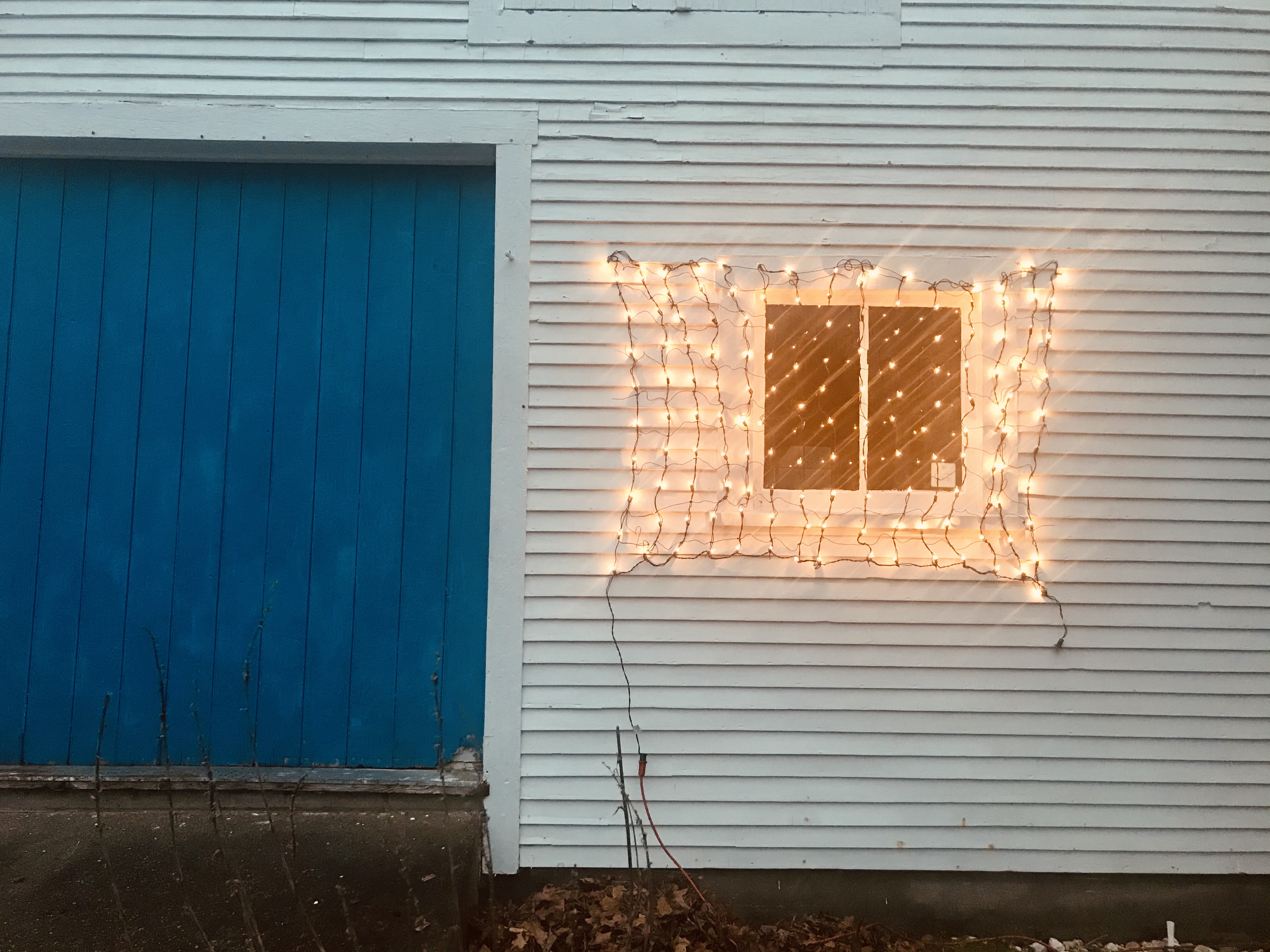
Walking back through town, I admire the holiday lights turning on as the darkness filters down — lights of all colors and blown-up snowmen and reindeer. The day has been unseasonably warm for November. Take this in, I think. And next time, bring a mask and wear orange, too.

“Writing often reveals us to ourselves, lets us name what’s important to us and what has been silent or silenced inside us.”


― Gregory Orr
Tuesday

… one can either choose to live, or not. We have to tell ourselves a story that makes living possible.

— Katherine E. Standefer, Lightning Flowers: My Journey to Uncover the Cost of Saving a Life

And so we go on, telling our stories. My daughter returns from her one high school class on Monday morning, and tells me so many teachers were out.

I head to work, leaving her in front of the wood stove with her chrome book, the cats sprawled on either side of her.

At the library, a teen comes in and tells me he thinks the school will close soon. The teen lives on a back road and can’t drive yet. He’s a voracious reader. In the spring, he told me, he read everything in the house, then everything again and again, and finally resorted to Netflix. I tell him to take as many books as he wants. He fills a bag. When he leaves, I wonder when I’ll see him again. Maybe Wednesday. Maybe not.

And so we go on. I name our little wood stove Jenny.

Okay, my daughter says. She is part of our family.

Stay well.

Warmth

When I return home from work in the evening, one cat is stretched on the rug before the wood stove, the other lies on the coffee table, front paws draped over the table’s edge. It’s a scene of utter cat joy.

My daughters are laughing on the couch about something foreign to me — some kind of iPhone. I pull over a chair and sit down with a bowl of potatoes and vegetables and meat.

While they share a story about their negotiations over dinner dishes and compost and wood chores, I soak in the warmth of our living room.

All around us rages the virus, a rising irritability, utter uncertainty over the future. For years, I’ve relied on my ability to figure out a plan. Listening to my girls, I decide this is the heart of my plan: be like the cats. Drink in where we are now. Let that nourish us. And, for God’s sake, laugh at the jokes the kids tell.

“Perhaps home is not a place but simply an irrevocable condition.” 

— James Baldwin

Sunset, Skunk, State Police

Before I leave work yesterday afternoon, I stack piles of papers labeled with stickies in my scrawled handwriting — a roadmap for myself for the next day’s work.

Outside, the sunset is crazy beautiful.

I drive home, listening to VPR. The governor has sent the state police to lodging establishments, in an attempt to crack down on quarantine requirements. My brother, in New Hampshire, appears to be sealed off from us, in a sea of Covid.

At home, my 15-year-old dreads the thought of another lock-down, like last spring. But it’s not April 2020 in Hardwick, Vermont. In November, unlike in April, Covid is among us, in the schools, among people we know.

In the evening, my friend and I walk around town in the dark. The long bar in Positive Pie is empty, save for the barkeep at the far end, his head bent over his phone. At the high school, we walk down a wooden flight of stairs to the soccer field that a group of volunteers recently built. In the field’s center, we gaze up at all those stars, the Milky Way arched over the firmament.

Back at my house, we stand in the driveway, talking, talking, in the unusually warm November evening. A skunk ambles around the neighbors’ house — a normality I can embrace — although, after a few moments, I back up and head into my house for the night, where my daughters are planning to make tiramisu for Thanksgiving.

I wish I could invite all of you…..

“When I face the desolate impossibility of writing five hundred pages, a sick sense of failure falls on me, and I know I can never do it. Then gradually, I write one page and then another. One day’s work is all I can permit myself to contemplate.” 


― John Steinbeck

Photo by Gabriela

The Right Thing

On a walk my daughters and I often take in the evening, we pass a house where a little black cat trots out to meet us. The cat’s tail is bony, its nose white as if dipped into a saucer of cream.

We always turn down that particular street, saying, Let’s go see the cat, and stop and pet this friendly creature.

In the dark last night, a car followed us, then stopped, as the cat sat in the street. When the cat didn’t move, my daughters and I turned and walked back, to encourage the cat to head along now. The driver pulled up and rolled down the window.

I didn’t recognize this curly-haired woman. She asked me if the cat was mine. When I said no, she wondered aloud why she had kept sitting in the car. I didn’t know what to do, she told me. The cat didn’t move.

I laughed and told her, You did the right thing.

She raised her hands from the steering wheel and began laughing. I did the right thing! she exclaimed.

Walking home in the dark, I kept thinking of what looks to be a long winter ahead. But for a radiant moment, Saturday showed us our VP-elect proudly acknowledging the history and labor of so many nameless others. It’s a historic moment my daughters relish.

“So often in life, things that you regard as an impediment turn out to be great, good fortune.”

— Ruth Bader Ginsburg

High School in the Time of Covid

My daughter’s high school varsity soccer team, the Lady Cats, advanced into the playoffs — local joy against rising Covid rates and the election hurtling along.

I didn’t play sports as a student, the lone wolf who ran long solitary runs — pretty much what I’m doing now, except these are short solitary runs. But to be a kid on a local team who wasn’t expected to do well at all — that’s a big deal.

Friday, I’m home briefly in the middle of the day. My daughter and her friend have finished school for the day. In the living room, they’ve set up this year’s version of high school, each with their notebooks and a school-issued Chromebook, surrounded by piles of my library books, their cleats drying beside the wood stove. The room is sunny and warm, and the girls are intently working at whatever assignment — chemistry or algebra.

I fill my thermos with espresso and ask my daughter’s friend if she’d like a cup. I’m joking, but she happily accepts. I’d love an espresso.

So, in a little china cup painted with blueberries that my daughter once used for milk, I serve this girl an espresso, who thanks me.

Before I head out the door again, I look back at these two. I’m happy to be employed, heading to interesting work, on this sunny autumn day, in my Shire of Vermont. But goodness, I’m grateful for girls and warmth. The whole world matters — disease and political collapse — but this afternoon matters, too.

I open the kitchen door, call I love you, step out into the chilly afternoon, and close the door carefully behind me.