“When the electricity shuts off, you boil water, you crack ice.”

In addition to showing up at Dartmouth-Hitchcock for chemo and consults to save my life, which thankfully appears to be going nicely, I also joined a writing group the hospital offers. Because writing saves lives, too.

Here’s a poem I read in this class, too good not to pass along.

“Chickens” by Kate Gale

I come from hay and barns, raising  
chickens. In spring, lambs come.  

You got to get up, fly early, do the orphan run  
sleep till dawn, start the feeding.  

When the electricity shuts off, you boil water, you crack ice.  
You keep the animals watered.  

You walk through the barn, through the hay smell, 
your hair brittle where you chopped it with scissors  

same ones you use for everything. Your sweater has holes.  
When you feed the ram lambs, you say goodbye.  

Summer, choke cherries; your mouth’s dry. Apples, cider.  
Corn picking. Canning for weeks that feel like years.  

Chopping heads off quail, rabbits, chickens.  
You can pluck a chicken, gut it fast.  

You find unformed eggs, unformed chicks.  
They start chirping day nineteen.  

You make biscuits and gravy for hundred kids  
serve them up good. You’re the chick  

who never got past day nineteen, never found your chick voice.  
You make iced tea. They say, you’re a soldier in the king’s army.  

At night, you say to yourself, Kathy, someday.  
We go walking. We go talking. We find a big story.  

A cracking egg story. A walking girl story.  
A walking out of the woods story. A not slapped silly story.  

A not Jesus story. Hush, Kathy you say, we get out of here.  
We find out where chicks go when they learn to fly.

Don’t let your cow get the upper hand, er, hoof…?

Ah, February, the month with the strange “U” that children stumble to spell. Two inches of a sugar snow this morning when I carried out the stove’s ashes, the cardinals whistling the day alive, a buttery full moon charming the evening sky. For the past few weeks, my life has overflowed with the challenges of faraway aging parents, with details mundane and immense, and all very very real. There’s that Tolstoy saying about families unhappy in their own way. Carrying in firewood, I remind myself: families endure the unspeakable in their own particular vernacular, swaddled in the way of all human life.

Sugaring season is hustling into Vermont now. The years I spent sugaring with a husband and two young daughters taught me to strip away the unnecessary, to bend into work when bending is required. It’s a habit I’ve carried to writing, and I’ve managed now to write three books against odds that even now seem not in my favor. But it was single parenting that honed my skills to grasp the nourishing in times of hardness, suck hard the marrow of the real. In a conversation with a young homesteader and poet today, she offers me a line of wisdom so pithy and wise I laugh out loud: Don’t let your milk cow get the upper hand on you. Yeah, think that one over.

Here’s a David Goodman interview with Elizabeth Price, mother of the young Palestinian man Hisham Awartani who was shot with two friends in Burlington, Vermont, last November. The family epitomizes courage, knowledge, and depth of heart — highly recommended.

Kindling.

Kitchen table, Hardwick, Vermont

In below zero temps, I stop by the library on my way home from work to pick up an interlibrary loan book. My friend in her mask runs down from her balcony office, and we huddle against the library’s 100-year-old radiator.

She tells me about the death of a person in town, from Covid. My friend is wearing a sweater from yarn she spun and dyed, from goldenrod blossoms she gathered. The sweetness of early fall is a long, long way from us. I’d been thinking that someday these days will be but a remembrance to us, and here I’m hearing word of family who will never forget these bitter January days.

I finish the afternoon chores I’ve set out to do — buy cheese at the co-op, get the mail at the post office, stop by the superintendent’s office to sign the high school budget warning we voted on last night. At home, I feed the wood stove and the cats and set pizza dough to rise.

Then I do my final outside chore — I gather bits of bark and kindling from the barn floor and a few dry sticks into a cardboard box. In the early, dark morning, I’m up first, and this kindling box is my easy way to begin the day. I think of it as a little gift to myself.

The cold is fierce around me. I stand in the barn, holding that box in my leather gloves, thinking of nothing at all. Just standing there.

Zen. Broken Sink Drain. A Meaningful Life.

back porch view

I’m lying on the couch reading Sigrid Rausing’s Mayhem when my daughter calls from the kitchen, ‘Mom, you’re not going to like this!’

The sink drain has split apart again and gray water floods the kitchen floor. For a moment, I think, whatever, and then ask her to get an old towel.

I have now repaired this drain three times, each time in nothing but sheer annoyance and impatience.

The problem, naturally, has something to do with PVC and epoxy, but more to do with me. My ex-husband put in this drain, in his trademark cob-job way, fitting together scraps of plastic pipe. I’m irritated at my own ineptness, my unwillingness to devote real time to YouTubing a solution, the scantness of my nonworking hours.

I’d rather paint a wall than repair a drain.

After we mop up the water and pile the unwashed dishes on the sink drainboard, we put on our boots and take a walk in the falling snow. It’s the first snowfall of the year. Snow is our old friend, falling silently, sparkling in house and streetlights. This first bit will melt today and return again soon.

Sunday morning. Put the house in order. Take the broken pieces to the hardware store. Ask for advice.

True recovery is a profoundly ethical journey, finding meaning and dignity through solidarity and restitution. Without that, there may be a cessation of drinking or substance use, but there is no real recovery.”

— Sigrid Lausing

Small Journey

My younger daughter drives the two of us on a cold January afternoon to Montpelier. I can’t remember the last time I’ve been to the state capital, although (pre-pandemic) I was in Montpelier at least once a week.

We’re in search of a birthday present for my oldest daughter — a single present, that’s all I’m looking for — and we go into only one store. At the register, the owner tells me how happy she is to see people; the city has been a ghost town for the last week.

In the downtown’s heart, we pass empty storefronts. I’ve never seen so many vacancies in Montpelier before. On one main corner, my daughter notices the bakery where I once bought her chocolate chip cookies is locked, too.

Where I can’t bear to pass by is the library, the beautiful stone building where a year ago I often spread out my laptop and papers and worked for hours. In the large reading room, the well-heeled snapped on lamps and read and wrote. There was a couple who always appeared who seemed to be gambling online. The homeless and college students filled chairs. After school, children ran through.

At my daughter’s request, we walk through Hubbard Park in the cold and up the stone tower to see the city surrounded by mountains.

When we walk down the snowy steps, a mother and her daughter are sitting on the tower’s stone floor. There’s only openings for windows and doors, and the girl is crying with cold. The mother struggles to tie an icy lace on the girl’s ski boot.

Been there, I think, done that.

I no longer have the keys to my own car. My daughter drives past the state house where no one is out. Not a single person on the granite steps. Driving home, she suddenly says, The good thing about living in Vermont is spring. Even if winter seems forever, there’s always spring.

[Kintsugi], the Japanese method of repairing broken pottery [uses] gold to bind the pieces together. In this way, the break becomes what is beautiful, what is valued. It is a way to embrace the flaw, the imperfect. In place of the break, there is now a vein of gold.

— Nick Flynn, This is the Night Our House Will Catch Fire

Photo by Gabriela S.

Finally!

In the midst of surely what will be known in American history as a lousy time, Bernie Sanders inadvertently made knitting cool.

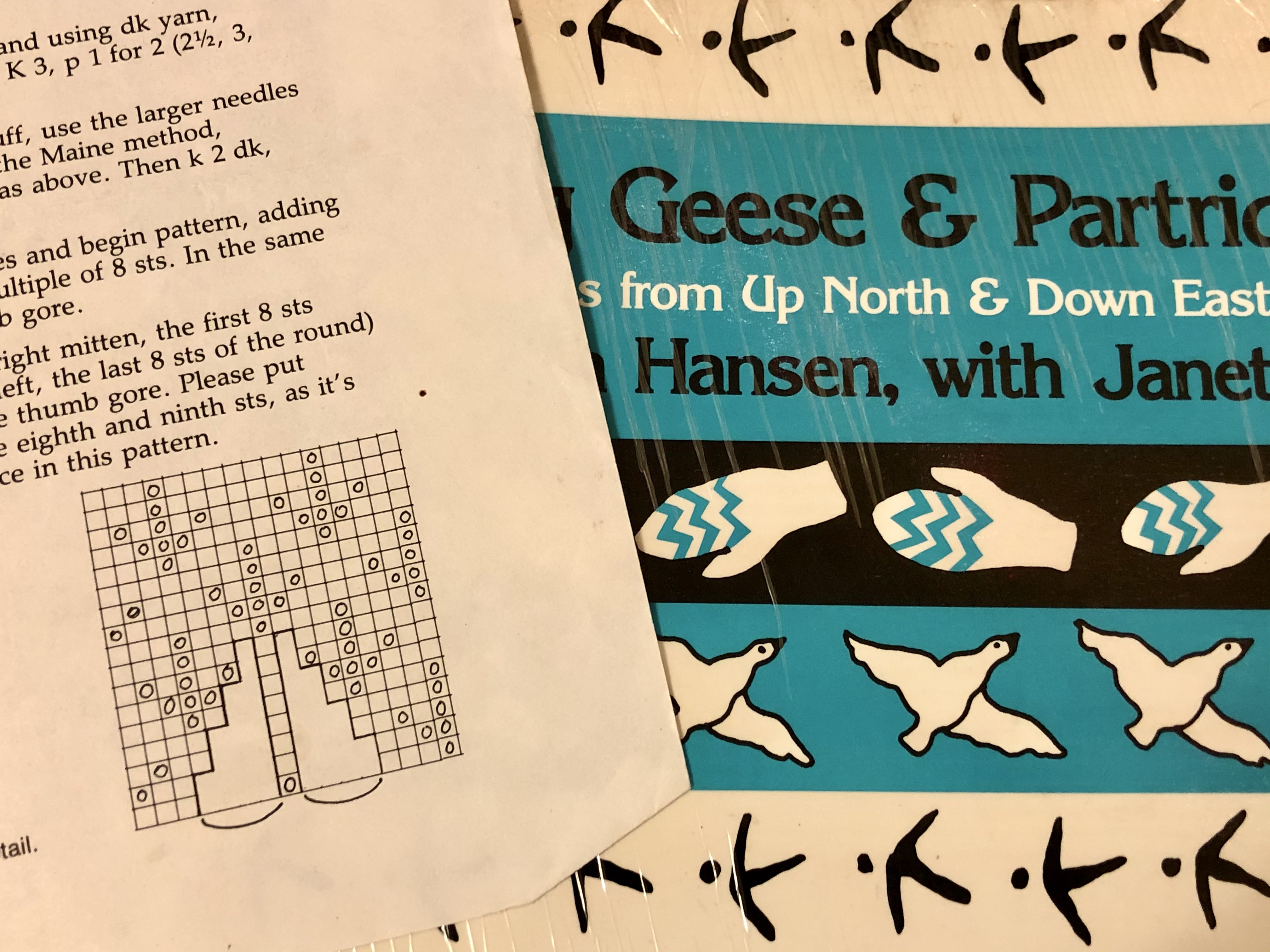
When my youngest daughter was a toddler, one winter I cracked open a knitting book my mother had given me from her stash and taught myself to knit two-stranded mittens. In those days of diapers and playdough and winter isolation, I experimented with yarn weight, needle size, and colors. The prettiest mittens I knit had one cuff gnawed by mice when I left the pair overnight in our sugarhouse.

When we moved from one house to another and we jettisoned so many belongings, I considered that particular knitting book before I packed it in a box. At that point, I wasn’t sure I would ever knit another pair of mittens, but I packed the book, more out of sentimental affection than anything else.

This morning, I pulled the book from the bottom shelf of my bookcase. I was looking for a pattern after offering to knit my brother a pair of mittens. In the center of the book, I found pages of one daughter’s artwork. She had a set of Noah’s ark stamps as a little girl, and had carefully stamped and colored a scene.

This daughter went through a period when a hand-me-down paperback Noah’s ark book was her favorite bedtime tale — all those animals and Noah’s family cozied in a handmade boat, first having a party, then enduring through a tediously long journey, with the rewards of the olive branch, the dove, dry land, and the rainbow at the end.