Jan Thaw

Rain pours. My daughters return, full of excitement of the ocean, of staying in a city, of a friend, and — for my younger daughter — driving around with my brother, stepping into his cool life.

They have brought me a wooden box of green tea and a tin of red goji berry tea.

Time seems suspended in the endlessness of January, but it’s not: the rain will slick to a landscape of ice, the days are already lengthening.

Again, from poet Kim Stafford:

IMG_7055

Home

Nearly two years ago we moved into our house — from the house where my daughters had lived their whole lives. Now, two years in, this new-to-us 100-year-old house, the house has morphed into home, with a particular shade of yellow I painted the dining room, our first chicken buried in the backyard, the front porch filled with piles of library books, Yahtzee score cards marked up, kid sweatshirts.

Infinitely lucky we three females are, to move five miles down the road, from a forest to a town, our cardboard boxes ferried by friends.

Here’s my State 14 postcard.

IMG_5570

End of July, Postcard From Hardwick, VT

Until she was 18, my older daughter lived on a dead-end dirt road, surrounded by mixed hardwood forest, dense conifers along the house’s northern boundary. Walk ten minutes from our house now — all right, maybe six minutes — and we’re deep in the woods again. Every evening, hermit thrush sing behind our house.

While July is stunningly beautiful across Vermont, I see how quickly July varies from home to home. Where do the pollinators flock? Just a few miles from our former house, we see cardinals. Here, the water is nearby, and the mornings are misty.

Yet another boon to Vermont summer — walk just a little in sandals and the wildness surrounds you.

“There’s always a sunrise and always a sunset and it’s up to you to choose to be there for it,” said my mother. “Put yourself in the way of beauty.”

— Cheryl Strayed, Wild

IMG_2903.jpg

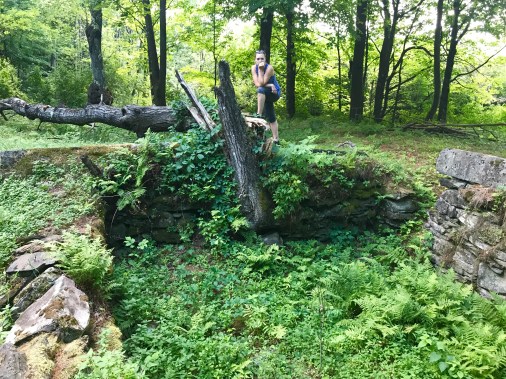
Site of former pest house, Hardwick, VT

Train Trip

Four summers ago, my family planned an Amtrak journey from Vermont to Santa Fe, New Mexico, in what would be the longest family trip of our girls’ childhood. That summer trip evolved into an illustration of that Robert Burns’ line about the best laid schemes not following the script.

We set out with a curveball detour to Charlottesville, then to New Mexico via Chicago. Somewhere in the month of  August, driving my dad’s old Subaru through the Navajo reservation, I wondered what if the hydrangea outside our back door was blooming, and if we would ever return home.

We did, of course.

In Travels with Charley, Steinbeck writes about how trips take over — true, true….

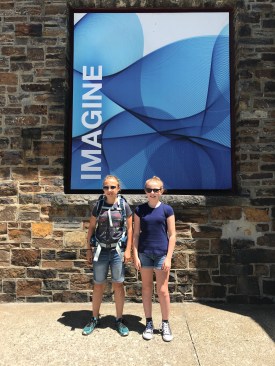
Yesterday, for a writing assignment, I took my 13-year-old and her friend to the southern end of Vermont on Amtrak  — just enough of riding the rails, of licking ice cream and browsing bookstores, walking across the bridge spanning the Connecticut River so we stepped into New Hampshire.

Back the Montpelier station, we drove home through the breathtaking July dusk, along dirt roads flanked brightly with David Budbill’s ubiquitous day lilies. My daughter went to sleep last night with her cat curled at the foot of her bed.

I saw in their eyes something I was to see over and over in every part of the nation — a burning desire to go, to move, to get under way, anyplace, away from any Here. They spoke quietly of how they wanted to go someday, to move about, free and unanchored, not toward something but away from something. I saw this look and heard this yearning everywhere in every states I visited. Nearly every American hungers to move.

— John Steinbeck, Travels With Charley: In Search of America

IMG_2690.jpg

Brattleboro Museum of Art, Vermont

Hardwick Postcard #1: Start Here

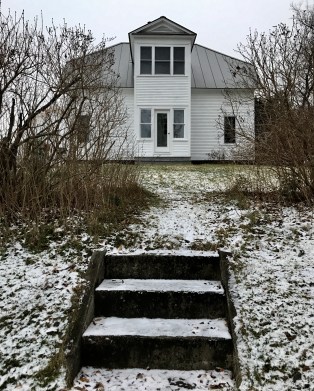
The front steps from our yard to the street reflect a time when people walked more. These days, the walkers in town are mainly kids and adults who, for one reason or another, don’t drive.

When I closed on the house, my older daughter was a high school senior who hardly seemed to attend school, so she came, too, on a hot and sunny June day. We’d known the sellers for years, and, as the closing was slightly delayed, we had some time to laugh. The electric company was switching out the poles in front of the attorney’s office, and the power was going to be shut off. We had a back-up plan to move across town, as modern closings need electricity, and  we tossed around the idea of using the library’s wifi on their front stone steps.

Afterwards, my daughter and I walked around the empty and freshly-painted house. Roses bloomed under the front windows that somehow, in all my examination, I had failed to see.

We hadn’t moved one thing in, still walking around barefoot in the sunny rooms, when a car pulled into the driveway. The woman, who was about my age, had grown up in the house. She was with her husband and their teenage daughter, and they had driven a very far distance for a relative’s graduation from the local high school. When she was a teenager, she told me, her future husband came and sat on the front steps with her, courting. From those steps, there’s a view down into the valley of the village and a trapezoid of the reservoir between the curves of mountains.

We walked through the house. She took pictures and told me stories. They live now in the middle of this huge country, and they wouldn’t return to Hardwick for many years. In the driveway, we shook hands, and then they drove away.

Sometimes the stars align. What a piece of luck to begin living in this house with the stories of a family who had lived here for over thirty years and loved this house and this place. In the few minutes I spent with this couple, I knew they had their own share of misfortune – and love and goodwill.

For a writer – and maybe for everyone, really – stories are manna. That afternoon, my daughter and I were no rush to move in. We opened all the windows and let in the June breeze, suffused with the scent of roses.

We shall not cease from exploration, and the end of all our exploring will be to arrive where we started and know the place for the first time.

– T. S. Eliot
IMG_0526.jpg

Home/Place

My our tiny place on the planet is reveling in summeresque weather; I write this, knowing days are not far off when our collective Vermont shoulders will brace against the polar vortex. Meanwhile, the sweet warm air brims with dragonflies and fluttering insect life galore.

If there’s one theme – for what that word may be worth – that might struggle up to the surface of my writing life, it’s likely interconnectedness. So many of the bad decisions I’ve made have stemmed from my own blind ignorance – not understanding how this led to that and why this other thing was a factor, too. Years ago, when I first started college, a professor very simply pointed out that some things we can see with our eyes, and some things we can’t, but that doesn’t make those unseen things any less real.

When my daughters and I talk about the hurricane season roaring in, far from us, or Trump’s public words about Charlottesville, I find myself saying I don’t know, surrounded by the vastness of these things. Begin with questions, I keep reminding my girls and myself. Questions are a real place, too.

Here’s one of the ending paragraphs from this fine book:

I wanted to try to write a book about poverty that didn’t focus exclusively on poor people or poor places. Poverty was a relationship, I thought, involving poor and rich people alike. To understand poverty, I needed to understand that relationship. This sent me searching for a process that bound poor and rich people together in mutual dependence and struggle. Eviction was such a process.

– Matthew Desmond, Evicted: Poverty and Profit in the American City

FullSizeRender.jpg

Where We Live, Hardwick, VT