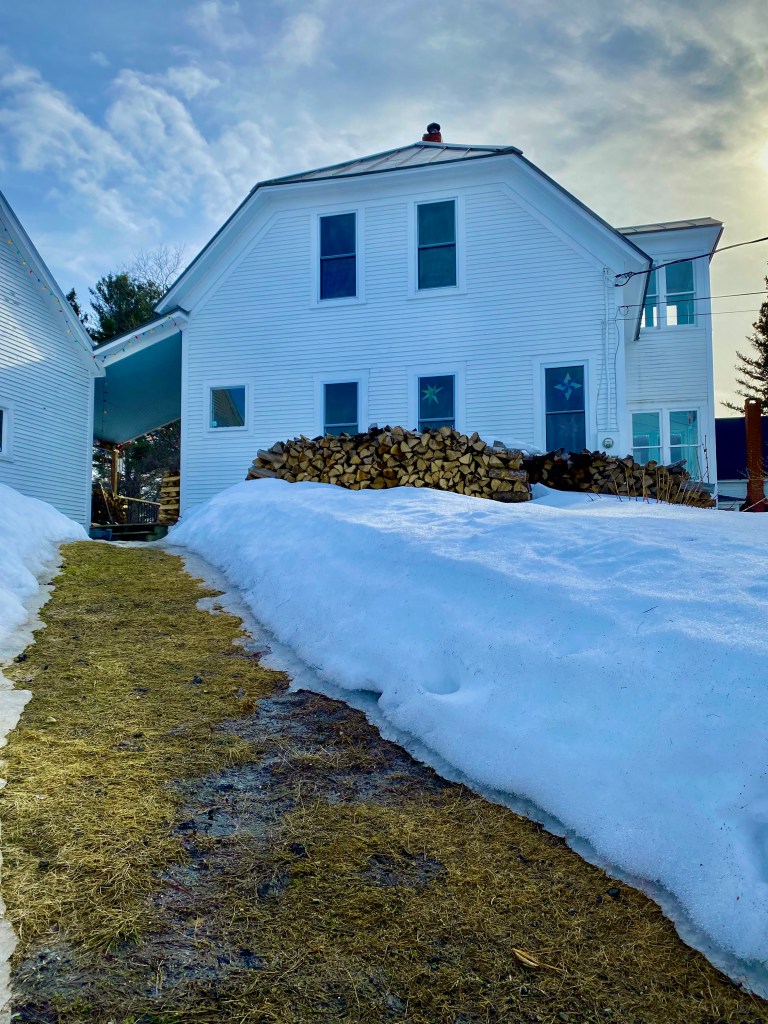
A cup of tea, surrounded by ice, broken boards.

In the pale blue dawn, I wake with the taste of wild mushrooms in my mouth. In my dream, I’m eating tender stems from a soft paper bag. In the non-dreaming chemo world, I’m temporarily forbidden from dining on fresh anything from the produce world, but in this nubbly dream I munch on, relishing the residual taste of dirt, the forest itself.

I open my eyes. Day 4 – oh, I am counting these 21 days until the sixth of these six chemo sessions – Day 4, and through my window, geese wing across the sky. These past few days, spring blew in, fierce sun. On my back deck, broken by ice, a friend stopped by yesterday. I made tea, and we talked about this and that, kids and disease and politics, when we might plant spring peas. On my desk waits a cardboard box of wildflower seeds, a gift for this summer.

Spring is radiant light and also brokenness. The ash buckets trailing coals, the deck joists smashed by the roof’s ice, the barn still desperately in need of paint. Me, too, broken, with my few hours of clarity in the mornings, the stumbling way I’m heading towards this final treatment. Around me, too, the remains of this winter: people who have helped me more than I could have imagined, others who have distanced themselves, the disease itself, perhaps, too much, the leer of mortality a shivering thing. All that is neither here nor there. The cancer has stolen a share of my vitality, my economic steadiness, a winter of my life. And yet, all these pinwheeling days and nights as I’ve traversed this tunnel – what an infinitely rich journey, one I never would have booked a ticket to join.

My daughter sends word of singing redwing blackbirds. Spring, mightier than winter’s brawn. The season of planning, putting things back together, rearranging and cleaning, of tipping our eyes up to the sun, relishing the light.

…. Ariel Gore repeatedly quotes Audre Lorde’s The Cancer Journals in her Rehearsals for Dying. In these lines, I was reminded how we each respond to crisis in others’ lives, too, from the soil of our lives.

Each woman responds to the crisis that breast cancer brings to her life out of a whole pattern, which is the design of who she is and how her life has been lived.
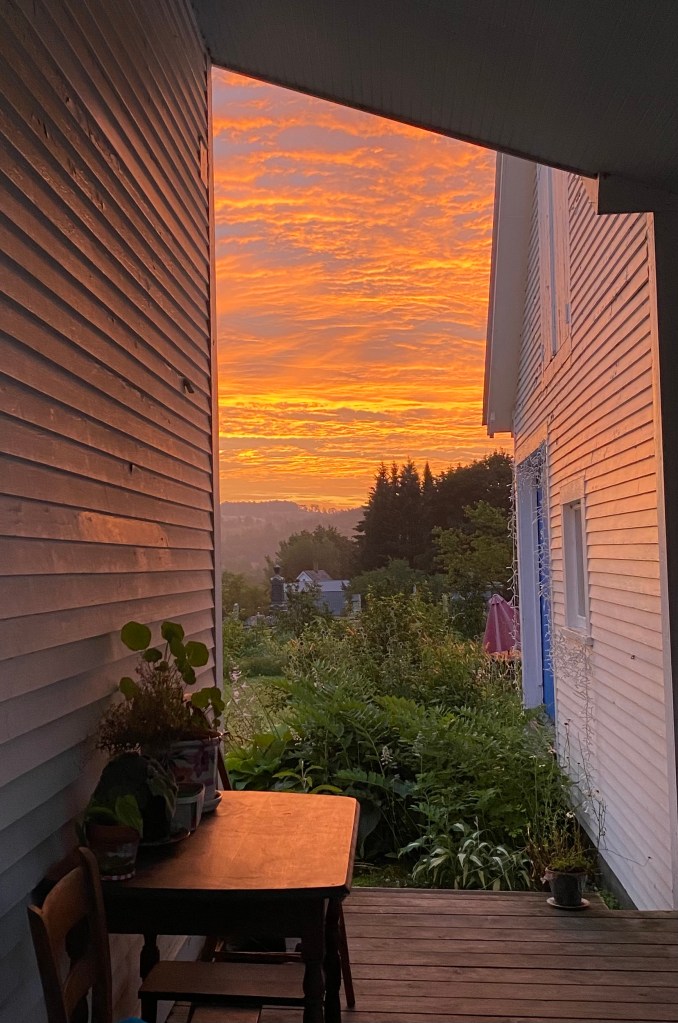
The natural course of things.

Dawn, I’m barefoot in the dewy garden, gathering peas, the world ignited. By the time my daughter and I meet in the kitchen, a little after five as she drinks coffee and heads to work, gray has skimmed over the sky, rain rain rain pushing in. (Side note: Red Sky at Morning, Richard Bradford’s novel, is a terrific classic novel, the former husband of my very long ago nursery school teacher, somewhere in Santa Fe….)

A year ago, heavy rains flooded much of my state. As I left Greensboro yesterday afternoon, I passed a village resident digging a trench with a shovel, some preventative channeling. About this time last year, I realized I knew a number of people who were driving around with shovels in their cars or pickups.

We are now in midsummer. Around two sides of our house, my garden grows — cottage roses and cup plant and phlox — and the wild rallies on the other two sides — jewel weed and box elder and goldenrod twine around porch railings, brush against the clapboard. Snip snip must be done, and yet somehow hasn’t yet. The groundhogs multiply, run beneath our chairs on the deck. I wonder about those foxes, about the natural course of things, wonder again, Well, what do I know? What will happen will happen….

A stranger appears at our house…

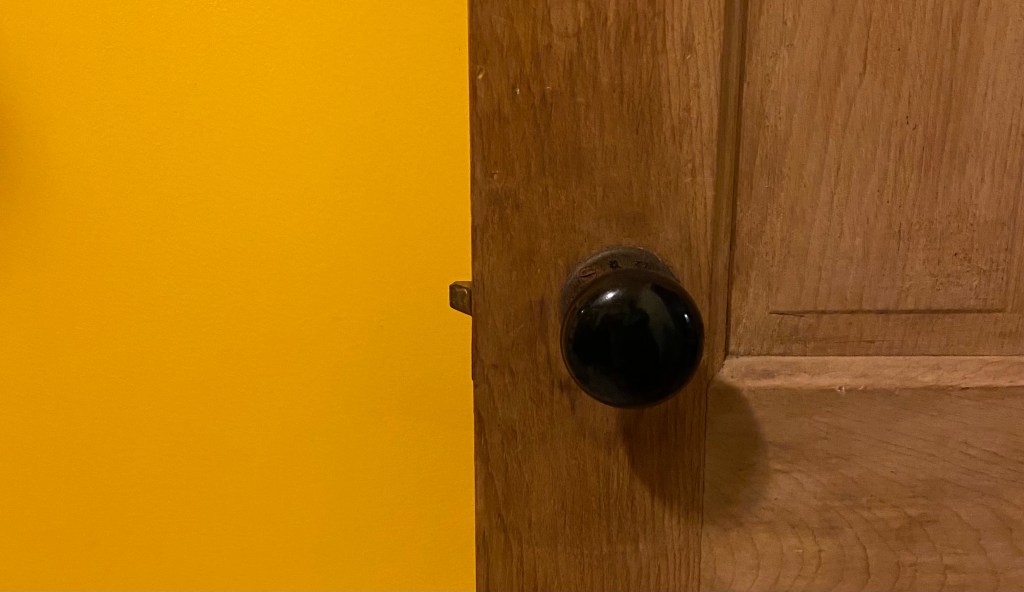
A stranger appears at our house while I’m watering one night, the little drink I offer my tomato plants on hot days. Her grandmother lived in this house, an old woman widowed now in another part of Vermont. I let the stranger in. She’s mystified that a tiny pantry in the kitchen was removed. I can answer some of her questions — that the four tiny bedrooms were changed to two tiny rooms and one larger one, that the downstairs walls were painted yellow by me.

Someday, I say, someone will knock down a wall and change this, too.

Outside, in the evening light that’s storybook shades of peach and lemon and lime, I tell her the soil is sand. She remembers the ants who bit her as a tiny child, and she remembers the lilacs. We stand talking a little about our lives — how I came to live here, where she’s now. I ask, Who planted the roses, but she doesn’t know.

Just before she leaves, she looks at the foot-wide strip of cement that surrounds the house. “My sister and I used to dress up in my mother’s old clothes and high heels. Everything was too big for us, so we scuffed the heels around the house.”

She gets back in that rusty mini-van, waves, and heads off. A few days later, she sends me photos, 1960s-style, of kids in what’s now my living room. And the wallpaper? She remembered it indelibly and wanted me to see it, based on some notion that pineapples and giant leaves were a fine addition to the walls of a small Vermont living room.

There’s one last thing, though. She even wanted to see the basement. As we stood looking at the stone walls and the rough-hewn floor joists, we wondered about the housewrights. How well-built this house is, tucked on a hillside in a place that seems both part of the village and not. My days, too, are numbered here. I’ll die here, or I’ll move elsewhere. All these stories are pieces of this house — these little girls, sixty years ago, in too-big shoes, hands pressed against this house for balance, giggling.

July, it’s worth noting again, July July July, month of growth, today own parents’ anniversary. Each of these July days…. Savor in some kind of way.

Household chores and world events.

The last day of 2023, I let the fire in my wood stove extinguish, and I take my stove apart. The stove has been spitting ash and spark through a damper, a chore I’m driven to by sheer necessity.

I unscrew the stovepipe and the back heat shield and plate, and carefully remove the two honeycomb metal filters that are choked with fine ash. It’s a messy job, and I’m a messy woman. My curious cat walks through the cinders and leaves dirty paw prints on my white enamel kitchen sink.

When I’ve put the stove together again, I find the driest kindling I can in my barn and build a small fire and slowly heat the stove again, kneeling before the glass where the flames ripple, listening to public radio hash over the year. I add wood, study the flames, murmur to my cat who is seriously invested in this warmth and the doubtless impending feline nap.

I’d once torn a photograph from a New Yorker issue and thumbtacked it near my desk of Marina Oswald, taken the morning after her husband Lee Harvey Oswald was arrested for assassinating President Kennedy. Her face twisted unhappily, she’s pinning cloth diapers on a line. So it goes: the necessity of domestic life as the great events of the world unfold.

My stove burns merrily. I bake spanakopita and invite a few dear ones who bring chocolate. This morning, January. A drift of snowflakes. The lean winter light.

The snow is melting
and the village is flooded
with children.

— Issa

Thanksgiving Poem.

Don’t Hesitate

If you suddenly and unexpectedly feel joy,
don’t hesitate. Give in to it. There are plenty
of lives and whole towns destroyed or about
to be. We are not wise, and not very often
kind. And much can never be redeemed.
Still, life has some possibility left. Perhaps this
is its way of fighting back, that sometimes
something happens better than all the riches
or power in the world. It could be anything,
but very likely you notice it in the instant
when love begins. Anyway, that’s often the case.
Anyway, whatever it is, don’t be afraid
of its plenty. Joy is not made to be a crumb.

— Mary Oliver

The Pleasures of Creation.

An old friend and I walk through the hilly town forest, sharing the tenor of stories that are manna for my soul: which ways our lives have turned and bent, what are the elements that shape us and our families. A little sleet or maybe rain patters down on what remains of the leaves.

On my way home, I stop at the coffee shop and drink espresso in my damp sweater smelling of sheep — a lovely barnyard smell or a repulsive one, depending on the person I suppose. I carry my laptop and my notebook back home to my wood stove and my cats who remind me their needs are few and the most reasonable constant in this house.

By five, it’s dark as the inside of a pocket. Public radio spins in the greater world. In my tiny dining room, I pull a book from shelf and set it on the table, then another and another. In an hour or so, by then listening to This American Life about rats, I’m in the basement searching for the half-full can of Sunshine paint I used in the bathroom last winter.

Three more walls await me. I’m out of paint and decide a lime-lemon will suffice. I’ll need to drive that half-mile to the hardware store, which annoys me as I have brand-new studs on my snow tires, and why waste those on dry pavement?

All this: it’s that old familiar question, that rub between creation and destruction. Espresso and sunshine-yellow paint have never cured the world’s ills, but a slice of pleasure can’t harm.

In my bookshelves, I find a poem I printed out shortly before the pandemic nailed shut Vermont, still utterly relevant today:

Blackbirds
by Julie Cadwallader Staub

I am 52 years old, and have spent
truly the better part
of my life out-of-doors
but yesterday I heard a new sound above my head
a rustling, ruffling quietness in the spring air

and when I turned my face upward
I saw a flock of blackbirds
rounding a curve I didn’t know was there
and the sound was simply all those wings,
all those feathers against air, against gravity
and such a beautiful winning:
the whole flock taking a long, wide turn
as if of one body and one mind.

How do they do that?

If we lived only in human society
what a puny existence that would be

but instead we live and move and have our being
here, in this curving and soaring world
that is not our own
so when mercy and tenderness triumph in our lives
and when, even more rarely, we unite and move together
toward a common good,

we can think to ourselves:

ah yes, this is how it’s meant to be.