Studded Snows

What’s the one thing that makes Vermont winters survivable? Friends? Laughter? Knitting? A chicken roasting in the oven? Nope: snow tires.

Driving to Burlington on a snowy Sunday morning to interview a young poet, I kept thinking, At least I bought new snow tires. When my daughter disappears in the darkness to work, I think, I’m so glad I shelled out for those tires.

On my way home through the Calais back roads, I pull over at the town hall, a beautiful and somewhat mysterious building to me — why is it here? what’s the history that’s now disappeared around this building? I’ve been listening to NPR’s Wait, Wait, Don’t Tell Me and laughing so hard I’m actually crying.

Outside my little Toyota, I’m immediately reminded of winter’s enchanting beauty, the bit of wind on my cheeks and the snowflakes in my eyelashes. Sunday afternoon, and no one’s out and about, save for one  grownup far down the road, walking a dog. Leaving my car at the roadside, I walk down to the meeting house and stand there, staring up at the steeple in the gauzy snow, listening. Then I put those snow tires to use again.

Winter seclusion —
Listening, that evening,
To the rain in the mountain.

— Issa

IMG_4381.jpg


Antidote

A photograph of my daughter and her friend is on a Good Citizen poster.

What the heck does that mean, she asks? Who’s a good citizen?

I drag up my standard answers: that history matters, that good fortune doesn’t equate with good character, that our actions affect others, whether we see — or want to see — this or not.

Later, I realize I should add this in: read and write poetry.

Poems build our capacity for imaginative thinking, create a tolerance for ambiguity, and foster an appreciation for the role of the unknown in human life. From such compact structures of language, from so few poems, so much can be reinforced that is currently at risk in our culture.

— Tony Hoagland, Twenty Poems That Could Save America

IMG_2241


Local Wanders

When I lived on 100 acres in fairly rural Vermont, I didn’t imagine we’d change that story. 100 acres is a large chunk of land, and those 100 acres didn’t end at any boundary save a single dirt road along one side. The corners were rebar pins, surrounded by thousands of acres alive with fisher and bear and moose, jack-in-the-pulpit and hobblebush.

Living in Hardwick village now, the wild still surrounds us. Along our former road, tumbled-in stone foundations are reminders of farming families, who at some point packed up and moved along.

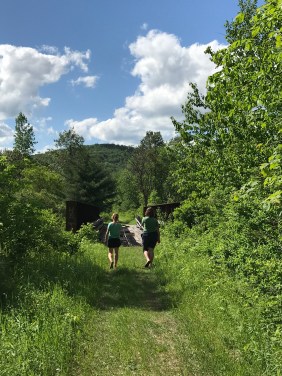
Yesterday, we walked along the railroad tracks, walled in at times by forest, and crossed the Lamoille River over a questionable bridge, hidden in this oh-so-June green beauty behind the town. I could imagine a hundred years ago, terrain cleared around the tracks, the rail bed studded with cinders. Save for the four of us, we saw no one but a crow.

The first step … shall be to lose the way.

— Galway Kinnell
l

IMG_5392

Photo by Molly S.

This Old House

For years, I’ve been buying my daughters creemees in the summer and admiring a small, terribly neglected house across the road. With an exterior of stained glass windows and ornate eaves, I imagine the inside has extraordinary woodwork. Surrounded by too many power lines, lived in by a series of renters, the house appears unkempt and ill-loved, the modern world grown up around it.

As a writer, I’ve looked at innumerable houses, and this little house seems hard-pressed for a good future, too near the road as it is, too near a river that floods, too not wanted… and yet, I’d love to walk through these rooms. I’d love to know who once lived here. With that riverbed soil, I imagine someone tended a burgeoning garden.

The grammar of shape is innately understood. Unlike speech, it is visible in plants and animals everywhere. The intuitive design process gives access to that knowledge. You do not work at design, you play at it.

– Jonathan Hale, The Old Way of Seeing

FullSizeRender.jpg

Hardwick, Vermont

Rust


With so little snow and a great deal of sun, we spent some time walking through the neighbors’ fields today. When they bought the property, they dragged out all the abandoned farm machinery, the wheels and gears, and lumped it together on an old cement slab. The collection had been in the weeds for God knows how long, and doubtless it’ll remain clustered together, gradually rusting, accumulating leaves and the odd fallen stick, for a stretch of unknown eternity, too.

Unlike Robert Frost’s birch fences that rotted in three foggy mornings and one rainy day, machinery, having changed the landscape in such profound ways, slowly returns to the earth fleck by fallen fleck. This machinery has done all the hard moving it’s going to do.

I can’t but think there’s some odd comfort in even the mightiness of steel and internal combustion going the way of all things: that all the driving power of industrialism will yield to entropy, that the earth in her slow and patient way will fold back around the fortresses of men, and eventually have her way.

In known history, nobody has had such capacity for altering the universe than the people of the United States of America. And nobody has gone about it in such an aggressive way.

— Alan Watts

FullSizeRender

Spinning Planet

Almost immediately after a children’s play at the Craftsbury Library tonight, my daughters ran outside. Was it the weirdly warm December weather? The joy of seeing a long-time friend? I sat on the back porch slouched in a rocking chair, watching the sun sink behind the Lowell ridge, listening to ten-year-old hysterical laughter.

My teenager appeared, and we were all crazed, wandering around the church, the gazebo, the war memorial. As the dusk steadily pressed down, the children raced across the Common. At the far end, I saw the white-painted fence, and nothing of the children but a smear of a red coat.

Spring fever? In December? In a world rapidly turning upside down? With my teenager, our conversation often seems one long meandering line of history, of the bloody business spanning centuries. But the world turned upside down is inescapable in this mud-season December, with my laundry hung out to dry on the clothesline.

The girls lay on the grass, and I teased them, Make snow angels. Christmas is coming! I pressed the toes of my boots against one of the girls’ feet. This same girl bequeathed me these boots a few years ago, when she had outgrown them. Having walked through some serious living in these boots, the sole under my right foot has split, a crack where water from the thawing earth bled up through my sock, soaking my skin.

In the twilight, she was laughing. How’s that for a composition? This glossy-eyed girl, giggling in the shifting bits of remaining light, ruddy-cheeked with gorgeous health, hair unraveling in a braid, her back and shoulders pressed into Vermont sod while overhead the constellations merge into view, and our planet spins steadily, on and on….

Out of the night that covers me,
Black as the Pit from pole to pole,
I thank whatever gods may be
For my unconquerable soul…

— Invictus

IMG_0374

Woodbury, Vermont